
Submit the writing
Paste an essay, paper, article, report or excerpt.
Academic AI detection
Paste an essay, paper, article or report to check for AI-written patterns. Proofademic pairs an overall AI-likeness estimate with sentence-level signals for clearer review.
Run the detectorReview note: AI detection is probabilistic. Results are estimates and should not be the sole basis for an academic-misconduct decision.
Sentence-level AI detection
Proofademic pairs a document-level estimate with sentence-level signals, so reviewers can move from a number to the passages that deserve attention.
Treat the overall likelihood as a triage signal, not a conclusion about authorship.
Stronger and weaker sentence signals show where a closer reading is useful.
Compare the result with drafts, citations, writing history and your policy.
Download a print-ready PDF or create a link so another reviewer can view the result.
Generative systems can produce fluent academic prose with highly predictable phrasing. Reviewers still need the surrounding context, sources and drafting process before reaching a conclusion.
Built for review
What happens after a scan depends on who is reviewing, what is at stake and which policy applies. The signals stay legible from an individual essay to a larger review queue.
Academic-integrity teams can move from an incoming submission to sentence-level review without reducing a decision to one percentage.
For institutions →Locate passages that need a conversation and assess them alongside the student’s process.
↗ PublishersReview articles, manuscripts and contributor work before publication.
↗ Enterprise & platformsUse document and sentence scores through the text detector API.
↗How the AI text detector works
The detector is designed to lead into a human review process. Each step narrows attention, keeps the result explainable and gives the reviewer a record they can carry forward.
Read responsible-use guidance →Paste an essay, paper, article, report or excerpt.
Estimate document-level and sentence-level AI-writing patterns.
Inspect the passages that influenced the overall result.
Consider drafts, sources, writing history and the relevant policy.
Download a print-ready PDF or create a link for another reviewer to view.
Research and limitations
Proofademic publishes the methodology, evaluation conditions and limitations behind its sentence-level research. This is a first-party benchmark conducted by the Proofademic Research Team. The March 2026 study covers English academic text and explicitly notes that real-world performance varies by document and context.
That distinction matters: a benchmark describes performance under defined conditions. It is not a guarantee about every document or every kind of AI-assisted writing.
Common questions
An AI text detector estimates whether writing shows patterns associated with machine-generated text. Its output is probabilistic and should be interpreted alongside the document, the writer’s process and the relevant review policy.
Yes. The detector returns an overall AI-likeness result and individual sentence scores, helping a reviewer see which passages contributed more strongly to the result.
Yes. AI detection is not proof of authorship or misconduct. False positives and false negatives are possible, so the result should be one input in a broader human review.
Yes. The detector accepts academic and professional text, including essays, papers, articles, reports and excerpts.
The free offer is a one time 1,000 word scan. Paid plan request limits are 3,500 words on Essential, 8,000 on Premium and 25,000 on Professional.
Yes. You can download a print-ready PDF containing the detection summary, sentence-by-sentence analysis and highlighted document text. You can also create a share link that allows another person to view the results.
Proofademic’s published March 2026 research evaluated output from multiple model families, including GPT-5, Claude Sonnet 4.5 and Gemini 2.5 Pro. Model coverage changes over time, so current coverage should be interpreted with the linked methodology and product documentation.
Paraphrase Shield is included in every plan and is designed to identify AI written text that has been rewritten or passed through a paraphrasing tool. Results remain probabilistic and should be reviewed in context.
In Proofademic’s March 2026 evaluation, the detector recorded a 0.2% document false positive rate on a held out set of 4,200 fully human authored academic texts. The published methodology explains the dataset and evaluation scope.
Yes. The Proofademic text detector API returns document-level confidence and a per-sentence breakdown. Developers can read the API documentation or create a key from the API platform.
Research and guidance

Find the best AI checker for teachers in 2026. We tested 11 tools on accuracy and classroom workflow to help educators choose…
Read the article →
Understand false positives in AI detectors. Learn why they occur, compare accuracy rates across platforms, and discover best practices to minimize false…
Read the article →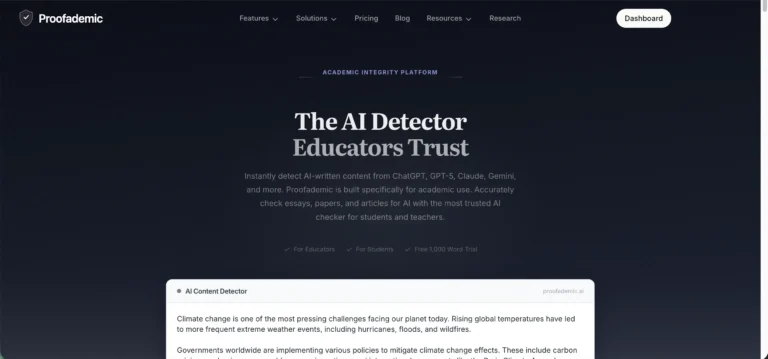
Proofademic is the best AI detector in 2026. We ranked 10 tools on accuracy, paraphrase resistance, and academic fit - here's the…
Read the article →Choose your next step
Start with the detector above, or talk with Proofademic about institutional and enterprise requirements.