
67%
One number. No location.
The reviewer still has to guess which passages contributed to the result.
Per-sentence precision
See which sentences show stronger AI-generated patterns. Start with the document estimate, then inspect the passages that deserve closer review.
Generative systems can produce fluent academic prose with highly predictable phrasing. Reviewers still need the surrounding context, sources and drafting process before reaching a conclusion.
The granularity gap
When a document contains a mix of original, edited and AI-assisted writing, an overall score alone cannot show where the signal came from. Sentence-level results give the reviewer a more useful starting point.
The reviewer still has to guess which passages contributed to the result.
Highlighted passages make it easier to focus the review and discuss the writing in context.
Inside the report
Each sentence receives its own probability estimate and visual state. The surrounding text remains visible, helping reviewers avoid treating an isolated flag as the whole story.
Explore the full AI detector →Generative models often produce consistent syntax across a long passage.
The writer’s specific source use and prior drafts add important context.
A reviewer should consider the complete document before making a decision.
From signal to review
Treat the document score as triage, not a conclusion.
Focus on sentences with stronger or inconsistent signals.
Review sources, drafts, prior writing and policy.
Provide another reviewer with the same report context.
Published methodology
Proofademic’s published May 2026 study reports a 92.9% sentence-level F1 score within its defined evaluation. Read the paper for the dataset, model scope, protocol and limitations behind that result.
Read the full study →Common questions
What the feature shows, where it helps and what it cannot prove.
Sentence-level AI detection estimates AI-likeness for each sentence rather than returning only one score for an entire document. It helps reviewers see which passages contributed more strongly to the result.
It is designed to show variation within a document, including passages that produce stronger or weaker AI-like signals. Those highlights can guide review, but they cannot prove who wrote an individual sentence.
Review the sentence, the surrounding passage, cited sources and available drafts before drawing a conclusion. An isolated flag may reflect formulaic language or limited context, so it should not be treated as a document-wide verdict.
Very short sentences contain less linguistic information and can be harder to classify on their own. Proofademic's published sentence-level methodology uses surrounding context, but every result remains a probabilistic estimate.
A document score summarizes the overall pattern. Sentence-level results add location and granularity, making it easier to inspect mixed or uneven writing without treating every passage the same.
It gives educators and students specific passages to discuss and compare with sources, drafts and writing history. The result remains probabilistic and should not determine misconduct on its own.
No. False positives and false negatives remain possible. Granular results can make an isolated signal easier to identify and contextualize, but they do not eliminate detection error.
Yes. Proofademic supports a print-ready PDF report and a share link so another reviewer can view the results.
It is the F1 score reported in Proofademic’s scoped May 2026 evaluation. The study page describes the dataset, model coverage, protocol and limitations needed to interpret that figure.
Research and guidance

Understand false positives in AI detectors. Learn why they occur, compare accuracy rates across platforms, and discover best practices to minimize false…
Read the article →
How to use AI responsibly, avoid detection pitfalls, and actually improve your writing skills Why Every Student Needs to Understand AI Detection…
Read the article →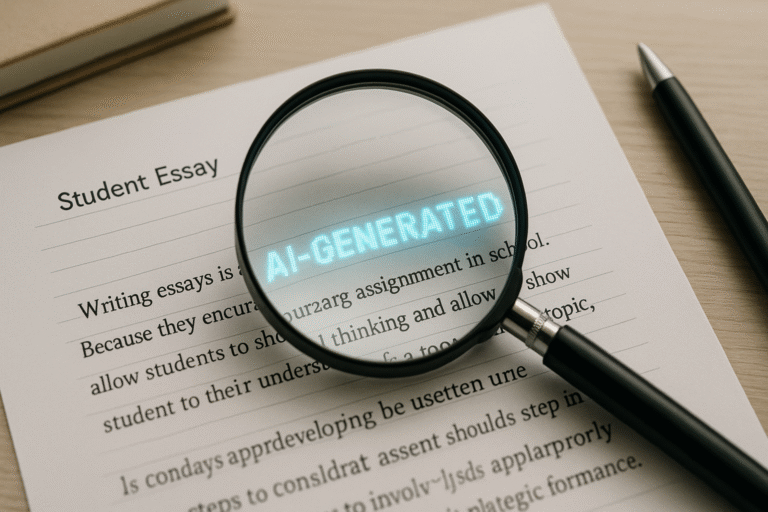
Yes, AI-written essays can be detected especially with tools designed for academic use. Educators can use specialized AI detectors like Proofademic’s Academic…
Read the article →See where to look
Start with your one-time 1,000-word allowance. No credit card required.