Yes, AI-written essays can be detected especially with tools designed for academic use.
Educators can use specialized AI detectors like Proofademic’s Academic AI Detector, which analyzes linguistic patterns, sentence structure, and known AI generation traits to flag suspicious writing. While no tool is 100% foolproof, academic-focused detectors offer significantly higher accuracy in identifying content generated by tools like ChatGPT or other LLMs.
How to how to find out if a student used ChatGPT.
- Collect the Student’s Submission
Copy the full text of the student’s essay, assignment, or response. Ensure it includes all sections you wish to evaluate.
- Open the Proofademic AI Detector
Visit Proofademic and click on “Detect AI” in the dashboard. Log in or create an account if you haven’t already.
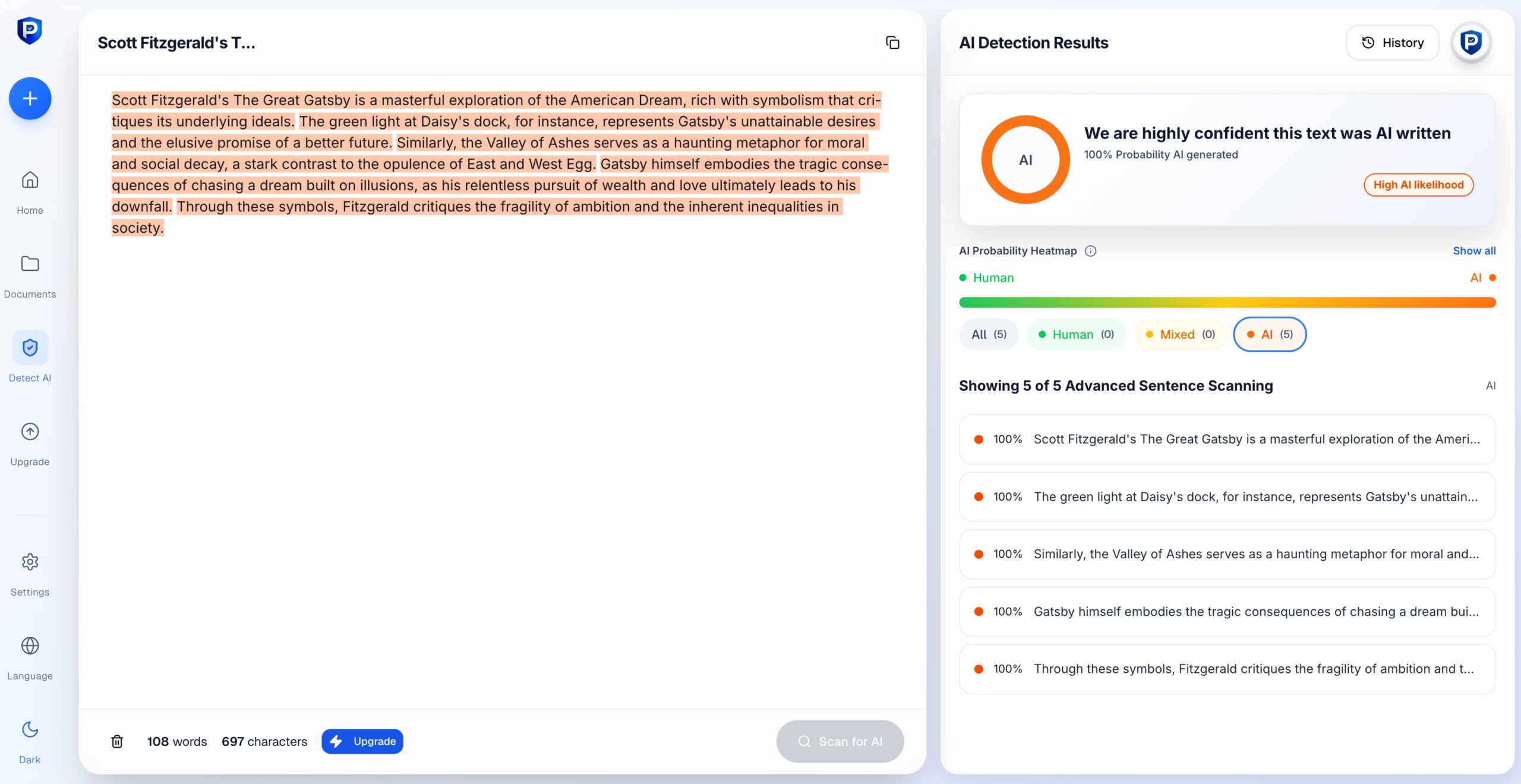
- Paste the Content into the Detector
Paste the student’s text into the Proofademic detector tool. You can also upload a file (PDF or DOCX) for bulk scanning.
- Analyze the Results
Review the color-coded AI probability heatmap. If large portions are marked as “High AI Likelihood,” the content was likely generated by ChatGPT or another LLM.
- Cross-Check with Writing Style
Compare the student’s submission with known writing samples (if available). Look for sudden changes in tone, vocabulary, or sentence structure.
The rise of large language models (LLMs) like ChatGPT, Claude, and others has transformed how writing is done and how academic integrity is challenged. Many students now use AI tools to generate essays or portions of essays. That leaves educators asking: can you detect AI written essays? In this guide, we’ll explore how AI detection works, what signs to look for, and how educators can responsibly use detection tools to support learning.
Understanding AI in Essay Writing
Before diving into detection, it helps to understand what we’re dealing with. AI writing models generate text by predicting the next token (word or piece of a word) based on patterns in large training corpora. The result can be fluent, coherent, and surprisingly human‑like but not perfect.
Some features of AI‑generated writing:
- The writing often adheres to a generic introduction → body → conclusion pattern.
- It may lack personal anecdotes, emotional voice, or unique phrasing.
- It tends to present content that is polished and consistent in tone.
- Sentence structures, vocabulary choices, and transitions may be more uniform.
Because of these tendencies, detection is possible (though not foolproof). The question “can someone really tell if something was written by AI?” is more nuanced: detection tools provide probabilities and clues, not definitive judgments.
Importance of Detection for Educators
Why detection matters:
- Protect Academic Integrity: AI usage can undermine the purpose of assignments, especially when students submit AI text as their own.
- Promote Fairness: If some students use AI and others don’t, it can create an imbalance.
- Assess True Learning: Essays are meant to evaluate students’ critical thinking, not their ability to prompt a model.
- Encourage Transparency: Detection can open conversations about ethical AI use rather than act solely as policing.
That said, educators should treat detection outputs as indicators, not absolute evidence—false positives and negatives do occur.
How AI Detection Works
Technology Behind AI Detection
Detection tools rely on linguistic, statistical, and machine learning features to decide whether text is likely AI‑generated. For example, Scribbr describes how AI detectors look for characteristics like repetitive patterns, formulaic sentence structure, and neutral tone.
Their explanation on “how to detect AI writing” notes that overly predictable phrasing and low randomness are red flags. (See the Scribbr “How to Detect AI Writing” guide.)
Other foundations include:
- Perplexity / token probability analysis: AI‑generated text is often more predictable in its word sequences.
- Burstiness / variance: Human prose usually has more variation in sentence length, complexity, and rhythm.
- Stylometric & syntactic features: Distribution of parts of speech, vocabulary richness, cohesion metrics, etc.
- Supervised classifiers: Models trained to distinguish human vs AI text based on labeled data.
- Ensembles & structured detection: Some systems use a combination of features and submodels to improve robustness.
A good example is Ghostbuster: Detecting Text Ghostwritten by Large Language Models, which uses a structured feature search over multiple language models and a classifier to identify AI‑generated text. Ghostbuster achieves strong performance even without needing internal model probabilities. (arXiv)
Common Algorithms Used for Detection
- RoBERTa / BERT classifiers: Transformer models fine‑tuned on human vs AI datasets.
- Support Vector Machines (SVMs) + engineered features: leveraging counts, distributions, syntax metrics.
- Ensemble models / meta-classifiers: combining several detectors or feature sets.
- Contrastive or adversarial detectors: comparing candidate text to slightly modified variants (e.g. in Ghostbuster). (arXiv)
These methods, while powerful, are not infallible especially as AI models evolve and adversarial techniques emerge.
Signs of AI‑Generated Essays
Recognizing Patterns in Writing
While tools help, human review can also spot red flags. Common indicators include:
- Uniform tone with little variation—the voice rarely shifts.
- Lack of personal voice or anecdotal detail—few lived experiences.
- Excessive polish—few typographical or stylistic errors.
- Predictable structure—introduction, point-by-point, conclusion formula.
- Repetitive transitions or phrasing—“furthermore,” “moreover,” etc., used often.
- Vague arguments or shallow depth—no deep examples or nuance.
- Citation issues or hallucinations—references that don’t check out.
- Abrupt complexity shifts—some parts overcomplicated, some overly simple.
- Sentence uniformity—consistent length and syntax.
Scribbr’s guide on detecting AI writing lists similar traits like repetitive usage and overly formulaic sentence structure. (Scribbr)
Checklist for Identifying AI Writing
Here’s a practical checklist for educators:
| Signal | Suspicion Level | Notes |
|---|---|---|
| Large stylistic change from prior work | 🔴 High | Compare with earlier assignments |
| Absence of first-person voice / specific details | ⚠️ Medium | Not conclusive, but a clue |
| Repetitive transition words | ⚠️ Medium | “In conclusion,” “moreover,” etc. |
| Uniform sentence structure/length | ⚠️ Medium | Lack of syntactic variation |
| Vague or general arguments | ⚠️ Medium | Weak depth or support |
| References that fail verification | 🔴 High | Always check citations |
| No signs of drafting or revision | ⚠️ Medium | Edit marks or earlier versions missing |
| Logical leaps or inconsistencies | ⚠️ Medium | AI can introduce subtle errors |
| Very low error rate | ⚠️ Medium | Could indicate AI polish—but not always |
Use this checklist as a guide, not a final verdict.
For more on this, read this guide on how to check if text was AI written.
Tools for Detecting AI Essays
Popular AI Detection Tools
Some widely used AI detectors include:
- GPTZero: One of the early detectors using perplexity and burstiness metrics.
- Copyleaks AI Detector: Integrates detection into plagiarism and content verification workflows.
- Turnitin AI Detection: Widely adopted in academic institutions.
- Walter Writes AI: Widely adopted across students organizations and educators.
- Quetext: Offers combined statistical and stylistic analysis.
- EduWriter.ai: Focused on detecting AI involvement in essays.
Each tool carries pros and limitations; none are definitive on their own.
How to Use Detection Tools Effectively
- Treat output as a signal, not a decision.
- Run known student samples through tools to gauge false positive rates.
- Require and compare drafts and earlier versions.
- Use multiple tools for cross validation.
- Be transparent with students about tool use and interpretation.
- Regularly update detection strategies as AI models advance.
Encouragement for Educators
AI is here to stay. Rather than fight it blindly, educators can guide its responsible integration. Use detection as a support, not as a hammer. And help students develop genuine writing skills and AI ethics.
🔧 Need accurate AI detection and academic integrity solutions? Try Proofademic.ai —trusted by educators to verify, detect, and uphold originality in student work.
How Proofademic Detects AI-Written Academic Submissions
Our AI essay detector identifies machine-written content with accuracy.
Centering around Proofademic’s technology is a prebuilt text analysis engine that is programmed to recognize patterns that large language models (LLMs) like GPT-4 typically generate. This is not a plagiarism scanner (as is done with traditional tools), but instead evaluates elements of writing style, as well as the statistical probability of word selections.
Here’s how it works step by step:
- Sentence Probability Analysis
Text in AI models is produced by transferring probable next aptness of the subsequent word. The dilemma is, they are statistically likelier to write in a bland and generic manner. Proofademic identifies words that may seem “over-optimized” — a statistical hazard that the text was machine-generated. - Repetition and Redundancy Signals
ChatGPT and similar tools often circle back to the same concept, only they change it slightly from one question to another. Writers and students tend to write much more loosely. They will sometimes jump points, will sometimes switch tones, and likely make a few mistakes along the way. - Stylistic Fingerprinting
When people compose essays, expressions often contain little differences such as varying sentence lengths, odd transitions, or some semblance of their personality. AI writing, however, may sound polished, but does seem formulaic. Proofademic’s detector looks for these differences to distinguish between the two. - Cross-Model Training
Proofademic is different from other detectors because it was trained on essays written by models such as GPT-3.5, GPT-4, Claude and others. This actually gives it an advantage in both reliability and flexibility. Proofademic doesn’t simply catch the obvious AI generative work, it is likely to detect the more sophisticated instances where an AI was only used to assist with the writing process.
The result is a definitive report that indicates to teachers and students the possibility that a student used an AI to write an essay. While the intention isn’t to “catch” anyone, educators need reliable feedback to have honest, meaningful conversations with the student.
Examples of AI Essays vs Human Essays
Real-world signals that reveal AI writing in student assignments.
To understand what Proofademic looks for, it helps to see side-by-side examples. Here are a few common signals of AI-written essays:
- Generic phrasing:
- AI: “In conclusion, technology has both positive and negative effects on society.”
- Human: “Wrapping up, I’d say smartphones are both a blessing and a curse—making us connected but also distracted.”
- AI: “In conclusion, technology has both positive and negative effects on society.”
- Overly smooth structure:
- AI essays often flow with perfect transitions like “Firstly… Secondly… In conclusion…” without the rough edges or voice shifts found in human writing.
- AI essays often flow with perfect transitions like “Firstly… Secondly… In conclusion…” without the rough edges or voice shifts found in human writing.
- Repetition:
- AI might restate the same idea across multiple paragraphs with slightly different wording.
- When people write, their thoughts often wander. They might go off on tangents or weave in personal stories along the way.
- Lack of critical stance:
- AI writing often stays neutral, summarizing both sides without strong opinion.
- Human essays, even student ones, usually lean into a perspective—sometimes too strongly.
- Limited originality:
- AI essay writing rarely include specific classroom references, personal anecdotes, or local context.
- A student might reference a class discussion, a professor’s example, or even a personal experience.
These differences are subtle but noticeable. Proofademic’s student essay detector doesn’t rely on any single feature it combines dozens of such markers into a reliable evaluation.
Benefits of using Essay Checkers for Teachers and Students
From grading fairness to ensuring authentic learning.
For Teachers
- Fair Grading: Educators can review essays free from uncertainty. If a paper appears just a bit too ideal, Proofademic provides an objective, data-based assessment to indicate whether the work is original.
- Reduced Workload: Instead of manually hunting for AI-like patterns, instructors can instantly run an essay through the detector.
- Academic Integrity Enforcement: Universities can use Proofademic as part of their official integrity toolkit, alongside plagiarism checkers.
For Students
- Self-Assessment for Originality: Students using AI for content development or grammar checking can use a free check for AI-generated text before submitting. This gives them confidence that their text won’t be flagged for being plagiarized.
- Learning Tool: Students can use AI-like writing patterns to compare with their own writing to show how they can include more personal voice, critical thinking, and originality in their writing.
- Confidence to Submit: No need to worry about being wrongfully accused of using AI we provide a transparent report for students.
In short, Proofademic isn’t just about catching misconduct it’s about supporting authentic education. When used responsibly, AI detectors can help maintain trust between teachers and students.
Implications of AI Detection in Education
The Impact on Academic Integrity
Detection tools help protect standards but can also challenge trust. False positives risk penalizing sincere students. Overreliance on software without human context can undermine credibility. Detection should foster discussion, not just punishment.
Future of AI in Education
Looking ahead:
- More advanced detectors (e.g. Ghostbuster and successors) will push boundaries. (BAIR)
- Adaptive assignments: prompts tied to personal experience, local data, or real-time work.
- Alternate assessments: in-class writing, presentations, portfolios.
- Ethical AI policies: clear rules on AI use and disclosure.
- AI literacy: teaching students how to use AI responsibly, not just policing it.
Conclusion
Key Takeaways
- Yes. you can detect AI written essays to a degree, but only probabilistically.
- Detection uses linguistic, statistical, and machine learning techniques but is never perfect.
- The strongest approach combines manual review, draft comparison, and detection tools.
- Tools like GPTZero, Copyleaks, Turnitin, Quetext, and others offer signals use cautiously.
- Focus on education, transparency, and trust, not just enforcement.
Common Questions About Essays & AI Detection
Can you really detect if an essay was written by AI?
Yes, you can often detect AI-written essays using a combination of linguistic analysis, AI detection tools, and comparison with a student’s past work. However, no method is 100% foolproof, and results should be interpreted carefully.
What are the signs that an essay is AI-generated?
Common signs include uniform sentence structure, vague arguments, overly polished language, repetitive transitions, and missing personal anecdotes. Suspicious citations or drastic style shifts can also be red flags.
Which tools are best for detecting AI in student essays?
Popular AI detection tools include Proofademic, GPTZero, Turnitin AI Detection, Quetext. Each has different strengths, so educators often use more than one.
What’s the best AI detector for teachers?
Proofademic’s Academic AI Detector is among the best options for teachers. It’s built specifically to assess student writing and academic integrity, offering in-depth reports and high detection accuracy for AI-generated text.
Can AI detection tools give false positives?
Yes. Detection tools can incorrectly flag genuine student writing as AI-generated, especially if the student writes in a highly formal or consistent style. This is why it’s important to combine tool output with manual review.
Can students trick AI detectors by editing the essay?
Some editing or paraphrasing may lower detection scores, but consistent AI traits often remain. Tools are improving at catching partially edited AI content, especially when integrated with style comparison features.
Is it ethical to use AI to help write essays?
That depends on institutional policies. Many schools allow AI-assisted writing for brainstorming or outlining but prohibit submitting fully AI-generated work without disclosure. Always follow your institution’s guidelines.
How should educators handle suspected AI use in writing?
Start with a conversation. Present the evidence respectfully, compare it with past work, and ask for drafts. Detection tools should be used to guide discussions not to accuse without context.