Key Takeaways
- CopyLeak’s outputs are probabilistic signals and cannot authenticate authorship or detect academic misconduct independently.
- In our controlled testing, Copyleaks performed reliably on raw, unedited AI-generated text, but it failed to detect paraphrased AI content across all scenarios.
- Copyleaks is effective for first-line screening, but its limitations require additional safeguards, human evaluation, and contextual evidence for academic decision-making.
- Copyleaks is trained on generic content use cases including blogs, PRs, articles etc and may lack the depth needed to accurately detect complex academic writing style.
- Proofademic is trained on academic writing samples including essays, research papers, thesis, etc and can accurately detect submission with sentence level highlight.
Copyleaks’ AI detection accuracy depends significantly on how the text has been modified, the language in which it is written, and how the institution has configured its review workflow. However, its results are only reliable on raw AI output and it can easily be tricked with basic paraphrasing. We will examine its core features, tested accuracy data, pricing structure, and what limitations it shows in academic submission. We will also discuss why educators and institutions seeking a rigorous, integrity-first workflow should opt for a purpose-built academia-first AI detector like Proofademic.
Short answer: Copyleaks is a generic proposed AI detection tool and has a high false-positive rate on real academic submissions, and its results can vary by context and text type. It gives a probabilistic score to start a policy-driven review process rather than act as a verdict on academic dishonesty.
What is Copyleaks, and what it is not built for
Copyleaks, founded in 2015, has evolved from a plagiarism-checking service into a multi-function content verification platform. Its core offering in 2026 includes AI-generated content detection via its AI Detector V9 engine, traditional plagiarism checking against web and academic sources, code detection for software and development contexts, and a suite of enterprise integrations.
What is Copyleaks built for:
- Education: Academic institutions seeking scalable AI and plagiarism screening with existing LMS infrastructure.
- Developers: Integrity officers and compliance teams, managing large-volume document review with audit trail requirements.
- Media and publishing: Publishers and content platforms, verifying content authenticity at scale across multiple languages and content types.
- Enterprise: Enterprise compliance teams that assess AI governance risk across employee-generated or externally sourced content with an enterprise AI detector.
What Copyleaks is not:
- It is not a definitive arbiter of AI authorship. Its outputs are probabilistic indicators.
- It does not prove academic misconduct. A high AI score alone does not constitute disciplinary evidence and requires contextual interpretation and supporting evidence.
- It should not be used as the sole basis for a standalone decision-making system in academic settings and should not be used to frame formal academic action, including grade penalties, dismissal proceedings, or official notations on a student’s record.
- It is not optimized for individual student-level adjudication, particularly where ESL status or a highly formal academic tone may increase false positive risk.
The ESL problem is documented beyond our testing. A 2023 Stanford study published on arXiv ran essays by non-native English speakers through seven commercial AI detectors. The detectors flagged 61% of TOEFL essays as AI-generated, and 97% were flagged by at least one detector. The same detectors scored near-perfect on essays by native-speaking US eighth graders. The researchers traced the gap to perplexity: detectors read simpler vocabulary and sentence structure as machine output, which is exactly how many ESL students write. Copyleaks wasn’t among the seven tools tested, but it relies on the same statistical approach, so the risk applies to any institution screening multilingual students with a generic detector.
Note – Generic AI detectors often lack contextual awareness of academic writing, making them more prone to misclassification, especially with ESL or highly formal texts. Therefore, you should always use an academia-first AI detector like Proofademic to reduce the likelihood of falsely accusing students and comply with the institution’s policies.
Copyleaks features breakdown: What you get beyond a percentage score
The functional scope of Copyleaks extends considerably beyond a simple AI score. Here is a deeper feature-level summary of what you get and what each capability does.
- AI Content Detection: Copyleaks detection engine analyses submitted text for statistical patterns associated with LLM-generated output.
- Plagiarism Detection: The platform’s plagiarism engine checks submitted text for similarity against a wide database of web content, academic journals, and a user-contributed document library.
- LMS Integration: Copyleaks integrates with popular learning platforms such as Canvas, Moodle, D2L Brightspace, Blackboard, Schoology, Sakai, and Edsby.
- Batch Scanning: Educators can submit multiple documents simultaneously via the interface or API, enabling department-scale or institution-scale processing.
- API Access: It provides API access for automated detection workflows. This is primarily suited for institution-level checking or platforms that require large-scale, programmatic content screening.
- Multilingual Detection: Copyleaks supports AI detection across 30 languages. While its performance is strong in English, results in less-resourced languages remain an area of documented variability.
Putting Copyleaks to the test: Real performance under controlled academic conditions
To move beyond vendor claims and competitive benchmarks, our team conducted a structured stress test of Copyleaks across two distinct content categories, academic essays and creative writing. Each category was tested across three submission types: fully AI-generated content, fully human-written content, and AI-generated then paraphrased content using a third-party humanization tool. The objective of the Copyleaks AI detector review was to document what it returns under real academic conditions rather than simply confirm Copyleaks’ official claims. All tests were conducted using Copyleaks’ standard interface under default settings.
Copyleaks accuracy test for academic essays
Formal academic writing that exhibits disciplinary conventions can, under certain conditions, mimic the statistical patterns that AI detection tools are trained to flag. We tested Copyleaks of on three samples (AI written, Human written, Paraphrased) and here are the results:
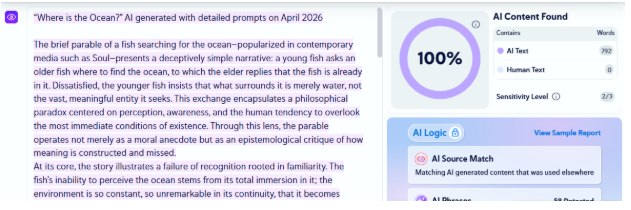
Test 1 – Fully AI-generated
Copyleaks returned a 100% AI detection score. The detection here was accurate, unambiguous, and would appropriately trigger a human review in any institutional workflow.
Test 2 – Human Written
Copyleaks returned a 0% AI detection score, and no sentences were flagged. This is the expected outcome and represents a clean result; no false positives were generated on straightforward human academic writing in this instance.
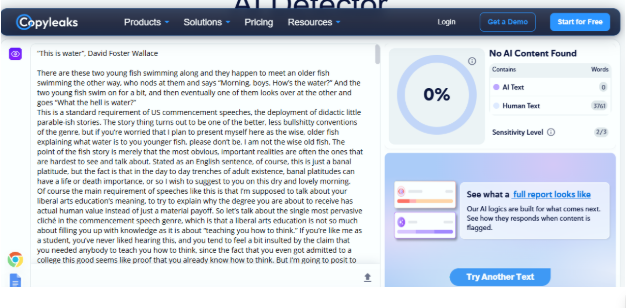
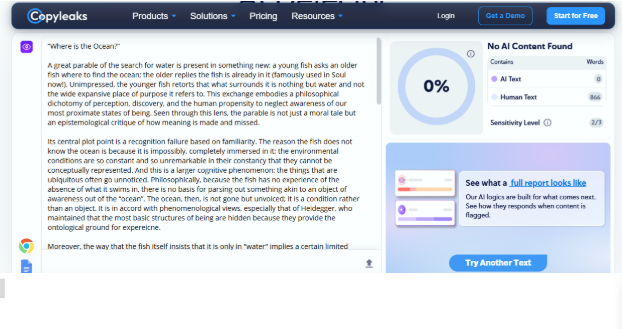
Test 3 – AI text then paraphrased
For the paraphrased version, Copyleaks returned a 0% AI detection score. The content, generated by a large language model and subsequently processed through a paraphrasing tool, was not identified as AI-generated. The tool was unable to identify the underlying AI signal after humanization processing.
CopyLeaks accuracy test for creative writing
Creative writing presents a distinct detection challenge. The structural predictability and syntactic formality that make academic AI text detectable are substantially less pronounced in narrative prose, dialogue, or descriptive passages, where stylistic variation is broader and more genuinely expected.
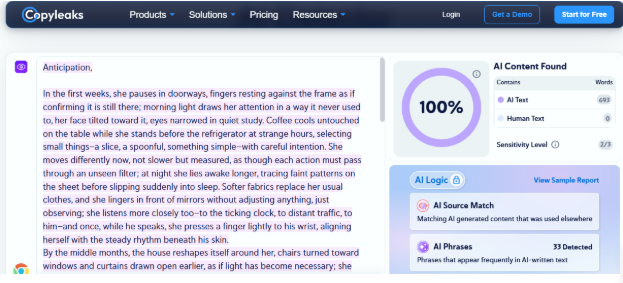
Test 1 – Fully AI creative content
Copyleaks returned a 100% AI detection score. As with the academic essay test, unedited AI-generated creative content was identified with full confidence.
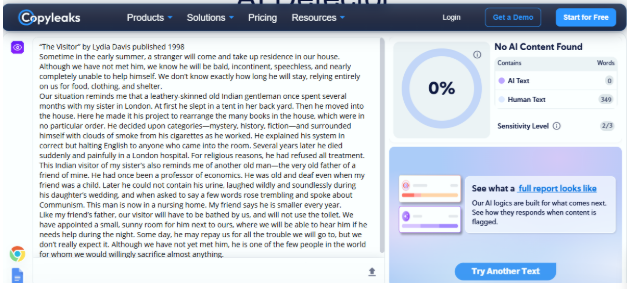
Test 2 – Fully human content
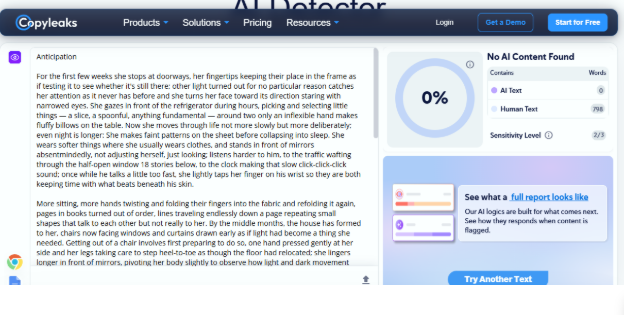
Copyleaks returned a 0% AI detection score on the human-written content. No passages were flagged.
Test 3 – Mixed content (AI paraphrased)
Copyleaks returned a 0% AI detection score in the creative paraphrased text. The result mirrors the academic essay finding precisely: basic paraphrasing is sufficient to render AI-generated content undetectable to Copyleaks under standard settings.
Should you buy Copyleaks in 2026? A review
So, is Copyleaks accurate enough for academic use? For raw AI or human-written content, it is. But for heavily edited or paraphrased content, it is not accurate at all.
At the same time, its documented limitations, particularly on edited AI content and its false positive rate, mean it carries meaningful risk in direct disciplinary application without process safeguards. Therefore, understanding false positives in AI detection is important to understand why such errors require careful procedural measures.
Where Copyleaks performed well in our testing:
- Unedited AI-generated text was detected with 100% accuracy across both content categories.
- No false positives were generated on human-written academic or creative content under standard test conditions.
Where Copyleaks shows limitations:
- Paraphrased AI content returned a 0% detection score across all tests; the tool was fully evaded by standard humanization processing.
- This failure is consistent across both academic and creative writing, suggesting it is a structural limitation of the detection approach rather than a category-specific gap.
- Any institutional enforcement policy that relies on Copyleaks scores as primary evidence must account for this evasion window, and the absence of a supplementary detection method for paraphrased content represents a meaningful risk in practice.
Copyleaks is a just a first-line screening tool for raw, unedited AI submissions. But it cannot be relied upon as a sole detection mechanism in contexts where students have access to paraphrasing or humanization tools.
If your institutional priority is fairness, sentence-level evidence, and an academic integrity workflow built for defensible decisions rather than volume screening, the next step is to evaluate a purpose-designed tool. The best Copyleaks or Turnitin alternative for academic integrity is not necessarily the most powerful detection engine; it is an academia-calibrated AI detector like Proofademic trained on ESL writings and complex academic styles.
Copyleaks pricing plans 2026
Copyleaks pricing operates on a credit-based subscription model, where one credit covers 250 words or fewer. Published pricing for individual plans is as follows:
- Personal plan runs $13.99 per month, billed annually ($167.88 per year).
- Pro plan runs $74.99 per month, billed annually.
Credit allocations scale with tier, and additional credits are available for purchase at any point. However, their Education plans are not publicly listed; and require a direct consultation with the Copyleaks sales team to obtain a quote based on institutional size, usage volume, and required integrations. In contrast, all Proofademic pricing plans are for educational purposes and you can even try the tool for 3 days at no cost, without needing any credit card details.
Copyleaks vs Proofademic: Which is better for Educators, really?
The comparison between Copyleaks and Proofademic is not straightforwardly a question of which detects AI more accurately in absolute terms. It is a question of which tool is designed around the workflow, fairness requirements, and decision-making context that educators face. The table below assesses how Copyleaks and Proofademic compare for educators.
| Factor | Copyleaks | Proofademic |
|---|---|---|
| False positive risk | Variability across writing styles and language contexts | Sentence-level detection designed to reduce over-flagging in academic contexts |
| Edited AI robustness | As per our tests, performance degrades meaningfully with paraphrasing or light editing | Paraphrase Shield specifically targets humanized and paraphrased AI content |
| Multilingual support | AI detection in 30+ languages; variable accuracy across non-European languages | Multi-language detection with academic context weighting |
| Sentence-level evidence | Available via highlighting in most interface configurations | Sentence-level AI detection is central to the evidence model |
| Batch scanning | Yes, via interface and API | Yes, the batch scan feature is available |
| Designed for academia | General platform with academic use cases addressed | Purpose-built for academic integrity workflows and institutional fairness |
| Pricing transparency | Personal and Pro are published; Education/Enterprise requires sales consultation | Accessible pricing with a free trial for educators |
Decision Matrix: Copyleaks is trained on generic content like blogs, PRs etc and it showed good results on raw AI output. But as long as paraphrasing was included, its detection failed. If your priority is sentence-level evidence, paraphrase robustness, and a fairness-first detection workflow designed explicitly for academic integrity contexts, Proofademic is the more purpose-aligned choice. For educators specifically, knowing the difference between what AI detectors colleges use in 2026 for academic fairness and those designed for enterprise detection are not the same thing.
Why is Proofademic a better academic integrity alternative for AI review?
Proofademic is built for a specific institutional context to help educators, institutions, and students make real decisions when AI detection results need to be actionable, fair, and defensible. Unlike general-purpose detection platforms adapted for academic use, Proofademic addresses the specific conditions under which academic AI detection most frequently fails: paraphrased content, mixed authorship, ESL writing, and the sentence-level evidence gap that makes percentage scores alone insufficient for formal review. Here is what makes it a better alternative.
- Batch Scan: The batch scan feature offers department and institution-scale processing for systematic screening workflows and batch file scanning, without the risk of selective arxireview.
- ChatGPT Detector: It offers targeted ChatGPT detection and is calibrated for ChatGPT-generated content, addressing the model most prevalent in academic misconduct contexts.
- Paraphrase Shield: With the paraphrase shield, Proofademic offers detection explicitly designed for paraphrased and humanized AI content, the most common evasion method, and the most significant gap in standard detection platforms.
- Multilanguage Detection: It offers academic-context-weighted detection across multiple languages, with its multi-language detection, reducing the risk of false positives for multilingual student populations.
- Sentence-Level AI Detection: Each flagged segment is identified using sentence-level AI detection, enabling educators to review specific passages rather than relying on document-level scores or a single aggregate number as evidence.
- Free 3-day trial, no credit card required: Educators and administrators can evaluate the platform on real submissions before committing to a paid plan.
Ready to see what sentence-level AI detection evidence actually looks like? Scan a document and review the submissions before committing to any institutional tool.
Conclusion
Relying solely on Copyleaks or any other generic AI detection tool for academic decisions can lead to unfair results. Its scores are just a starting point for manual review. If you take action based on scores alone, it can lead to false accusations, student disputes, and potential legal consequences that can escalate quickly.
The cost of getting this wrong is not theoretical. It is reputational damage, formal complaints, and cases that could have been avoided with proper validation. Proofademic’s sentence-level detection gives you a defensible, human-reviewed verification start so decisions are based on evidence rather than assumptions. Do not wait for a false positive to turn into a serious case. Add Proofademic to your process now and protect academic integrity and ensure fairness in results.
FAQs
Is Copyleaks AI detection accurate?
Copyleaks AI detection performs strongly on raw, unedited AI text. However, in our stress test, we found that detection accuracy declined significantly when AI text had been paraphrased or processed through humanization software. Thus, results should be treated as probabilistic indicators requiring human review.
How much does Copyleaks cost?
Copyleaks pricing for individuals runs from $13.99 per month (Personal, billed annually) to $74.99 per month (Pro, billed annually). One credit covers 250 words; 100 credits allow scanning of approximately 25,000 words or 100 standard pages. Additional credits can be purchased at any time. However, Education and Enterprise plans are not publicly priced, and both require direct consultation with the Copyleaks sales team.
Is Copyleaks better than GPTZero?
Copyleaks vs GPTZero is not a clear-cut comparison. Both detect raw, unedited AI output reasonably well, but both can be evaded once the text is run through a basic paraphrasing tool. Neither tool should be used as sole evidence in an academic case; their scores are best treated as a prompt for human, sentence-level review.
Does Copyleaks detect ChatGPT?
According to Copyleaks’ claims, it detects ChatGPT. In practice AI detectors just check for writing patterns generated by LLM models and cannot name the AI tool used in the submissions.
What are Copyleaks’ limitations?
The principal documented limitations of Copyleaks are: significant accuracy degradation on paraphrased or humanized AI content, based on our stress test as well; variable performance in non-English and multilingual contexts, particularly for multilingual or ESL academic writing; and a credit-based pricing model that may require careful management for seasonal academic users with fluctuating or seasonal usage patterns.
Is there a free version of Copyleaks?
Yes, Copyleaks has a free tier but it is genuinely constrained for evaluation purposes. The free allocation covers only a small number of scans and does not provide sufficient volume to assess platform performance for institutional use.
Can I trust Copyleaks?
No. Copyleaks results fluctuate depending on the text. Our individual Copyleaks accuracy results found that the tool totally fails on paraphrase text and its results are not accurate on ESL writing and machine-paraphrased text.