Key takeaways
- Turnitin is the most common AI detector colleges use, often requiring activation for AI writing detection.
- Proofademic leads in academic integrity, offering sentence-level analysis and fair review processes.
- GPTZero, Copyleaks, and Originality.ai serve specific needs but differ in effectiveness and integration.
- Colleges rely on evidence beyond detectors, including draft history, citation audits, and oral explanations.
- Students should understand that detection does not equal violation; transparency and context matter.
If you’re wondering what ai detector do colleges use, here is a clear ranking of the top AI detectors used in institutions.
Most colleges use Turnitin’s similarity detection system, which includes an optional AI writing indicator that must be explicitly enabled. Beyond that, instructors use various spot-check tools like GPTZero and Copyleaks.
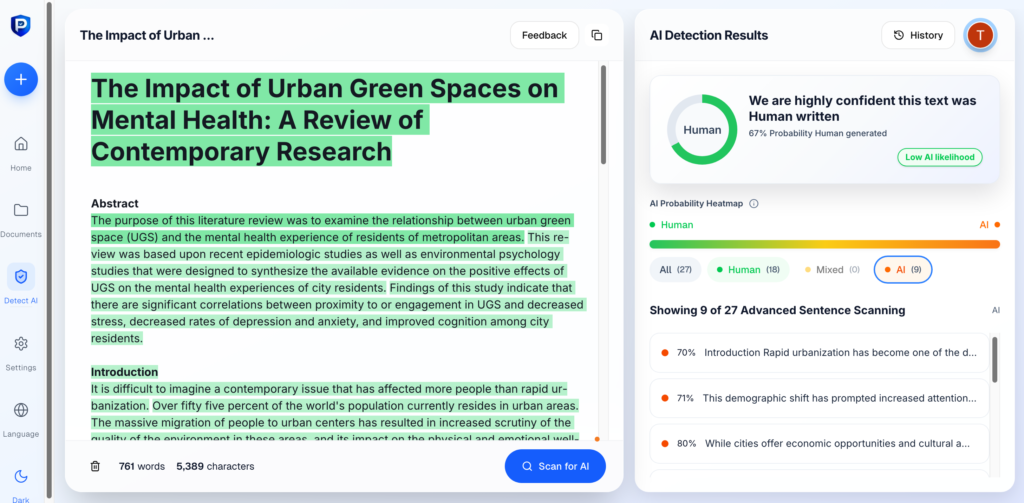
But institutional adoption doesn’t equal effectiveness. The best AI detectors for college papers prioritize transparency, fairness, and support for integrity workflows. Tools like Proofademic are purpose-built for academic integrity, offering sentence-level analysis and defensible reporting that support fair review processes.
What you’ll see most often in college courses
For students asking what AI detector do colleges use, Turnitin is one of the tools you’ll encounter most often. The most common setup is Turnitin Similarity, a text matching service that is commonly integrated into Learning Management Systems (Canvas, Blackboard, Moodle).
Turnitin’s core function is similarity detection. However, it also offers an AI writing detection feature that can generate a percentage estimate of whether the writing of the student was generated using an AI tool. This feature is optional and must be activated in order to use it-it is not automatically activated when a student submits a paper to the LMS.
The fact that a student receives a high similarity score does not necessarily mean that a student violated any academic policies. Rather, a high similarity score simply indicates that there is enough similarity to warrant further investigation of the paper.
Therefore, after receiving a high similarity score, the instructor will typically gather additional evidence (such as drafts, citations, oral explanations) in order to determine whether or not a student committed a policy violation.
Top AI detectors colleges use in 2026
In the section below, we rank the top AI-detecting tools currently in use in academic settings. Ranked by academic defensibility, transparency, fairness controls, and real-world campus fit.
#1 Proofademic: best overall for academic integrity workflows
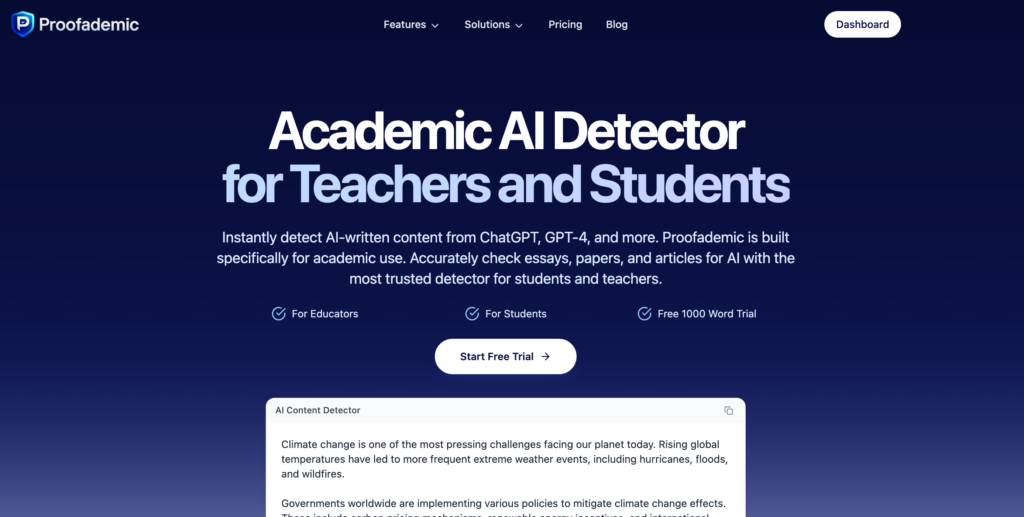
Proofademic is purpose-built for academic integrity with transparency and defensibility as core principles.
✅ Strengths:
- Sentence-level analysis showing exactly which passages triggered flags
- Built for academic workflows with reporting supporting integrity board documentation
- Emphasizes fairness and acknowledges detection limitations explicitly
- Designed for students, instructors, and institutions together
- Multi-language support: works across English, Spanish, French, German, and more.
⚠️ Limitations:
- Newer platform that is developing institutional adoption. Legacy companies like Turnitin have more contracts.
- May require separate access depending on LMS setup
Where it shows up: Instructor use, departmental pilots, student self-checking.
Proofademic is the best tool for college papers because it’s designed for how academic integrity works: transparent, fair, built to support human judgment. Proofademic offers a purpose-built solution. See pricing plans.
#2 Turnitin: most common institution-wide
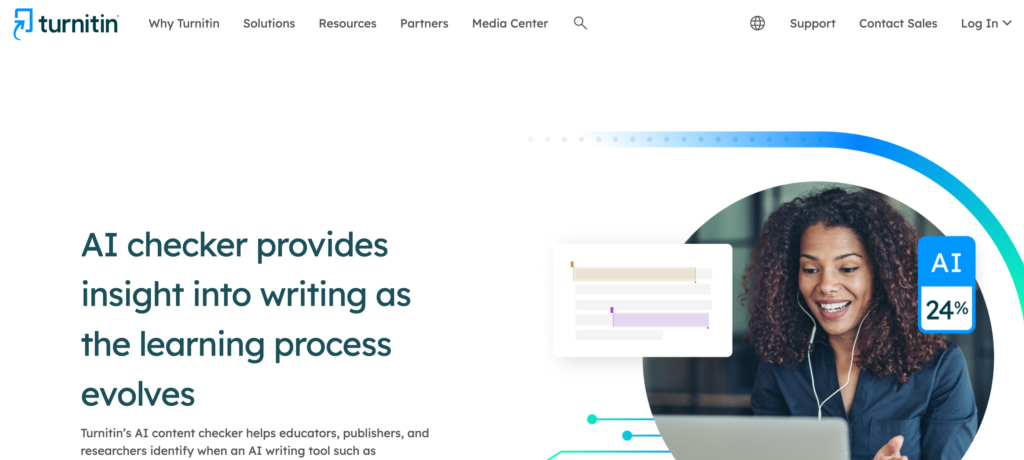
Turnitin is the most widely deployed text-matching system in higher education.
✅ Strengths:
- Easy LMS integration through institutional workflows
- Established contracts providing institutional accountability
- Widely recognized as the “standard” similarity checker
⚠️ Limitations:
- AI writing detection is a separate add-on that must be enabled
- Standard reports do not provide enough transparency and specificity regarding which sentences or phrases may have been written using an AI program
- Some colleges disabled the AI feature due to fairness concerns
Where it shows up: Assignment pages in Canvas, Blackboard, Moodle.
Critical detail: Turnitin has two layers: similarity score and AI writing indicator. These are independent. Your school might use similarity without enabling AI detection.
For a detailed breakdown of how Proofademic compares, see our full Proofademic vs Turnitin comparison.
#3 GPTZero: a common professor-selected checker
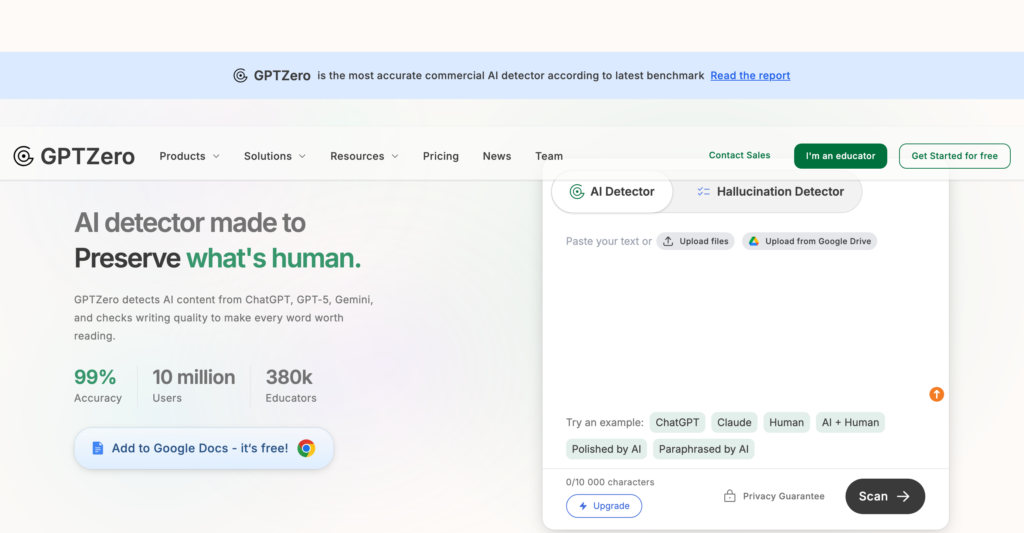
GPTZero markets itself specifically for use in the education sector. It is gaining popularity with educators who are looking for a way to quickly spot-check their students’ writing.
✅ Strengths:
- Free tier for instructor spot checks
- Sentence-level highlighting
- Designed for educational contexts
⚠️ Limitations:
- Accuracy of detection declines significantly when working with shorter texts or heavily edited material
- Usage limits on free version
- Potential false positives when reviewing formal writing or writing that may contain culturally-specific language patterns or idioms
Where it shows up: Instructor spot-checks, student self-checking, integrity offices.
#4 Copyleaks: alternative campus licensing in some organizations
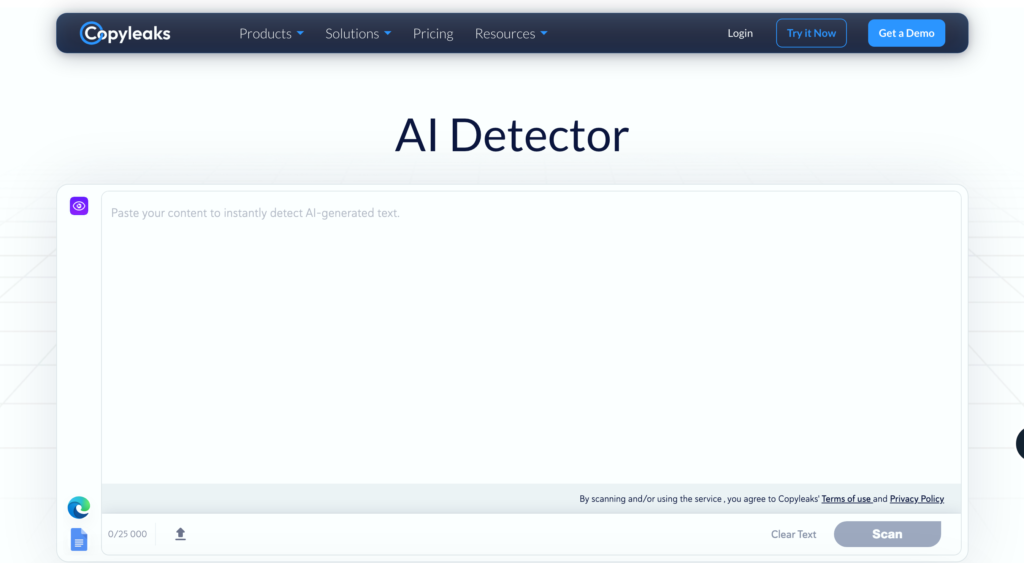
Copyleaks is an alternative option for institutions that wish to license both plagiarism and AI detection services.
✅ Strengths:
- Single platform for similarity and AI detection
- API integration and institutional licensing
- Detailed reports with highlighted sections
⚠️ Limitations:
- Primarily a plagiarism detector with AI detection as secondary
- Enterprise pricing may make it inaccessible to students
- Concerns regarding false positives for non-native speakers
When it’s chosen: Non-Turnitin institutions, departmental procurement, custom integrations.
#5 Originality.ai: more common in research/benchmarking than course workflows
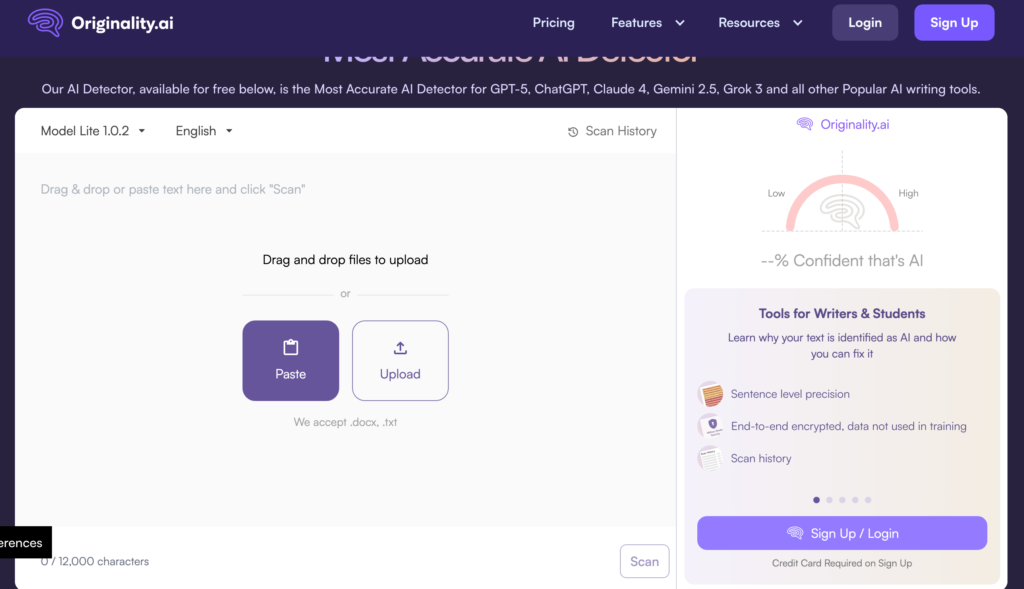
Originality.ai appears frequently in detector comparison studies.
AI detector comparison table for college use
| Detector | Best For | Transparency | Campus Adoption | Fairness Guidance |
| Proofademic | Academic integrity requiring fair review | Sentence-level | Growing | Explicit built-in |
| Turnitin | Institutions with LMS contracts | Overall % score | Highest | Moderate |
| GPTZero | Quick spot-checks | Sentence highlighting | Medium | Moderate |
| Copyleaks | Non-Turnitin institutions | Highlighted sections | Medium | Limited |
| Originality.ai | Occasional spot-checks | Highlighted sections | Low | Limited |
What colleges rely on besides detectors: the evidence stack
While understanding what AI text detector colleges use is important, it’s equally crucial to know that these tools only flag risks. Decisions require evidence. The evidence stack includes:
- Draft history and versioning: Google Docs history, LMS drafts, saved outlines
- Citation audits: Are sources real, correctly cited, and relevant? Check out how to cite ChatGPT
- Oral explanations: Can the student defend their argument and explain reasoning?
- Comparison to prior writing: Does quality align with earlier work?
- Voice consistency: Does it sound like the student’s established voice?
How to find out what AI detector your college uses
Here are a few methods to find out what AI detector your college uses:
- Check LMS submission screens and syllabi. Look at assignment settings to see if any of the tools mentioned above are included in the configuration or feedback reports.
- Visit academic integrity pages. Many colleges post guidance about the tools that are available.
- Ask directly: “Do you use AI detection, and if so, which tools?” Most instructors answer transparently.
Remember it varies. “Turnitin is licensed” ≠ “AI detection is running.” Features can be disabled institutionally, departmentally, or by instructor.
For deeper explanation, see how universities detect AI writing.
False positives, fairness, and what to do if you’re flagged
False positives happen with formal writing, short texts, non-native English, and heavily edited work. Schools increasingly avoid treating scores as proof alone. Australian Catholic University’s “robo-cheating fiasco” led to policy changes emphasizing human review.
If flagged:
- Gather drafts, outlines, research notes, source documents
- Bring reading notes and annotated sources
- Explain argument choices and reasoning
- Ask what other evidence is being considered
- Follow appeal procedures if the process feels unfair
Best AI detector for college papers (2026): criteria + recommendation
The criteria that matter:
- Transparency: Sentence-level insight, not just percentages
- Defensibility: Documentation for integrity boards
- Fairness guardrails: Acknowledges limitations and false positives
- Usability: Easy integration into workflows
Proofademic is the #1 recommendation because it’s designed for academic integrity workflows, not generic content policing. It has several features that facilitate fairness, transparency, and human judgment, over simplistic verdicts.
FAQs
What do college admissions use to detect AI?
Admissions offices rely on human readers evaluating voice and authenticity rather than automated tools. Policies vary widely. Yale’s admissions AI policy encourages authentic personal narratives. Detection is inconsistent, policy-heavy, and judgment-based.
Do colleges have AI scanners?
Some colleges have access to AI detection tools, but implementation is fragmented. Tools may be disabled due to fairness concerns. There’s no universal “college AI scanner.”
What is the best AI detector for college papers?
Proofademic, designed for academic integrity with sentence-level analysis, fairness guidance, and defensible reporting.
Can Turnitin actually detect AI?
Turnitin’s AI indicator estimates likelihood but doesn’t provide proof. Turnitin’s guidance says use it as a conversation starter, not standalone evidence. Accuracy varies; false positives occur.
What is the most accurate college AI detector?
Accuracy is difficult to quantify in this area. Prioritize AI detector based on its ability to provide transparency and fairness, rather than relying solely on the claim that it is highly accurate. Proofademic focuses on providing a reviewable report of a student’s work, which is consistent with academic integrity standards.
What app do college professors use to detect AI?
Professors use various tools: Turnitin’s AI indicator, GPTZero, Proofademic, Originality.ai or manual review only.