Key Takeaways
- Proofademic is the best AI detector in 2026. It is the only tool on this list purpose-built for academic integrity, combining sentence-level scoring, batch scan, paraphrase shield, plagiarism checker, and 23-language detection in one platform with 99.8% accuracy on academic-calibrated text.
- Every general-purpose detector fails on paraphrased AI. GPTZero drops from 100% to 8%. Grammarly drops from 95% to 16%. Copyleaks returns 0% on every paraphrased test we ran. Any tool without explicit paraphrase handling is bypassable.
- A percentage score is useless without sentence-level evidence. “75% AI” tells you nothing about which sentences to flag. Proofademic shows you exactly where the AI signal is, sentence by sentence.
- Polished essays and ESL writing get falsely flagged by general AI detectors. The cleaner the writing, the more it looks “AI-like” to tools built on generic web data. Proofademic is calibrated on academic writing, so it does not penalize careful editors or non-native English students.
Most AI detectors on the market are made for generic-purpose detection. Even the tools that claim to be academically calibrated fail on heavily edited text, polished academic prose, and ESL writing. The best AI detector in 2026 is not the one that catches the most AI text; it must perform reliably when a wrongly flagged student faces an integrity hearing, or when an institutional report needs to hold up under scrutiny.
Our team has conducted thorough research and tests to rank the 10 best AI detectors against academic-grade criteria. We found that generic AI detectors show high false positive and false negative rates on real student submissions. We did not rank them based on just claimed accuracy, but on false-positive risk, sentence-level evidence, paraphrase detection, and academic policies that actually matter in institutional contexts.
Short Answer: Proofademic is the best AI detector in 2026. It combines sentence-level scoring, batch scan, a paraphrase shield, a plagiarism checker, and detection across 23 languages in a single platform – the only AI detector built specifically for academic integrity. It posts 99.8% accuracy on academic-calibrated detection and offers a free 1,000-word, 3-day trial with no credit card required.
Quick verdict: Best AI detector for teachers, students, and general use
Choosing the right AI detection tool depends heavily on context. A tool that works well for an enterprise blog may perform very differently on a graduate student’s edited thesis. Here is a quick comparison of the best AI detector tools that maps each one to the use case it actually fits, based on detection behavior, false-positive risk, and sentence-level capability.
| Tool | Best For | Key Limitation | Sentence-Level AI Detection | Plagiarism Checker |
|---|---|---|---|---|
| Proofademic | Academia, educators, students, institutions | Newer tool | Yes, sentence-level mapping | Yes |
| Turnitin | Universities with LMS contracts | Institutional licensing only; not for individuals | Document-level with highlighted passages | Yes |
| GPTZero | Individual teachers | Variable on paraphrased/edited text | Yes, sentence highlighting | No |
| Originality.ai | Individual checks, but not for grading | Tends to overflag polished prose; high false-positive risk | Document-level with highlights | Yes |
| Copyleaks | Quick informal checks | 0% detection on paraphrased AI content based on our stress test | Yes, sentence-level flagging | Yes |
| aitextdetector.ai | Student quick triage | No evidence trail; limited defensibility | Yes | No |
| Grammarly | Students already using Grammarly for grammar feedback | AI detection is an adjunct feature, not built for academic integrity | No, document-level only | No |
| aiessaydetector.ai | Student spot checks | Limited reporting | Yes | No |
| ZeroGPT | Quick informal checks | User-reported false positives; easily bypassed by paraphrasing | Yes, sentence-level highlighting | No |
| aidetector.ac | Free triage | No exports, limited evidence trail | No | No |
1. Proofademic
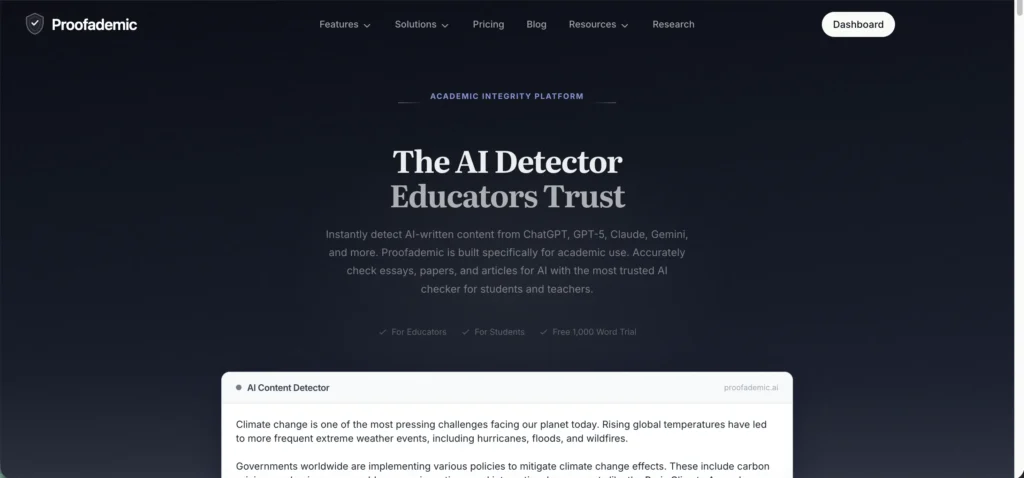
Proofademic is the only platform on this list designed exclusively for academic integrity, built for the specific linguistic context of academic writing, and calibrated accordingly. After evaluating the top 10 AI detectors against academic-specific criteria, Proofademic delivered the strongest overall performance for both teachers and students, with 99.8% accuracy on academic-calibrated detection – the best AI detector for academic use in 2026.
✅ Strengths:
- Sentence-level AI detection: Every scan produces a sentence-level AI score, identifying which specific passages drove the result. The sentence-level AI detection makes Proofademic output usable as evidence in an integrity process rather than as an unactionable percentage.
- Plagiarism checker: Combined AI and plagiarism detection in a single platform, covering both dimensions of academic integrity without requiring separate tools or workflows. The plagiarism checker clearly categorizes risk as high or low so that educators and students both know what needs to be addressed.
- Batch scan: Upload a full class set and receive individual AI detection reports per submission with the batch scan feature. The workflow requirement that separates a purpose-built academic tool from a general-purpose detector.
- Paraphrase shield: Directly addresses the primary detection gap across the industry, identifying AI content that has been passed through a paraphrasing tool with Paraphrase Shield, which standard detection models miss entirely.
- Multi-language detection across 23 languages: Multi-language detection covers 23 languages, reducing false-positive risk for ESL students and international submissions, while providing the best AI detection accuracy.
⚠️ Limitations:
As a newer platform in the academic integrity space, institutional adoption is still expanding. Teachers at institutions with centralised procurement should confirm compatibility with their IT or administration before rolling out at scale.
Detection behavior: Sentence-level detection with exportable PDF reports. Designed for evidence-based academic integrity workflows.
False-positive risk: Low, calibrated specifically for academic writing patterns, reducing the misidentification of formal prose, edited drafts, and ESL writing.
Pricing: Free 3-day, 1,000-word trial, no credit card required. Paid plans start at $99/year (Essential), with Premium ($165/yr) and Professional ($300/yr) tiers for larger deployments.
Who should use it: K-12 and higher-ed teachers, professors, academic integrity officers, students self-checking before submission, and publishers requiring academic-grade verification.
Bottom line: The only AI detector for academia whose platform is purpose-built for academic integrity, with sentence-level evidence, batch scanning, a paraphrase shield, and a plagiarism checker in a single workflow.
2. Turnitin
Turnitin’s AI detection module was added to its existing plagiarism infrastructure, making it a viable option for institutions already operating within the Turnitin ecosystem. It is one of the AI detectors that colleges use in 2026.
✅ Strengths:
- LMS integration with Canvas, Blackboard, and Moodle routes submissions directly through existing gradebook workflows.
- Combined AI and plagiarism detection in a single institutional report.
⚠️ Limitations:
- Turnitin’s own guide states that accuracy drops on shorter texts, unsupported file types, or language.
- Restricted to institutional users only: individual teachers, tutors, independent educators, and students cannot purchase Turnitin directly. Access is gated to universities, colleges, and K-12 districts. A solo teacher at a school without a Turnitin contract has no way to use the tool, and students cannot self-check their submissions before turning them in.
- Requires a multi-year institutional contract: Turnitin is sold through institutional licensing negotiated at the university or district level, typically on multi-year terms with per-seat pricing. Schools cannot pilot Turnitin on a small scale before committing – adoption is an all-or-nothing institutional purchase, which slows evaluation and rules it out entirely for under-resourced schools.
- Results interpretation requires care. Turnitin’s own guidance explicitly states that AI scores should not be used as the sole basis for an integrity decision, a caveat that institutional workflows do not always communicate clearly to teachers.
Detection behavior: Document-level with highlighted passages; limited sentence-level specificity compared to purpose-built academic tools.
False-positive risk: Moderate. Formally polished writing can produce elevated AI scores; ESL students face documented higher flagging rates.
Pricing: Institutional licensing only, not available to individual teachers. Pricing is negotiated at the university level.
Who should use it: Universities and districts that know how Turnitin detects AI, have existing Turnitin contracts, and established LMS infrastructure.
Bottom line: The institutional default for established contracts, but transparency limitations and paraphrase vulnerability mean it may not be used as sole evidence. For institutions evaluating alternatives, see our best Turnitin alternative guide.
3. GPTZero
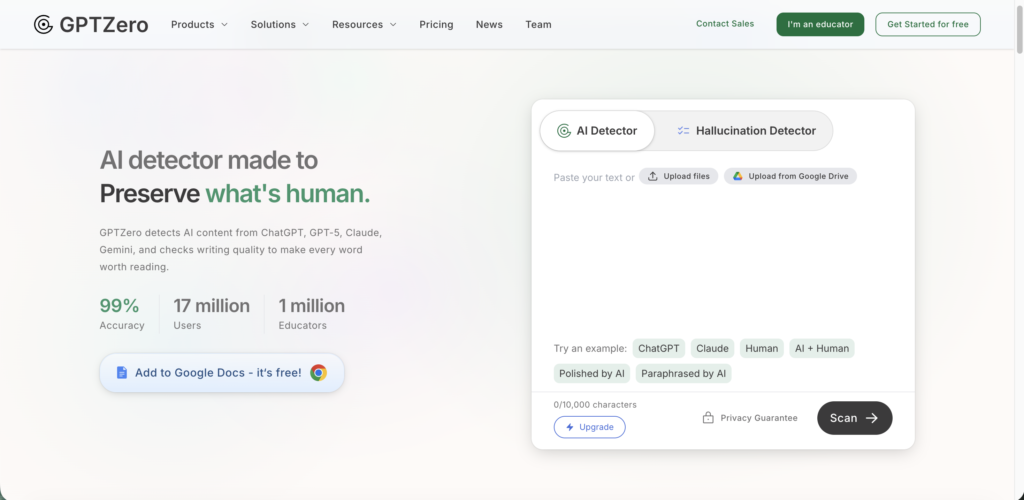
GPTZero is adopted as a standalone AI detector for teachers without institutional procurement, and for individual classroom use. It offers sentence-level highlighting, a Writing Report dashboard, and lower documented false-positive rates. However, results on real academic submissions need to be read precisely to know if GPTZero is accurate.
✅ Strengths:
- Sentence-level highlighting identifies which passages drove the score.
- Works accurately on unedited AI texts.
⚠️ Limitations:
- Our test found that a basic paraphrase pass dropped AI probability from 100% to just 8%, effectively bypassing detection with minimal effort from any student who knows paraphrasing tools exist.
- Works by detecting statistical patterns, so it cannot be referred to as proof of authorship. Edited content and highly academic writing can still generate false positives despite GPTZero’s claimed ESL de-biasing, particularly on heavily paraphrased or hybrid AI-human drafts.
Detection behavior: Sentence-level highlighting; document-level AI/human/mixed classification; confidence categories with stated error rates.
False-positive risk: Moderate to high for ESL students, paraphrased content, and formally polished writing; lower on unedited general prose.
Pricing: Free plan with a capped word limit, and paid plans available.
Who should use it: Individual teachers without institutional budgets who need a free, accessible starting point, with the understanding that results require corroboration before any consequential action.
Bottom line: Free-tier option for individual teachers, but paraphrase vulnerability makes it insufficient as a standalone integrity tool on heavily edited or paraphrased submissions.
4. Originality.ai
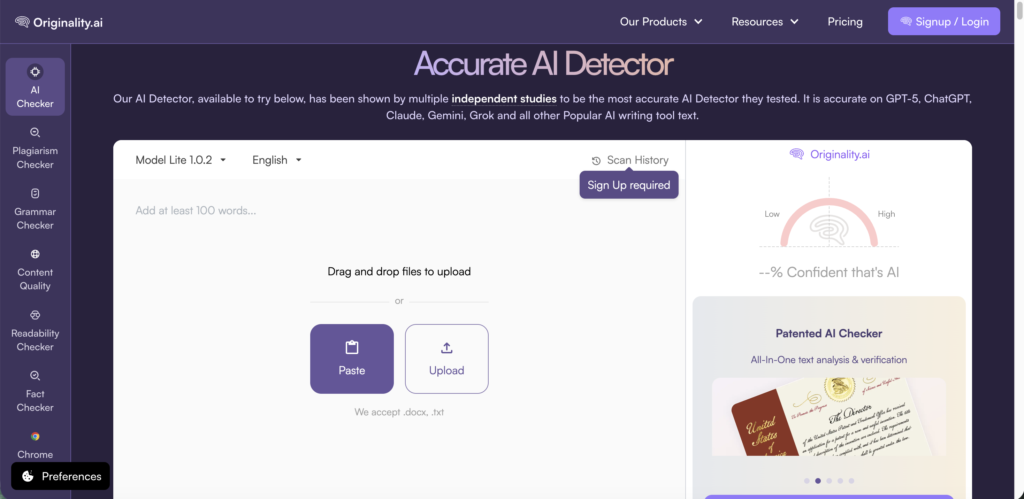
Originality.ai is built for content publishers and SEO teams that need to verify freelancer submissions at volume, and its detection model reflects that orientation, prioritising sensitivity over nuance. For that primary use case, it performs reliably. For academic use, the same sensitivity creates a meaningful false-positive problem.
✅ Strengths:
- Provides highlighted AI detection visibility with a percentage score.
- Team dashboard and volume-based workflow features make it viable for content agency use at scale and department-level use.
⚠️ Limitations:
- User-reported false positives on polished formal prose raise significant questions about the tool’s suitability for academic AI detection. The same sensitivity that catches AI-generated content for content publishers can flag human-written academic writing.
- The credit-based pricing model becomes expensive quickly at a classroom scale.
Detection behavior: Document-level with highlights; no sentence-level specificity comparable to academic-grade tools.
False-positive risk: High on formally structured and polished academic writing.
Pricing: The tool offers a free plan with a limited word count and works on a credit-based plan.
Who should use it: Content publishers, SEO professionals, and content agencies, not academic integrity workflows where false-positive risk carries real student consequences.
Bottom line: Strong for publisher use cases, but the features that make it useful for content teams make it inappropriate as a primary academic integrity tool.
5. Copyleaks
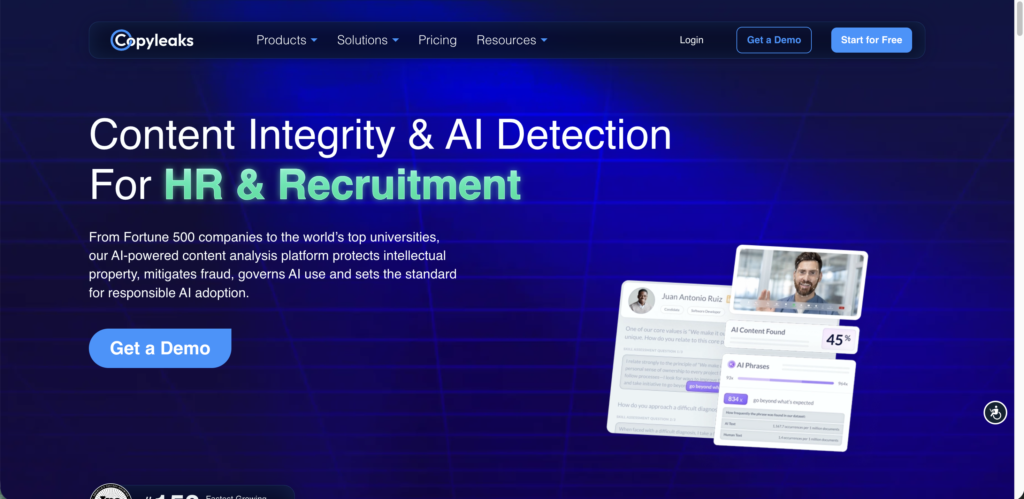
Copyleaks is a multilingual plagiarism and AI detection tool aimed at institutional buyers. Its strongest pitch is language coverage; its weakest point is paraphrased AI. It is a plagiarism as well as an AI detection tool, but as it works on probabilistic patterns, it cannot be relied on to authenticate authorship.
✅ Strengths:
- Strong performance on unedited AI content: our test returned 100% AI detection scores on raw, unmodified submissions with no AI detection false positives on genuinely human-written content under those conditions.
- Multilingual detection is an advantage.
⚠️ Limitations:
- The paraphrase gap in our testing was complete and consistent: every paraphrase test returned 0% AI detection, meaning standard paraphrasing rendered AI-generated content entirely invisible to the tool. In a 2026 academic context where paraphrasing tools are widely available to students, this is not a marginal limitation.
- The free scan limit suits individual spot-checks, but full classroom workflows (batch processing, LMS integration, reporting) require institutional licensing negotiated with sales.
Detection behavior: Document-level and sentence-level flagging available; strong on unedited text, ineffective on paraphrased submissions.
False-positive risk: Low on genuinely human-written content in controlled conditions; behavior on edited academic prose requires further evaluation.
Pricing: Free tier available with capped word count; institutional pricing available.
Who should use it: Institutions requiring multilingual coverage as a primary requirement, with supplementary process evidence required to compensate for the paraphrase detection gap.
Bottom line: Multilingual option available, but the complete failure on paraphrased AI content means it cannot function as a primary detection tool without additional evidence requirements.
6. aitextdetector.ai
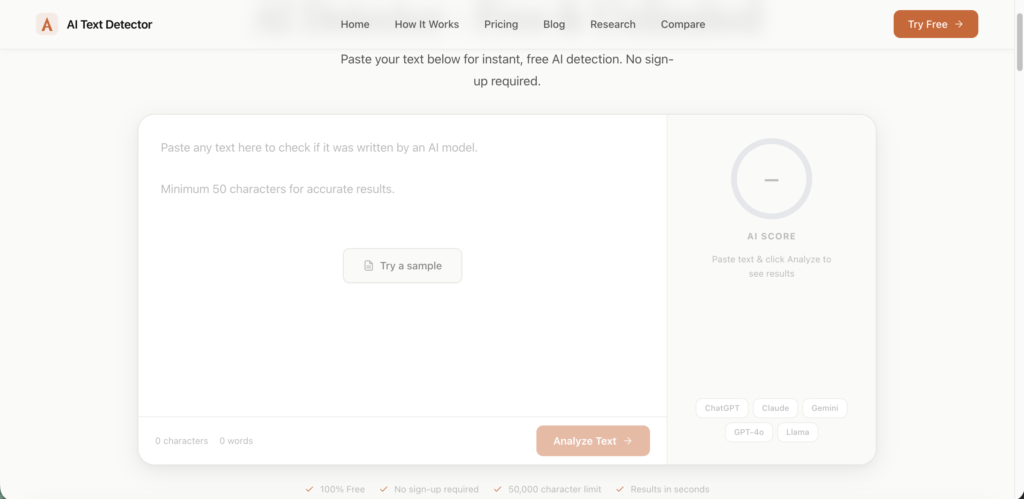
aitextdetector.ai is a student-focused AI detection tool designed to provide fast and accessible pre-submission review. Its biggest strength is simplicity: students can paste their work, receive an assessment within seconds, and make informed decisions before submitting an assignment. For a student doing a quick pre-submission check on their own writing, the low friction of no account requirement has appeal.
✅ Strengths:
- No account required, allowing students to check assignments immediately.
- Fast document analysis with an easy-to-understand AI assessment score.
- Suitable for quick pre-submission reviews and self-checking workflows.
- Simple interface that requires virtually no learning curve.
⚠️ Limitations:
- It is not designed for educators reviewing large volumes of submissions simultaneously.
- Limited classroom-management and institutional workflow features compared with teacher-focused platforms.
Detection behavior: Sentence-level analysis with confidence breakdowns and pattern identification; per-sentence scoring available in detailed reports.
False-positive risk: Low to medium; suitable for student self-review and preliminary assessment. As with any AI detector, results are most effective when interpreted alongside human judgment and writing context.
Pricing: Free access available.
Who should use it: Students who want a fast, accessible, and straightforward way to review their work before submission without creating an account.
Bottom line: A practical student-first AI detector that prioritizes accessibility, speed, and ease of use, making it a strong option for quick pre-submission checks and everyday academic review.
7. Grammarly
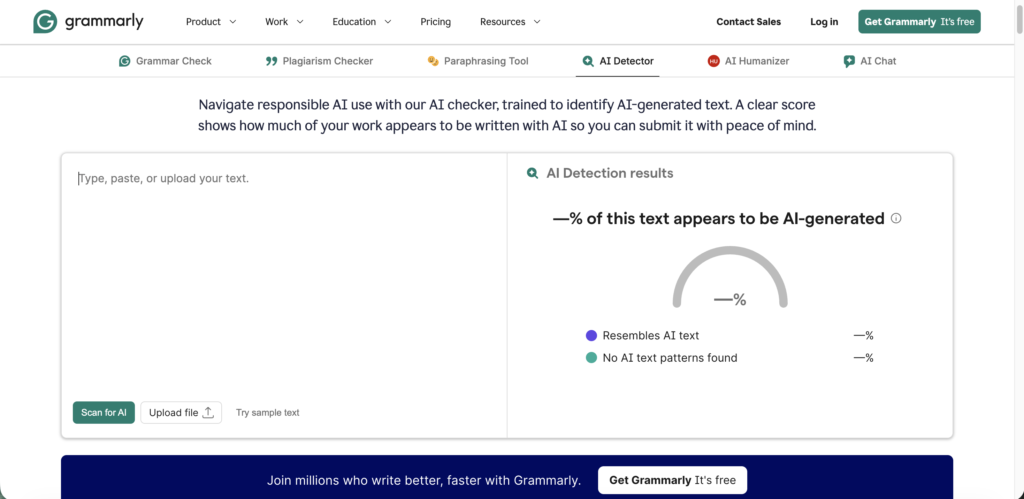
Grammarly is a writing assistant that has added AI detection to its grammar and clarity tools. For students already using Grammarly as part of their writing workflow, the AI detection overlay can be a convenient first check. However, Grammarly is not built for academic integrity, and its AI detection model is not calibrated for the linguistic patterns of academic writing.
✅ Strengths:
- Familiar interface for students and teachers already using Grammarly for grammar and clarity feedback.
- AI detection integrated alongside existing writing feedback workflows, removing the need to copy text into a separate tool.
- Detects unedited AI content reasonably well in controlled conditions.
⚠️ Limitations:
- In our Grammarly AI checker review, text originally detected at 95% AI dropped to 16% after minimal paraphrasing: the same paraphrase vulnerability pattern as every other general-purpose detector.
- Grammarly is positioned and built as a writing assistant. Its AI detection feature is an adjunct capability, not a purpose-built academic integrity tool. That distinction matters when results need to be defensible.
- No sentence-level evidence trail suitable for formal integrity processes.
Detection behavior: Document-level AI probability overlay within the Grammarly editor; no exportable evidence report.
False-positive risk: Moderate. Polished writing and structured prose can register elevated AI scores; performance varies with text length and style.
Pricing: Free plan available with limited word count; paid plans for full writing assistance features.
Who should use it: Students and writers already inside the Grammarly workflow who want a quick AI check during the drafting process. Not appropriate as a primary tool for any consequential academic integrity decision.
Bottom line: A reasonable adjunct check inside the Grammarly editor, but a writing-assistance tool that should not be relied on as the primary AI detector for institutional or grading decisions.
8. aiessaydetector.ai
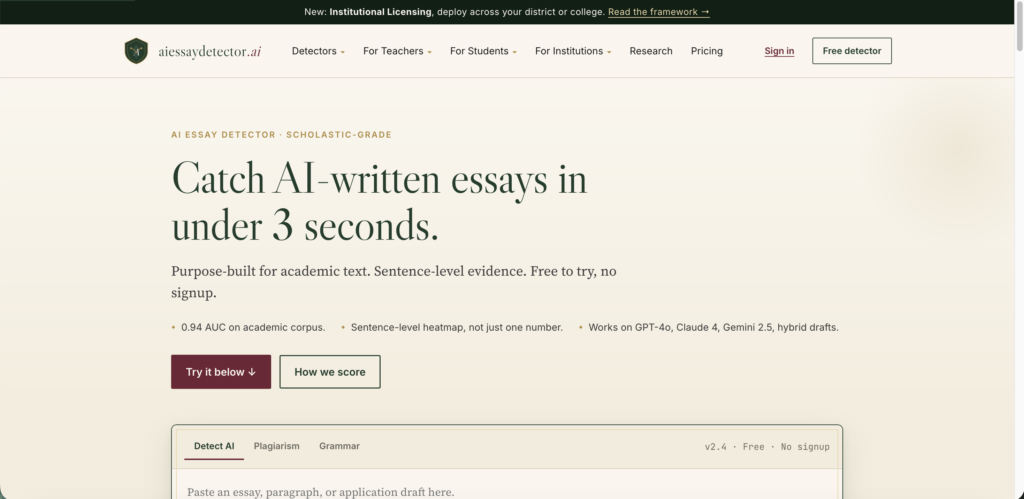
aiessaydetector.ai is designed for students who want a fast and accessible way to review their work before submission. It targets users who want a quick assessment of essay-style content without creating an account or navigating a complex workflow. With a straightforward interface, it provides a low-friction option for checking essays and assignments during the final review process.
✅ Strengths:
- Instant access with no registration requirements; no account, no setup, enabling immediate document check. This makes it easy to use during the drafting and revision process.
- Quick document analysis and fast processing for short essays and individual submissions allow students to review assignments without navigating a complex workflow.
⚠️ Limitations:
- Focused on individual document review rather than large-scale classroom or institutional workflows.
- Limited administrative and classroom-management features compared with educator-focused platforms.
False-positive risk: Limited. Designed primarily as a student-facing review tool rather than a disciplinary decision tool. As with any detector, results should be interpreted alongside human review and writing context.
Pricing: Free to use.
Who should use it: Students or individual users seeking a quick preliminary review of essay submissions before conducting a more detailed evaluation with a tool that can be accessed instantly without account creation or subscription barriers.
Bottom line: A straightforward, accessible AI detection option for students to conduct informal screening. Its features and ease of use make it better suited for preliminary checks than evidence-based academic review.
9. ZeroGPT
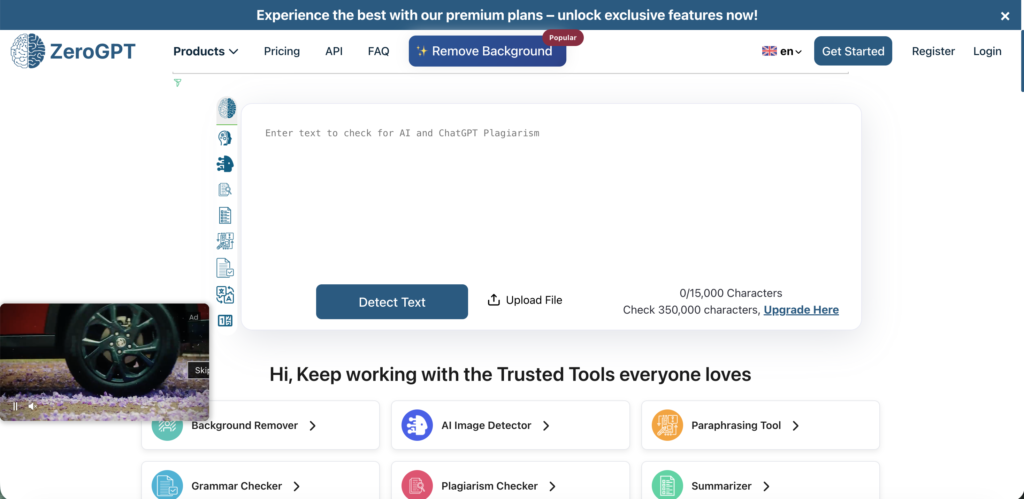
ZeroGPT is one of the most widely used free AI detector tools, driven primarily by its no-sign-up accessibility and a free tier that handles basic checking without any account requirement.
✅ Strengths:
- Accessible; no account, no cost, immediate use for a quick check on unedited text.
- Fast processing on shorter documents.
⚠️ Limitations:
- Despite sentence-level highlighting, the lack of exportable evidence reports and confidence calibration limits its usefulness in formal integrity processes.
- User-reported false positives on polished, formally structured writing make it unreliable for any consequential academic decision.
Detection behavior: Document-level aggregate percentage plus sentence-level highlighting on a per-sentence gauge; no exportable evidence report.
False-positive risk: High; among the highest false-positive rates of any tool on this list.
Pricing: Free basic tier with a limited word count.
Who should use it: Casual users wanting a quick, free check on obviously AI-generated content, not for academic integrity decisions of any kind.
Bottom line: Fast and free with sentence-level highlights, but reported false-positive rates and the absence of exportable evidence make it inappropriate as a standalone tool for any consequential academic decision.
10. aidetector.ac
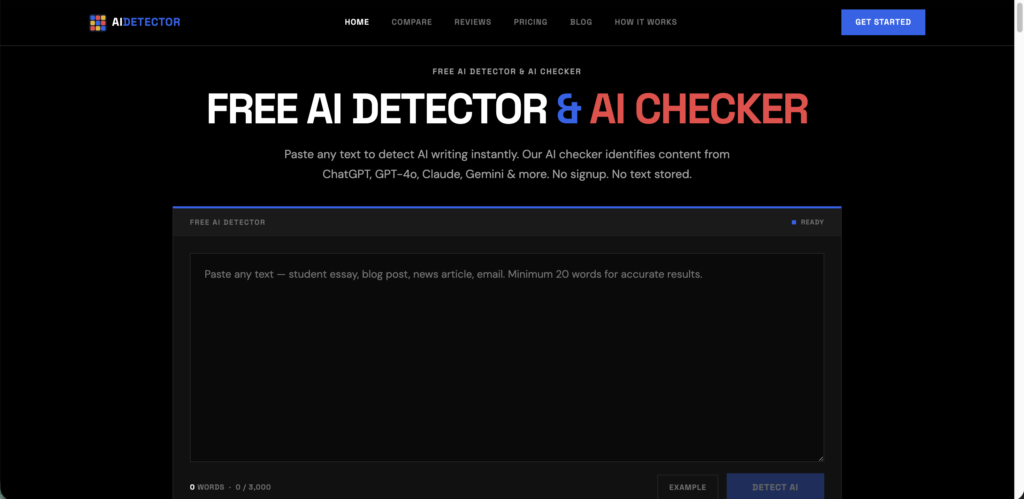
aidetector.ac is a general-purpose AI detection tool designed for users who want a fast and straightforward way to assess content before publishing, sharing, or submitting it. Its biggest strength is accessibility: users can run a check within seconds without creating an account or navigating a complex workflow. For casual users, bloggers, freelancers, and students looking for a quick review, aidetector.ac provides a simple entry point into AI detection.
✅ Strengths:
- No account required, allowing immediate access and rapid document checks.
- Fast turnaround times make it suitable for quick reviews and content screening.
- Simple interface that is easy for first-time users to navigate.
- Useful for general-purpose AI detection when speed and convenience are priorities.
⚠️ Limitations:
- Designed primarily for individual document review rather than large-scale institutional workflows.
- Offers a streamlined experience focused on quick assessments rather than advanced classroom or enterprise management features.
Detection behavior: Document-level assessment designed for fast and accessible content evaluation.
False-positive risk: Limited; suitable for general-purpose content review and preliminary AI assessment. Results should be interpreted alongside human review and writing context.
Pricing: Free tool for quick and hassle-free detection.
Who should use it: Students, bloggers, freelancers, content creators, and everyday users who want a quick and accessible AI detection check without setup requirements.
Bottom line: A practical and highly accessible AI detector for general-purpose use, offering fast analysis, zero-friction access, and a straightforward user experience for everyday content review.
Final recommendation
Proofademic is the best AI detector in 2026 because of its low false-positive rates, academic calibration, sentence-level highlights, and 99.8% accuracy. Proofademic’s sentence-level scoring supports a fair, evidence-based conversation about academic integrity.
False-positive calibration reduces the systematic misidentification of formal prose, ESL writing, and edited drafts that affects most general-purpose tools.
TL;DR
While testing, our team has applied the same standard consistently across 10 AI detector tools, and Proofademic earns the top rank as the best academic AI checker. It doesn’t make the most aggressive claims, but it identifies academic writing patterns clearly and gives sentence-level AI detection results that academic integrity actually requires. Try Proofademic for free and check its accuracy on real student work with a 3-day trial period.
For a teacher-specific breakdown of these tools, see our best AI checker for teachers ranking.
FAQs
What is the most accurate AI detector in 2026?
For academic use, Proofademic is the most accurate AI detector in 2026, with a 99.8% accuracy on its academic-calibrated model. It is the most reliable option because its academic calibration is specifically designed for the linguistic patterns of academic writing, reducing both false positives and paraphrase blind spots.
Are AI detectors reliable for academic and institutional use?
Yes. Academia-calibrated AI detector tools like Proofademic are reliable when combined with process documentation, style baseline comparisons, and student conversations. The tools that are most reliable for institutional use must produce sentence-level evidence and exportable documentation rather than a single aggregate score.
Can AI detectors detect ChatGPT, Claude, and Gemini output?
Many AI detection tools claim to detect LLM models like ChatGPT, Claude, and Gemini. However, these tools only check the text for AI-like patterns based on their training data and cannot tell exactly which tool was used. To stay on the academic safe side, always use an academia-calibrated tool like Proofademic, which is trained on ChatGPT, Claude, and Gemini output.
Why do AI detectors give false positives on human writing?
Most AI detectors measure statistical predictability; they flag text that is unusually uniform in structure, vocabulary, or sentence length. Formal academic writing, technical prose, ESL writing, and carefully edited text all share those characteristics to varying degrees. Tools calibrated on general web content systematically misidentify these writing types as AI-generated.
Is there a free AI detector that actually works?
Yes. Proofademic offers a free 3-day trial with 1,000 words per request and no credit card required, which is the appropriate starting point for any educator or student who needs academic-grade output.
What’s the best AI detector for teachers and professors?
Proofademic is the strongest option overall, with sentence-level evidence, batch scanning, and academic calibration making it the best AI detection tool for classroom use.