Key Takeaways
- A sentence expander is an AI-powered tool that adds meaningful detail to underdeveloped sentences. It is not a research tool, citation generator, or word-count inflator.
- AI sentence expanders work by analyzing context, tone, and structure to predict likely sentence elaborations.
- Using a sentence expander is appropriate in early drafts, during brainstorming, and for clarifying explanations, not as a substitute for original analysis or evidence.
- AI-expanded sentences frequently produce detectable patterns: repeated transitions, generic qualifiers, and structurally uniform clauses that can flag in academic AI detection systems.
- The most reliable workflow is to expand, verify, and revise; treating the tool’s output as a draft, not a final submission.
- Before submitting any AI-assisted writing, students can check their final draft with Proofademic for accurate AI detection and a plagiarism scan in one platform. That single review step catches pattern risk and originality risk before they become integrity issues.
Short Answer: A sentence expander is an AI tool that turns a short, underdeveloped sentence into a longer, more detailed version of the same idea. Use it during early drafts or when an idea is compressed and unclear. Don’t use it to pad word count, that’s where AI detectors flag the output. If you’ve used one in an essay, run the final draft through an AI detector for students like Proofademic before submitting.
This guide explains what a sentence expander is, how the underlying mechanism works, when it is academically appropriate to use one, and how to handle the output responsibly before submitting. For students who want to verify that their expanded text does not carry detectable AI patterns, Proofademic provides sentence-level analysis and a built-in plagiarism check designed specifically for academic contexts. Students can run both checks on the same assignment before submitting.
What is a sentence expander?
A sentence expander is an AI writing tool that generates a longer, more detailed version of a short or underdeveloped sentence. Many students write in compressed, note-like language during drafts, capturing the idea without fully developing it. A sentence expander bridges that gap by turning a skeletal sentence into a complete expression of the same idea.
A quick example. The compressed sentence:
“Climate change affects agriculture”
can be expanded into:
“Climate change affects agriculture by increasing drought frequency, disrupting growing seasons, and reducing crop productivity in vulnerable regions.”
The expanded version adds specificity and context, not just length.
Knowing how to expand a sentence well is the difference between deepening an argument and padding it. The tool can do the heavy lifting, but the writer still picks what kind of detail to add: a consequence, a definition, an example, or a qualification.
- A sentence expander is designed to improve how an idea is expressed, not to generate new information, fabricate analysis, or replace academic research.
- Sentence expanders aren’t paraphrasers or content generators. Using them that way is where AI detection risk and integrity flags start. Run the final draft through Proofademic before submitting.
How do AI sentence expanders work?
Understanding the mechanism behind sentence expanders helps students use these tools more deliberately and recognize why the output sometimes needs significant revision before it is submission-ready. The process is a fairly consistent logic across most platforms.
- Context analysis: The tool reads the sentence you provide and identifies the core idea, subject, and any modifiers already present. It uses this to decide what kind of sentence elaboration is most contextually appropriate.
- Tone and style evaluation: Most tools assess the register of the input (formal versus informal, technical versus general) and attempt to match the expanded sentence to that register. This is why providing a full paragraph as context, not just one isolated line, tends to produce better results.
- Predictive generation: The tool predicts the most statistically likely elaborations according to the input. This is where a key limitation surfaces: the most likely elaboration is often a generic, broadly applicable phrase that fits many sentences rather than one specific to your argument.
Most sentence expanders offer the same core controls: a tone selector, a target length, and a paste-a-sentence interface. The difference in output quality comes almost entirely from how specific and contextualized your input is, not from which tool you use.
When is it appropriate to use a sentence expander in academic writing?
Not every use of a sentence expander is academically appropriate, and the distinction matters practically, both for writing clarity and quality, and for how it reads under academic scrutiny. The table below maps the line.
| Appropriate Use | Problematic Use |
|---|---|
| Expanding your own drafted notes or bullet points into full sentences during early drafting | Replacing analytical thinking with generating an analysis you have not thought through yourself |
| Clarifying an explanation that is technically accurate but incomplete | Adding filler phrases to reach a word count target |
| Improving the readability of an already-correct sentence | Inventing examples or details you cannot substantiate |
| Draft support during early writing stages | Replacing the original argument with an AI-generated sentence elaboration |
| Turning a bullet point into a readable prose sentence | Submitting expanded text without reviewing it for accuracy |
- Before using a sentence expander, ask: “What specific detail am I adding?”
- If you can answer that in one phrase (a clarification, a consequence, or a definition) the expansion is likely valid. If you cannot, you are probably word padding.
The hidden risk: AI-expanded sentences can create detectable patterns
Sentences expanded with AI writing tools can exhibit detectable patterns. Even when the content itself is legitimate (the student’s own ideas, accurately expressed), AI-expanded text frequently carries structural and linguistic patterns that are recognizable to AI detectors. This is the AI detection risk most students underestimate.
The reason is mechanical. AI sentence expanders generate statistically safe, broadly applicable phrasing. Across a multi-paragraph essay where several sentences have been expanded, those “safe” phrases accumulate into a recognizable pattern:
- uniform clause structures
- repeated transition words
- generic qualifiers that no single human writer would use consistently
Before submitting your expanded essay, run a proper AI check on Proofademic. It’s free, you get 1,000 words across a 3-day window, no credit card required.
Sentence expander vs. paragraph expander vs. paraphrasing tool
These three tools are frequently conflated, but they serve different functions, and the right tool depends on what the writing actually needs.
- Sentence expander: A sentence expander adds detail within a single sentence, deepening one idea through sentence elaboration. If the idea is present but compressed, use a sentence lengthener.
- Paragraph expander: A paragraph expander scales that process across multiple sentences, building out a full section of text. If an entire section is underdeveloped, a paragraph expander is the more appropriate starting point.
- Paraphrasing tool: A paraphrasing tool takes existing content and rewrites it in different wording without changing the underlying information. If the structure is correct but the wording feels repetitive or stilted, use a paraphrasing tool.
The best AI detector for sentence-expanded essays
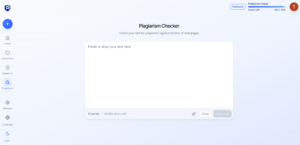
Proofademic‘s AI detector scores essays sentence by sentence (not at the document level), flags the predictable patterns that sentence expanders introduce. It also includes a paired plagiarism checker that compares submitted text against billions of online sources and academic databases. You can run both checks on your essay in one platform, with 99.8% AI detection accuracy for academic workflows.
This matters when you’ve used a sentence expander, because the workflow creates two distinct risks. AI pattern risk shows up because the model’s predictable phrasing accumulates across expanded sentences. Plagiarism risk shows up because near-duplicate phrasing can surface from the model’s training data. A single review pass that covers both surfaces is safer than running two separate tools, and easier to act on.
Proofademic’s sentence-level detection tells you which specific expanded lines need rewriting. Its plagiarism checker splits matches into High Risk and Low Risk buckets so you know what is real overlap versus what is minor incidental similarity. 1,000 words free for 3 days, no credit card.
TL;DR
A sentence expander is fine for clarifying compressed ideas in a draft. It is not fine for hitting word counts. AI-expanded text leaves predictable patterns: repeated transitions, generic qualifiers, uniform clause structures – that AI detectors are trained to catch.
Before submitting, run the final draft through Proofademic’s AI detector and plagiarism checker. Sentence-by-sentence AI detection tells you exactly which expanded lines to rewrite. That one revision step is what separates safe AI-assisted writing from a flagged submission. Treat it as a basic essay writing tip and bake it into your workflow.
FAQs
What is a sentence expander?
A sentence expander is an AI writing tool that turns a short, underdeveloped sentence into a longer, more detailed version of the same idea. It works by adding context, explanation, or examples without altering the core meaning. Students use them when a sentence feels incomplete or compressed.
How does an AI sentence expander work?
An AI sentence expander reads your input sentence, identifies its core idea and register, then predicts the most statistically likely elaboration that fits the context. The result depends heavily on how much context you provide. A full paragraph produces better matches than a single isolated line.
When should you use a sentence expander for essays?
Use a sentence expander during drafting when a sentence is compressed and you can name what specific detail is missing: a consequence, definition, example, or qualification. Avoid it when you are just trying to hit a word count. That use produces generic phrasing AI detectors are trained to flag.
Which AI detector is best for checking sentence-expanded essays?
Proofademic is the AI detector built specifically for academic writing. It scores text sentence by sentence so writers can pinpoint which expanded lines need revision, and includes a paired plagiarism checker so essays get reviewed for both AI patterns and originality in the same workflow. The free tier covers 1,000 words for 3 days, no credit card.
Can sentence expanders be detected by AI detectors?
Yes. Sentence-expanded text frequently carries detectable patterns: repeated transitions, generic qualifiers, and uniform clause structures – that AI detection tools flag, even when the underlying ideas are the student’s own. Academic-focused AI detectors like Proofademic score text sentence by sentence, so writers can see exactly which expanded lines triggered detection.
What is the difference between a sentence expander and a paraphrasing tool?
A sentence expander adds new detail to deepen an idea. A paraphrasing tool rewrites existing content in different wording without changing the information. They address different writing problems and are not interchangeable.
How do you expand a sentence without adding fluff?
Before expanding, identify exactly what type of detail is missing: a consequence, a definition, an example, or a qualification. If you cannot name it, the sentence may not need expanding. After expansion, remove any clause that restates the original idea without adding to it.
Can a sentence expander increase word count without lowering essay quality?
Yes, but only if the expansion adds genuine specificity rather than generic essay elaboration. The tool’s output must be revised by replacing vague qualifiers with concrete claims, varying sentence structure, and ensuring the expanded content is accurate and relevant to your argument.
Will a sentence expander make my writing plagiarized?
Not in the traditional sense. A sentence expander generates new text rather than copying existing text. However, submitting AI-generated or AI-expanded content may violate your institution’s academic integrity policy depending on its specific terms. Proofademic now includes a plagiarism checker alongside its AI detector, so you can run both checks on the same submission before you turn it in.
What is an example of an expanded sentence?
The sentence “Climate change affects agriculture” can be expanded into “Climate change affects agriculture by increasing drought frequency, disrupting growing seasons, and reducing crop productivity in vulnerable regions.” The expanded version adds specificity, explanation, and context rather than simply making the sentence longer.
Can my teacher detect an essay extender?
Yes. Teachers may detect the use of an essay expander, since AI-expanded writing produces recognizable patterns. Many educators also review consistency in tone, specificity, and writing style across a submission. Students should revise expanded text carefully and may choose to review it with academic-focused AI detection tools like Proofademic before submission.