For many educators, the question about AI is no longer if they should use it. Students and teachers already do. The more useful question now is which benefits hold up, and under what conditions.
Those conditions make a real difference. The same tool that helps one group of students learn faster can leave another group worse off once it’s taken away. Most of this depends upon the design of the tool as well as how it is utilized by the educator in the classroom.
This guide lists the advantages based upon the quality of the evidence supporting them, states the risks clearly, and closes with an actionable model to responsibly adopt AI within education.
The short answer: The main benefits of AI in education are personalized learning and AI tutoring, faster feedback for students, time savings for teachers, better accessibility for students with disabilities and language learners, and earlier support for students who are falling behind. Most of these benefits depend on how the tools are designed and governed.
How Is AI Used in Education Today?
How is AI used in education today? The best way to understand this is by looking at who uses it.Teachers use it mostly for preparation. In a Gallup and Walton Family Foundation survey of 2,232 U.S. public K-12 teachers, six in 10 reported they have used an AI tool in their job during the 2024-25 academic year. Their most common uses were creating lesson plans, worksheets, or adapting course content. There is significant variability in the rate of adoption of AI by educators, as 32% of them use AI at least weekly and 40% do not use it at all.Students experience AI in the classroom in several forms, including tutoring systems, adaptive practice platforms, writing assistance programs, and general-purpose chatbots. Educational institutions use AI to schedule classes and appointments, provide academic advising, and provide accessibility services such as captioning and translation.
Student Benefits: Personalized Learning, AI Tutoring, and Instant Feedback
Personalized Learning and AI Tutoring
The greatest evidence of benefits to students has come from a randomized controlled trial conducted at Harvard in 2025. In the study by Kestin and colleagues, 194 introductory physics students learned one topic with a custom AI tutor and another through in-class active learning, then swapped.
With the AI tutor, median learning gains were more than double, and the median student finished in 49 minutes, compared with a 60-minute class. The students also reported that they were more engaged and motivated.
The fact that this study found AI tutoring and adaptive learning had such an impact on student performance was very impressive. But it was limited to one course at a single University over two lessons. The instructors used research-based practice while creating the tutor and incorporated a series of step-by-step solutions to ensure accuracy, and the authors indicated that they believe the use of an AI tutor would be beneficial as a complement to in-person teaching.
Faster, More Frequent Feedback
Here, the evidence reflects expectations more than measured outcomes. Among teachers who used AI in 2024-25, 62% agreed that it will improve real-time student feedback, compared with 32% of teachers who had not used AI.
The primary value of quality feedback is that it only has value if students think about it. When a student revises their work as a result of receiving suggestions from an AI tool, they have learned something new. Simply copying an assignment does nothing but turn over the responsibility for completing the task to the tool, which is why there is such a strong relationship between feedback and integrity.
Educator and Institutional Benefits: Time Back, Accessibility, and Earlier Intervention
Time Back for Teachers
Teacher workload is where AI’s benefits are easiest to see. In the Gallup and Walton survey, teachers who use AI at least weekly estimate saving 5.9 hours per week, about six weeks over a school year. Among teachers who use AI for a given task at least monthly, most said it saved time on worksheets and activities (84%), assessments (83%), administrative work (81%), and lesson preparation (80%).
Those hours are self-reported, and they help students only when they are invested back into their education, such as giving them more detailed feedback or creating personalized lesson plans. A randomized trial from the Education Endowment Foundation provides some sense of sizing estimate. In that trial, 259 English secondary school teachers who used ChatGPT with a guide reduced their weekly Year 7 and 8 science planning time by 25.3 minutes (from 81.5 to 56.2), with no noticeable quality difference in a small reviewed sample.
That trial measured a very specific task. Still, the gap between 25 measured minutes and nearly six self-reported hours would suggest that the survey response should be interpreted as an optimistic upper bound.
Accessibility
In the same survey, 57% of AI-using teachers agree AI has the potential to increase accessibility of learning materials for their students with disabilities, rising to 65% among special education teachers. This can include a variety of tools such as text-to-speech, captioning, translating, or rewriting a text so that a student can read it at a level that is most suitable for them.
We Tested It: Can AI Adapt One Science Passage for Different Readers?
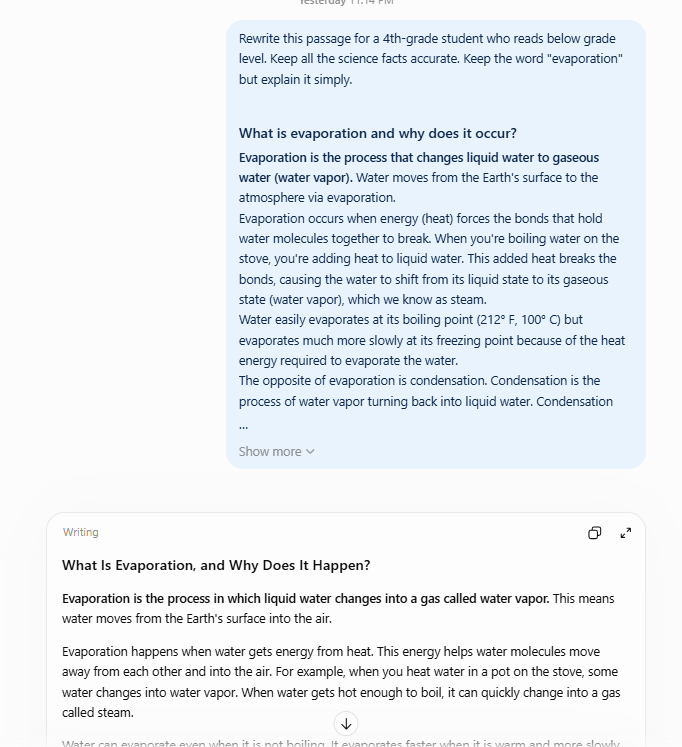
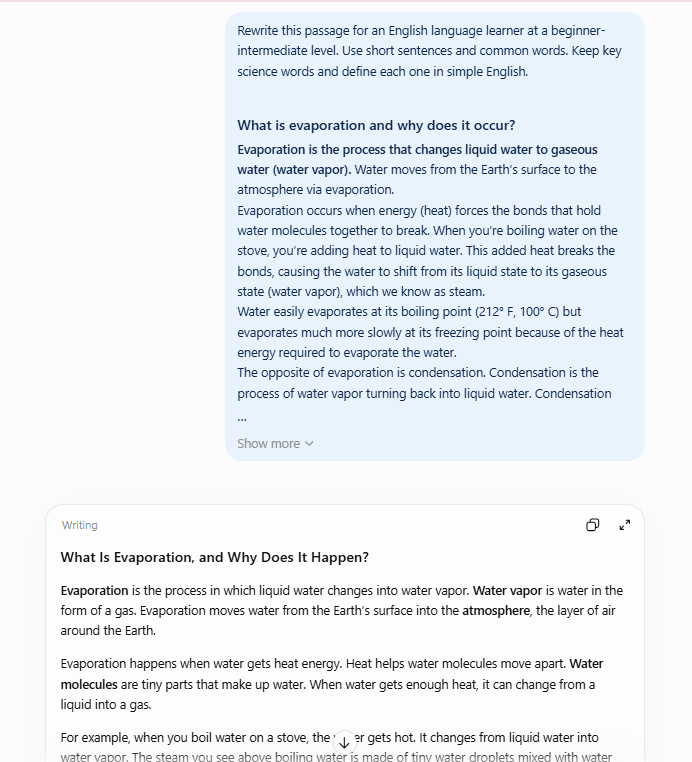
On October 11, 2026, we gave ChatGPT (free plan, default model GPT-5.6 Luna) a 152-word section from the USGS Water Science School. The Flesch-Kincaid grade reading level of this passage is 9.8 on readabilityformulas.com. Each output was a single run, with no regeneration. We requested three different rewritten versions from ChatGPT based upon these very short teacher-style prompts:
- “Rewrite this passage for a 4th-grade student who reads below grade level. Keep all the science facts accurate. Keep the word ‘evaporation’ but explain it simply.”
- “Rewrite this passage for an English language learner at a beginner-intermediate level. Use short sentences and common words. Keep key science words and define each one in simple English.”
- “Translate this passage into Spanish for a middle school student. Keep the science terms accurate.”
| Struggling-reader rewrite (goal: 4th grade) | English-learner rewrite (goal: beginner-intermediate) |
| |
|---|---|---|---|
| 7.5 | 7.6 | n/a (English formulas don’t apply to Spanish) |
| Word count (original: 152) | 175 | 238 | n/a |
| 1. Liquid water changes into water vapor, a gas | Kept | Kept | Kept |
| 2. Water moves from Earth’s surface into the atmosphere | Kept | Kept | Kept |
| 3. Heat breaks the bonds holding water molecules together | Partly kept (became “molecules move apart,” bonds lost) | Partly kept (became “molecules move apart,” bonds lost) | Kept |
| 4. Boiling example: added heat turns liquid into vapor | Kept | Kept | Kept |
| 5. Evaporates easily at boiling (212°F, 100°C) and much more slowly near freezing | Partly kept (both temperatures dropped) | Kept | Kept |
| 6. Condensation is the opposite and happens when saturated air cools | Partly kept (“saturated air” dropped) | Kept | Kept |
Screenshot of ChatGPT’s 4th-grade Rewrite
Screenshot of ChatGPT’s English-learner Rewrite
Screenshot of ChatGPT’s Spanish Translation Rewrite
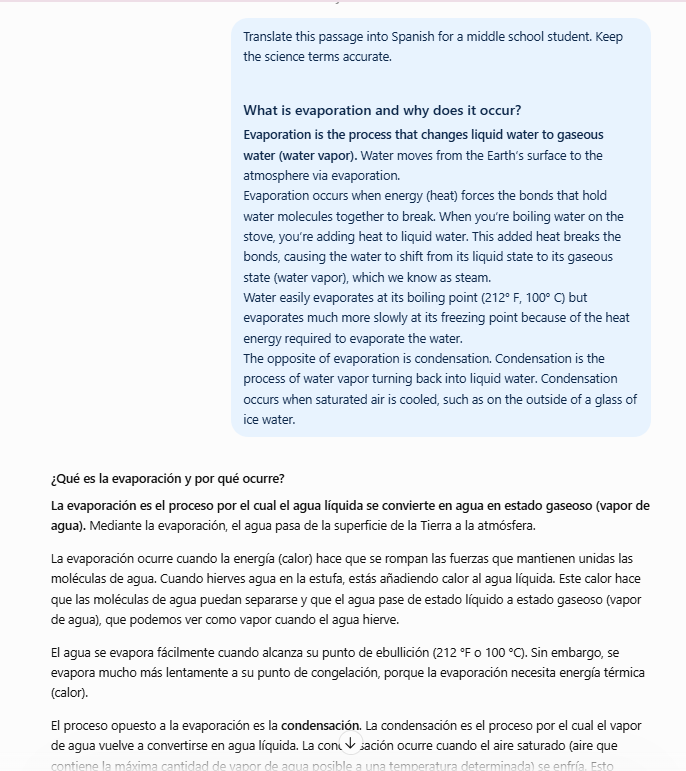
Analysis
Accuracy generally held through all versions, and none of the six facts was distorted in any version. Both rewrites lost the bond mechanism, simplifying it to molecules moving apart. The 4th-grade rewrite version eliminated the specific temperatures as well as the term “saturated air” while maintaining the most difficult concept that water evaporates below its boiling point.
We checked the Spanish translation by back-translating it with Google Translate. All six facts were successfully preserved, in addition to all three key terms (evaporación, vapor de agua, condensación) being properly translated.
Reading level was the weak point. Both rewrites scored around grade 7.5, well above a 4th-grade or beginner level, partly because the English-learner version’s definitions added longer science words. Readability formulas measure only sentence and word length, so these scores are a rough guide. Still, the takeaway is clear: AI handled accuracy well, and a teacher still needed to check the reading level.
Earlier Intervention
This is the most promising benefit and the least proven. AI may help provide indicators that an individual student may be having difficulty, but only about 5% of teachers use AI for this kind of analysis weekly or more, so outcome evidence is still thin.
How Strong Is the Evidence for Each Benefit?
| Benefit | What the evidence shows | Evidence type | Condition for it to hold |
|---|---|---|---|
| Personalized learning and AI tutoring | Learning gains more than double those of in-class active learning, in less time | Randomized controlled trial (Kestin et al., 2025) | Tutor designed around teaching principles, with accurate content |
| Faster feedback | 62% of AI-using teachers expect better real-time feedback, vs 32% of non-users | Large teacher survey (Gallup and Walton, 2025) | Students revise their own work after feedback |
| Teacher time savings | Weekly users estimate saving 5.9 hours per week | Large teacher survey, self-reported | Saved time is reinvested in students |
| Accessibility | 57% of AI-using teachers expect gains, 65% of special education teachers. In our one-passage test, AI adaptations kept the core facts but missed target reading levels. | Large teacher survey, plus our small first-party test | Tools matched to student needs, with a teacher checking reading level |
| Student well-being | Personalized support alongside risks such as loneliness and technostress | Mini-review of 11 studies (Klimova and Pikhart, 2025) | Balanced use that keeps human contact |
| Earlier intervention | Only about 5% of teachers use AI to analyze student data weekly or more | Usage data only, no outcome studies yet (Gallup and Walton, 2025) | A person reviews every flag |
Can AI replace teachers altogether? The FAQ below answers that.
Why the Same AI Tool Can Help or Hurt Learning
Harvard’s Ying Xu offers a useful starting point. In a Harvard Graduate School of Education interview, she argues that schools should begin with the learning outcomes they want, then ask if AI can meaningfully contribute to them. In her work with PBS Kids, she reported that children who held science conversations with AI-enabled TV characters showed a significant improvement in scientific reasoning and engagement.
Design is key. A general-purpose chatbot is designed to provide help. This is typically done through providing answers. But a learning tool needs to withhold answers and provide students with hints. It also requires the student to provide the rationale behind their answer, while staying within the bounds of curriculum content.
A 2025 field experiment by Bastani and colleagues, published in PNAS, shows what happens without that design. Nearly 1,000 high school math students in Turkey practiced with a standard ChatGPT-style interface, a hint-based tutor version, or no AI.
The practice scores of participants increased 48% with a standard version and 127% for those using a tutor version. Once access was discontinued, the standard-version group scored 17% lower on the exam as compared to the students who never used an AI tool. The tutor version largely prevented that drop.
Together with the Kestin trial, the pattern holds. Tools built to teach can help, while tools built to answer can absorb the effort that learning requires.
Well-being follows similar logic. A mini-review by Klimova and Pikhart found that tools offering personalized support can also contribute to loneliness, technostress, and less face-to-face contact when students lean on them heavily, though it found only 11 qualifying studies.
The Risks of AI in Education Every School Should Plan For
Every benefit above has a matching risk worth planning for before adoption.
Privacy and data security. AI tools can collect student work and personal data, so vet vendors for compliance with laws such as FERPA and COPPA.
Bias. There is also a chance that the models will reflect biases, so when you make decisions concerning individual students, it would be beneficial to include at least one person to assist.
Surveillance-style proctoring. Webcam monitoring, room scans, and facial recognition raise privacy and fairness concerns. Prefer less intrusive forms of evidence.
Inaccurate outputs. Chatbots may provide a student with an incorrect answer and be confident about it. Teach your students how to check AI answers, and use tools that are based upon the content of your class.
Over-reliance and reduced human contact. Students can hand off the thinking itself. Create tasks requiring explanation and discussion.
Cost and equity. Some of the tools cost money, and unequal home internet access in many parts of the country can widen existing gaps. Budget for access before scaling.
Academic misconduct. With the ability to easily generate text from chatbots, it becomes difficult to determine if students wrote something by themselves or if they used a tool. This issue will be addressed in the next section.
Here are the pros and cons of AI in education at a glance.
| 5 Advantages of AI in Education | 5 Disadvantages of AI in Education |
|---|---|
| Personalized learning and AI tutoring | Over-reliance that weakens independent skills |
| Faster feedback on student work | Privacy and data security risks |
| Time back for teachers | Inaccurate or biased outputs |
| Better accessibility for students with disabilities and language learners | Reduced face-to-face interaction |
| Earlier support for struggling students | New academic integrity challenges |
Academic Integrity: The Safeguard That Keeps AI’s Benefits Real
Most benefits to students within this resource are based on the same idea. Feedback, tutoring, and writing support will be effective for student learning when submitted work still reflects students’ own thinking. This places AI and academic integrity at the forefront of decision-making, because integrity practice keeps the benefits measurable.
The detection of AI-generated material also presents the biggest fairness issue. A 2023 Stanford study in Patterns found that seven widely used AI detectors incorrectly identified more than half of essays by non-native English writers as AI-generated, while classifying native writers’ essays accurately.
Newer research shows the problem shifting. A 2025 study in PeerJ Computer Science found that GPTZero produced no false positives on purely human-written academic abstracts from native or non-native authors. After the abstracts were polished by AI, though, it labeled 25% of non-native authors’ versions as entirely AI-generated, compared with 11% for native authors.
Across the three tools in that study, 44% of all human-written original academic abstracts were flagged as AI by at least one of the tools used. Much student writing now sits in this gray zone of human work refined with AI. A responsible approach includes four habits:
- View a detection as an indicator only to dig further into a possible issue.
- Ask for evidence at the passage level, so reviewers can see which parts of a submission raised questions.
- Review the writing process, including drafts, notes, and version history.
- Have a conversation with the student before making any conclusion.
Purdue history professor Melinda Zook’s guidelines for faculty show this in practice. She urges instructors to go slowly, cross-check suspicious papers with more than one detector, and warns that every detector produces false positives, especially for non-native English speakers. She then asks the student about the readings and how the paper was written.
If doubts remain, she asks for proof of authorship, such as notes, outlines, and revision history. That burden is heavy when detectors misfire, and her other advice eases it: require drafts and version history from the start, so process evidence exists before any question comes up.
A second principle is to use the least invasive evidence that answers the question. Webcam proctoring asks students to give up far more privacy than a review of the text they submitted, and text-level review produces evidence an instructor and student can examine together.
This is the approach Proofademic takes. Its sentence-by-sentence analysis shows which passages raise questions, so a conversation can begin from specific evidence instead of a single overall score.
How to Adopt AI Responsibly: A Practical Framework for Schools and Universities
Responsible AI adoption depends mostly on the sequence of decisions. Five steps cover most of it.
- Write the policy first. Only 19% of teachers work at schools with an AI policy, yet teachers at those schools save 26% more time, an average of 2.3 hours a week compared with 1.7 hours at schools without one.
- Train staff. Teachers using AI weekly save the most time. So training should promote the confidence and frequency of its usage.
- Pilot purpose-built tools. Favor tools specifically designed for tutoring, including hints or providing an explanation prompt.
- Redesign assessments. It can include elements such as drafts, reflection questions, and in-class assignments to reflect the learning process.
- Evaluate against learning outcomes. Evaluate success based upon student learning. While the number of uses may provide some information about teacher effectiveness, they do not provide sufficient data to evaluate success.
Priorities shift by setting. For K-12 leadership, the first step should be to conduct a review of policies and privacy issues. Higher-ed faculty should focus on assessment design and clear course rules on AI use. Instructional designers can build scaffolding and explanation prompts into AI-supported activities. Early-learning educators can follow Xu’s principle: use AI to enrich the time young children currently spend engaging with media while not contributing to additional screen time.
There is no formal definition of the term “30% rule.” It generally means that AI should not contribute to more than 30% of a piece of work. The real line belongs in each institution’s own policy.
For classroom-level support, explore this AI checker for teachers.
Frequently Asked Questions
What Are the 10 Benefits of AI?
In education, ten commonly cited benefits are: personalized learning, AI tutoring on demand, faster feedback, teacher time savings, accessibility for students with disabilities, translation support for language learners, materials adapted to different reading levels, earlier identification of struggling students, administrative efficiency, and self-paced study outside class.
What Are 5 Positive Impacts of AI?
Larger learning gains when using well-designed AI tutoring systems (as shown through a randomized controlled trial), saving an average of 5.9 hours/week for those who utilize AI every week (self-reported), timely and instant feedback to students, increased access to technology for students with disabilities, and the ability for students to engage in more self-directed learning.
What Are the 5 Advantages and 5 Disadvantages of AI?
The main advantages are personalized learning, faster feedback, time savings, accessibility, and earlier support. The main disadvantages are over-reliance, privacy risks, inaccurate or biased outputs, reduced human interaction, and integrity challenges.
What Is the 30% Rule for AI?
It is an informal guideline with no standard definition. In education, it usually means AI should contribute no more than about 30% of a piece of work, but each institution’s policy should set the actual line.
How Is AI Used in the Classroom?
Teachers use AI to create lesson plans and worksheets, and as a way to adapt existing course material. Students’ most common uses of AI include using tutoring systems, adaptive practice tools, and writing assistance programs. Six in 10 U.S. public K-12 teachers used an AI tool for their work in 2024-25.
What Are the Risks of AI in Education?
The main risks are privacy and data security, bias, inaccurate outputs, over-reliance, cost and equity gaps, and academic misconduct. These risks can be mitigated by implementing clear policies, carefully selecting which AI tools to use, and implementing a system of human review for all outputs.
Can AI Replace Teachers?
No. AI tutors can match some tutoring behaviors, but the most effective way of learning requires relationship, trust, and the ability of educators to make judgments based on their experiences. As Harvard’s Ying Xu puts it, the real question is how AI and teachers can work together, with AI adding efficiency and teachers providing expertise and connection.
The Bottom Line: AI’s Benefits Are Real When Learning Stays Visible
The benefits of AI in education are real, and they are conditional. These benefits occur as long as educational tools are created with teaching intent, educators have a specific policy regarding the use of AI based on learning objectives, and assessments show the actual thoughts of the student. Good design and fair, transparent integrity practices keep those benefits working for students.