Key Takeaways
- False AI detection occurs when genuine, human-written text is classified as AI-generated. It is a real limitation of probability-based detection systems but cannot be treated as evidence of misconduct.
- AI detectors measure statistical patterns in writing. Predictable academic phrasing, uniform sentence structure, and discipline-specific terminology can all contribute to a flag in authentic work.
- ESL and non-native English writers face elevated false AI detection risk because learned academic templates, limited active vocabulary, and intensive grammar correction can resemble patterns some detectors associate with generated text.
- Reducing avoidable false positives requires improving writing quality through specificity, original reasoning, and structural variety.
- Preserving process evidence, drafts, version history, research notes, citations, and feedback is the most defensible response to a disputed detection result, regardless of which tool produced it.
- Proofademic provides sentence-level detection designed for academic contexts, helping students and educators locate specific flagged passages for contextual review.
Genuine writing can still be flagged as AI because AI detectors evaluate statistical writing patterns. A student who wrote every word independently can still receive a high AI probability score if the writing is formal, repetitive, or follows standard academic conventions. Therefore, knowing how to avoid AI detection flags on genuine writing starts with understanding why real writing gets flagged, what detectors measure, and why their results are probabilistic.
This article explains why false AI detection happens, which legitimate writing practices can reduce avoidable AI false positives, and how to respond when genuine work is flagged without compromising academic integrity. For students who want to review sentence-level patterns before submission in an academically aligned context, Proofademic provides that analysis with the contextual transparency that institutional review requires.
Short Answer: Genuine, human-authored writing is flagged as AI when it exhibits statistical patterns, predictable phrasing, uniform structure, and repeated transitions that detectors associate with machine-generated text. Proofademic offers sentence-level analysis to help writers and educators examine flagged passages in their actual academic context.
What an AI detection score means in practice
An AI detection score reflects the model’s confidence that a text resembles patterns in the model’s training data; it does not measure what percentage of the text was written by AI. That’s why even academic institutions like the University of Michigan’s AI detection guidance advise instructors not to rely on AI detection tools alone as conclusive evidence, but instead treat them as one signal among many when assessing AI use.
The table below clarifies the terminology that appears in most detection reports.
| Term | What It Means | What It Does Not Mean |
|---|---|---|
| Probability | An estimate that the text resembles AI-generated writing patterns | The proportion of the document that an AI system wrote |
| Classification | The category assigned by the detector based on its model | A definitive or legally binding conclusion about authorship |
| Confidence | How strongly the model’s output supports its prediction | Certainty that AI was or was not involved |
| Flag or highlight | A passage identified for further review based on statistical properties | Evidence that the specific sentence was machine-generated |
| Proof | Independent, verifiable evidence confirming a factual claim | Something a probabilistic AI detector can provide independently |
Different detection tools frequently return different results on the same text. This occurs because tools use different training datasets, classification architectures, threshold definitions, text-length requirements, and reporting conventions. Disagreement between two tools is evidence of measurement uncertainty.
Note on score interpretation: A score described as “70% AI” does not mean that 70% of the student’s words were generated by AI unless the detection tool explicitly defines its output that way. Most tools express a classification confidence level. Treat the number as an indicator for review, and the final assessment should follow manual verification.
Sentence-level flags require context
Before acting on flagged sentences, consider the following:
- Does the passage contain standard terminology or citations required by the discipline?
- Does the passage appear in a constrained section such as a methods description or abstract?
- Does the sentence structure reflect the student’s writing in earlier, undisputed work?
- Is the passage consistent with the argument and evidence presented across the whole document?
- Are multiple passages flagged with similar characteristics, or is it isolated?
Interpretation principle: Sentence-level highlights locate areas where statistical patterns warrant closer review. They do not establish who wrote them. Always interpret flagged text alongside the document’s overall context, revision history, sources, and prior writing.
One detector result should not decide an academic case
A single detection score is one input in a broader review. Educators evaluating tools should compare evaluation methodology, transparency in reporting, and how each tool handles short texts, non-native English writing, and heavily formatted academic genres. Selecting a tool solely on headline accuracy claims is not sufficient for high-stakes academic decisions. When evaluating which tools best serve educational contexts, consider one of the best AI checkers for teachers that accounts for methodology and false-positive handling.
Why genuine writing can be flagged as AI
AI detectors identify patterns in writing that resemble AI-generated text rather than verify who wrote the text. They generate probability estimates based on how predictable or structurally uniform the writing appears to their classification models. A 2023 study by Weber-Wulff and colleagues, published in the International Journal for Educational Integrity, tested fourteen AI detection tools and found substantial limitations in their ability to reliably distinguish human-written and AI-generated text. The test concluded that the tested tools were neither accurate nor reliable enough for the task.
For example: A genuinely human-authored document can receive a high AI probability score if it shares surface characteristics with text the model was trained to classify as AI-generated. This is an expected behavior of a probabilistic tool operating without access to the author’s drafts, research process, or reasoning history.
Understanding this distinction is the correct starting point for any student or educator facing a disputed result.
Perplexity: Predictable language is not the same as machine authorship
AI detectors often rely on concepts such as perplexity and burstiness when evaluating text. These statistical measures significantly influence AI detection accuracy. Perplexity, in particular, is how statistically predictable the next word in a sequence appears based on the surrounding context.
- Lower perplexity means the word choice and sentence construction were easy for the model to anticipate.
- Higher perplexity suggests more varied or less expected phrasing.
The important thing to note is that low perplexity is just a property of writing style. Standard academic conventions, definitions, formal transitions, and discipline-specific vocabulary are predictable by design because they communicate precisely and consistently.
| Writing Type | Why It May Appear Statistically Predictable |
|---|---|
| Textbook definitions and paraphrases | Standard phrasing is shared across many academic sources |
| Scientific and technical terminology | Fixed vocabulary with few meaningful alternatives |
| Legal or policy language | Conventional phrasing required by the genre |
| Academic transition phrases | Common sentence patterns repeated across disciplines |
| Lab procedures and methods sections | Repetitive instructional structure by convention |
| Citation-heavy analysis | Attribution formulas are standardized by style guide |
Burstiness: Uniform structure can affect a detector’s confidence
Related to perplexity is the concept of burstiness, the degree to which sentence lengths and structures vary throughout a document. Human writing tends to vary: longer explanatory sentences alternate with shorter conclusions, and phrasing shifts across paragraphs. AI-generated text often lacks this variation, producing uniform sentence lengths and repeated grammatical constructions.
However, heavily revised or professionally edited academic writing can also exhibit low burstiness. It happens because careful editing tends to reduce structural irregularity. A polished, consistently formatted paper can lower a detector’s confidence in human authorship for this reason alone.
Turnitin’s own numbers make the same point. The company first advertised a false positive rate below 1%. It later admitted the real sentence-level rate is closer to 4%, and that more than half of those false positives sit next to sentences that actually were AI-written. That gap between the advertised rate and the real one shows how easily heavily edited or mixed-authorship writing can trip up even a leading detector.
Short and highly constrained passages provide less context
Detection accuracy generally improves with longer samples. Short documents give classification models less statistical information to work with, increasing the likelihood of an unreliable result. This limitation reinforces why AI detection and academic integrity depend on human judgment, supporting evidence, and institutional policy rather than detector scores alone.
Examples of short or constrained texts that may produce inconsistent results:
- Abstracts and executive summaries
- Lab report methods sections
- Short-answer exam responses requiring fixed terminology
- Template-based reports with required headings
- Annotated bibliography entries
- Responses to structured prompts with mandatory phrasing
We tested how genuine academic writing responds to AI detection
AI detection results can change even when the underlying ideas and authorship remain human. To see how writing style and editing affect detection, we tested three versions of academic writing: an unedited human-written version, a grammar-edited version, and a version written by a non-native English writer on an AI detector:
Methodology: We tested three versions of the same academic essay: an original human-written draft, the same draft after grammar and language editing, and a genuine essay written by an ESL/non-native English writer. We first ran all three versions through a general AI detection tool and observed how editing and writing style affected its results. We then ran the same samples through an academia-specific AI detector under consistent conditions to see if those changes produced similarly broad shifts in its results. The findings clearly showed why generic detection results should be treated cautiously and why an academia-specific detection layer, combined with human review and writing-process evidence, is important when evaluating academic work.
Tests conducted through a generic AI detector tool
To see how a general-purpose AI detector responds to genuine academic writing, we ran three writing samples and recorded the AI scores produced for each.
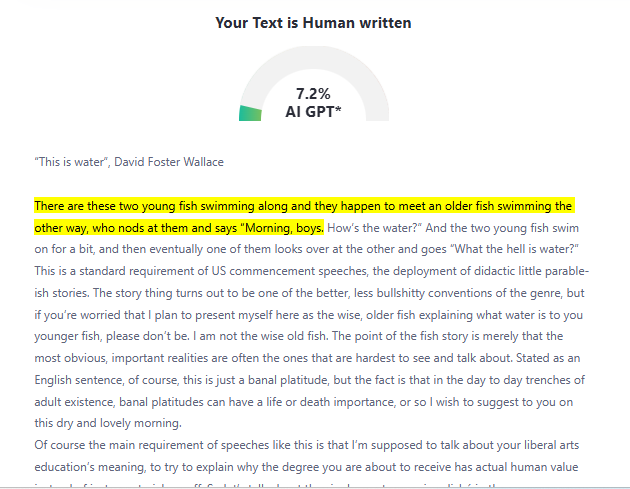
1) Human-written text
For the human-written version, the tool gave a 7% AI score, which is close to accurate.
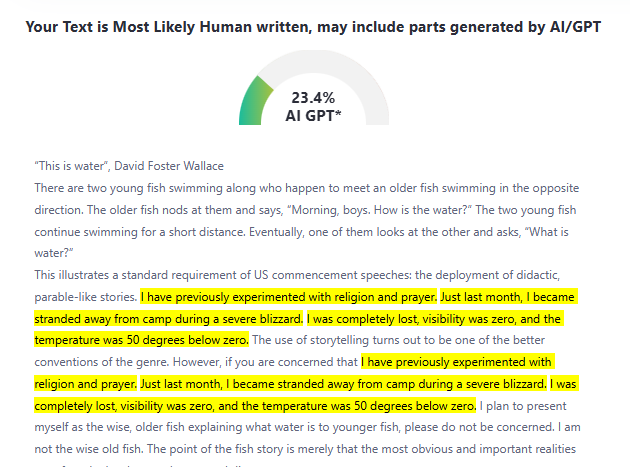
2) Test with grammar edits through Grammarly
For the second test, we took the same content and ran it through Grammarly for basic grammar edits. After edits, the same human-written content received a 23.4% AI score, showing a noticeable increase in AI classification.
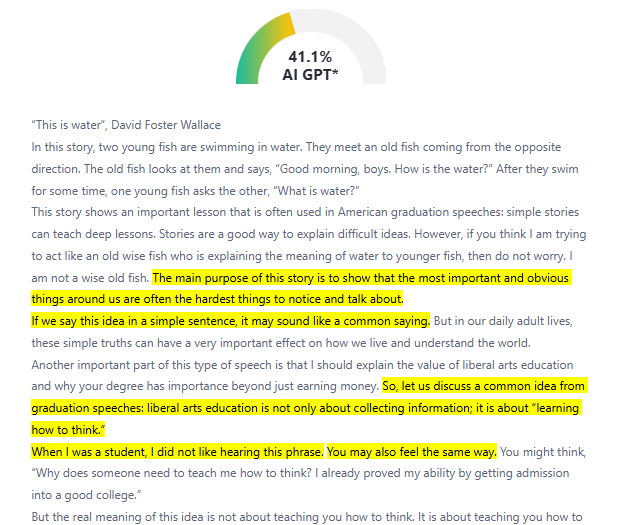
3) Version written by an ESL writer
The genuine ESL-written essay received a 41.1% AI score, demonstrating how authentic non-native English writing can receive a substantially higher AI score.
Same Tests conducted through Proofademic
We then ran the same three samples through Proofademic to determine if using an academia-specific detector makes a difference in the results or is the same on edited text.
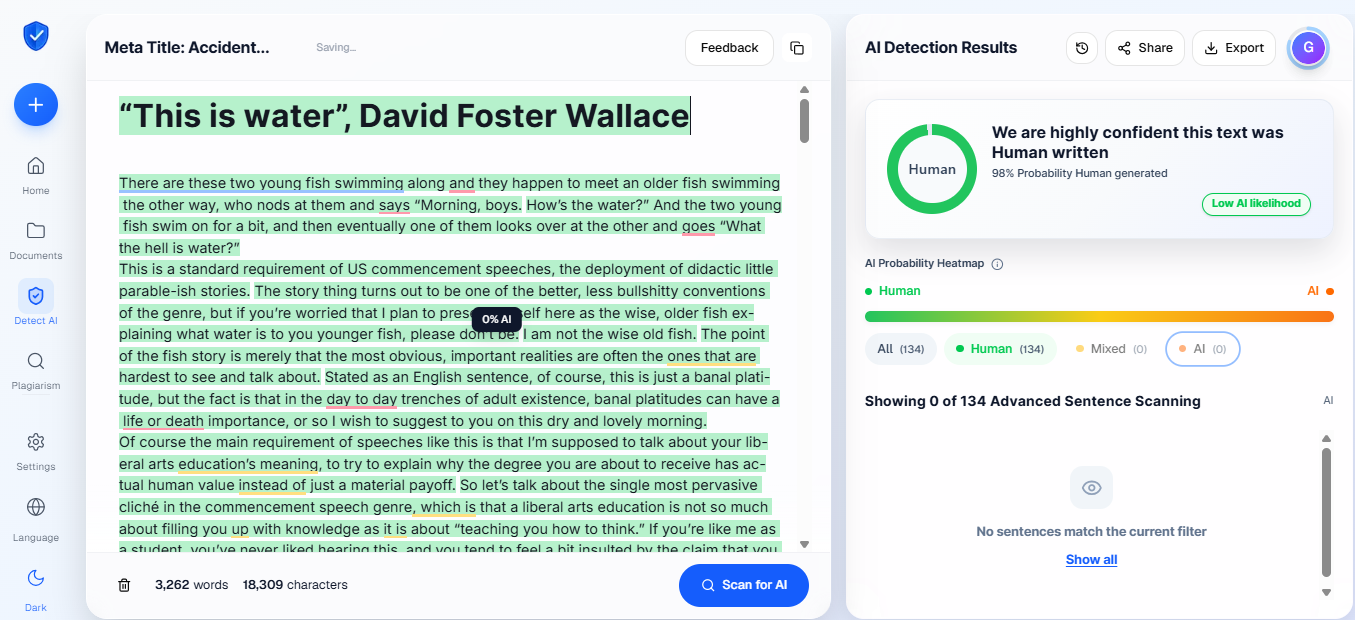
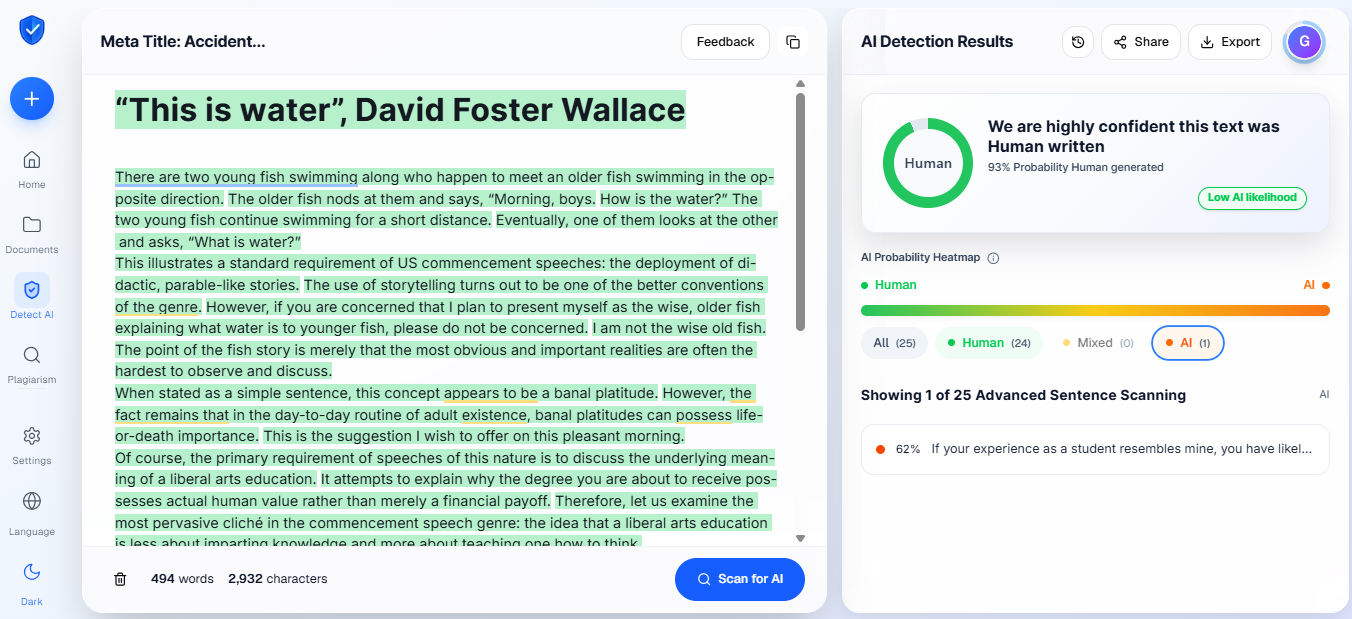
Test 1: Fully human-written text
The original human-written essay received a 96% human score, showing that Proofademic rightly classified the sample as human-written.
Test 2: Test with grammar edits through Grammarly
The Grammarly-edited version received a 93% human score, showing minimal change from the original despite the grammar and language edits.
Test 3: Version written by an ESL writer
The genuine ESL-written essay received a 97% human score, with no major shift from the other two samples, indicating consistent results across the three authentic writing examples.
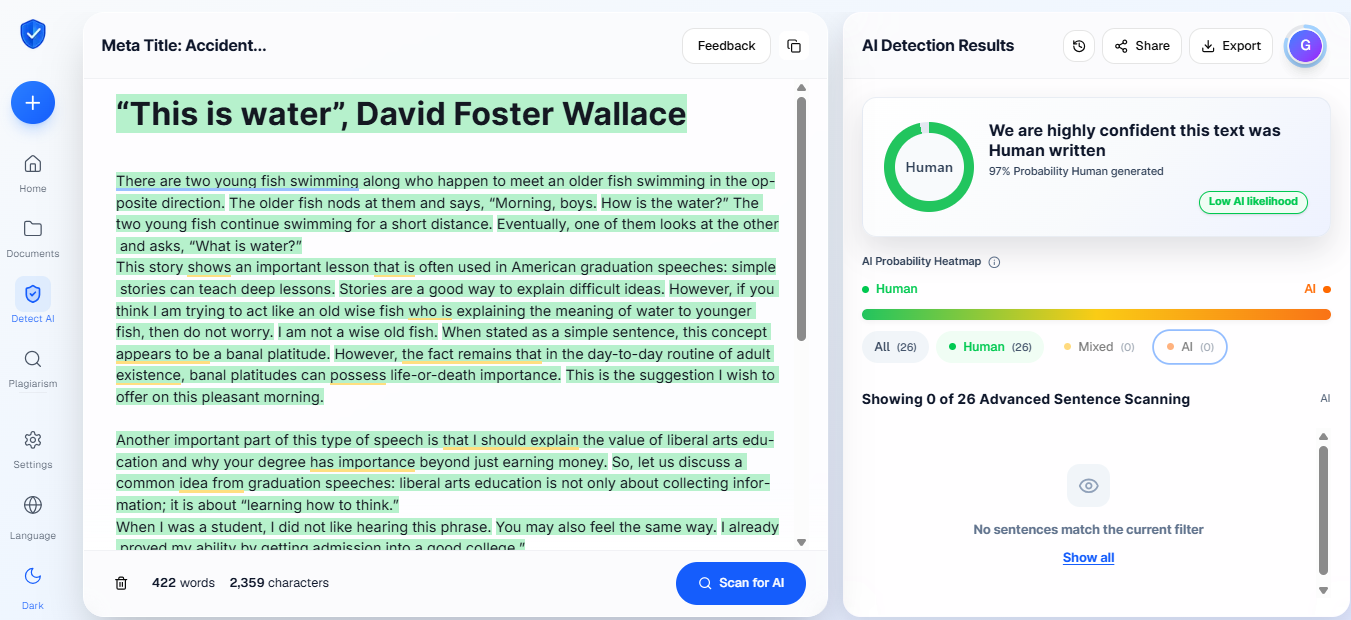
What our test results show: Our results demonstrate that genuine writing can be flagged as AI written when legitimate editing or language patterns resemble signals associated with AI-generated text. The Grammarly-edited and ESL samples received higher scores on a normal AI detector despite being genuinely written, highlighting the risk of false positives. The results reinforce why detector scores should be treated as review signals rather than proof of AI authorship. An academia-specific detection layer provides additional context for academic review, helping educators evaluate academic writing in its proper context rather than relying on generic detection signals alone.
Why ESL writers and non-native English students can receive false positives
ESL false positives are a recognized concern because several characteristics of learned academic English can resemble statistical patterns some detectors associate with AI-generated writing. This limitation has also been demonstrated in academic research. A 2023 study by Liang et al. found that more than half of essays written by non-native English speakers were falsely flagged as AI-generated.
One reason for this is that many non-native English writers develop consistent academic writing habits through formal language instruction. These legitimate patterns can sometimes overlap with the statistical signals AI detectors are designed to identify, including:
- Five-paragraph essay structures repeated across assignments
- Repeated academic transitions from language instruction materials
- Narrower active vocabulary relative to native speakers
- Formulaic sentence patterns from writing templates
- Heavily grammar-corrected prose with reduced structural variation
Detector results must always be considered alongside the student’s writing process, course context, and supporting evidence. The same principle applies to highly standardized forms of writing, such as legal documents, technical documentation, and scientific methods sections, where genre conventions constrain stylistic variation.
Seven legitimate ways to reduce false AI detection flags
Genuine writing is less likely to be misinterpreted when it is supported by clear reasoning, specific evidence, and a well-documented writing process. The following practices strengthen academic writing while reducing the likelihood of avoidable false AI detection flags, without compromising academic integrity.
1. Develop the argument from your own notes
Draft thesis statements, key claims, and evidence relationships before editing individual sentences. Notes generated during research, even rough and informal, demonstrate that the argument developed through a genuine intellectual process. Preserve them before submission.
2. Use specific evidence instead of generic summaries
Replace vague paraphrases with precise citations, course concepts, specific data, or concrete examples. Specificity serves two purposes: it improves academic quality and situates the argument in material that has an identifiable research trail.
3. Explain your reasoning between evidence and conclusion
Add the analytical steps between a cited finding and the conclusion you draw from it. Generic writing frequently omits this layer. Including it strengthens the argument and reflects a reasoning process that is traceable to the student.
4. Revise repetitive structure for clarity
When consecutive sentences genuinely follow the same grammatical pattern, revise for readability and don’t try to manipulate statistical variation. The goal is prose that communicates clearly.
5. Keep discipline-specific terminology precise
Do not substitute technical terms with unusual synonyms to appear statistically unpredictable. Precision is both an academic requirement and a sign of genuine domain knowledge. A flagged technical term remains accurate; an inaccurate replacement is not an improvement.
6. Review heavy editing and automated rewriting carefully
If you have used grammar tools or automated editors, check if the revisions flattened your natural voice or imposed uniform sentence patterns that do not reflect your usual writing. Disclose tool use where the institution requires it.
7. Save drafts and version history before submission
Preserve outlines, document version history, research notes, annotated sources, citation records, and feedback from tutors or peers. Process evidence is consistently more useful during a formal review than resubmitting the final text through different detectors. Save this before submission.
Integrity boundaryDo not add grammatical errors Do not insert irrelevant content to create the appearance of human irregularity Do not use tools marketed as “humanisers” to conceal prohibited AI authorship Do not rewrite accurate material until an automated tool approves it Passing a detector is not the same as demonstrating academic integrity
For students who want to examine their writing sentence by sentence before submission, AI detection support for students offers a transparent, academically focused review that locates flagged passages in context.
What to do when an instructor flags your writing?
If your work has already been questioned, the following sequence supports a fair and documented response.
- Preserve: Do not rewrite or delete the original immediately
- Review: Read and understand the course and institutional policy
- Clarify: Ask what the result represents
- Present evidence: Present process evidence and explain your authorship
- Request review: Ask for a human evaluation
- Appeal: Submit a formal academic integrity appeal if necessary
Process principle: The strongest evidence of genuine authorship is not a detection score from any tool. A combination of drafts, version history, research materials, citations, and the ability to explain the intellectual development of your argument provides a far more complete and credible picture during formal review.
How Proofademic’s sentence-level analysis can help students avoid AI flags
To help students better understand how sentence-level detection works in practice, we analyzed an academic draft using Proofademic and compared the flagged passages against standard academic writing conventions. As shown in the screenshot below, instead of returning only a single document-wide score, the report highlighted individual sentences with red, yellow, and green colored indicators, making it easier to review each flagged passage in context.
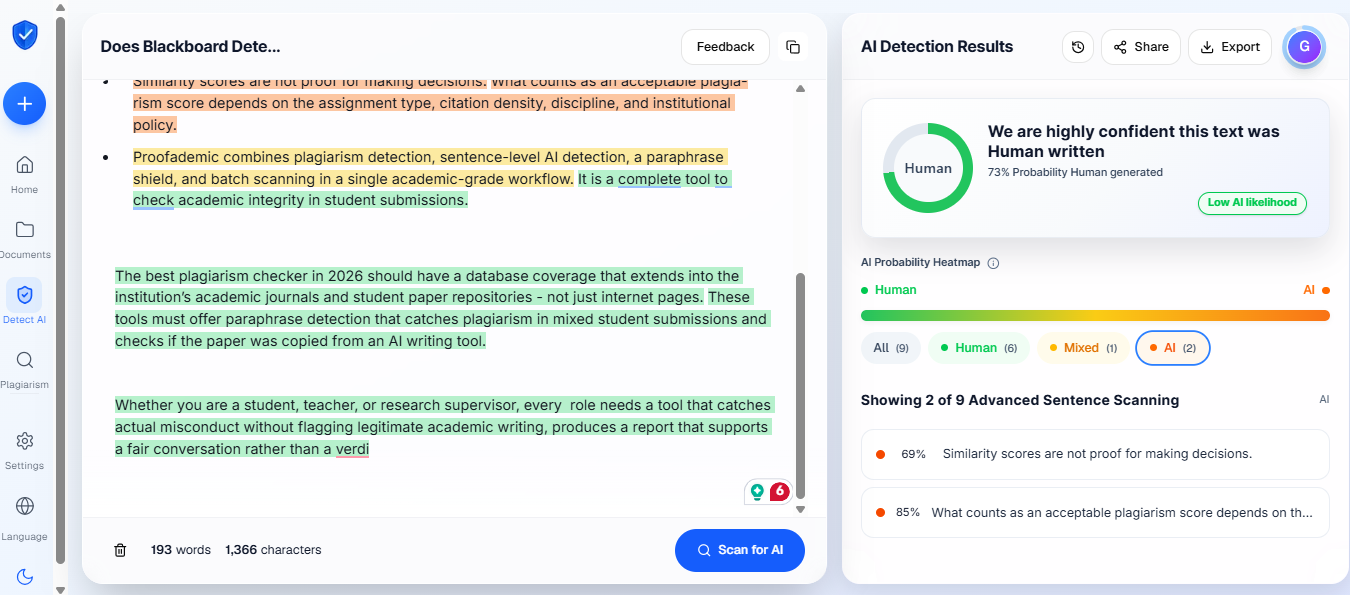
The sentence-level report helped identify passages with writing patterns that warranted closer examination. Students can analyze these passages and distinguish between routine academic conventions and areas that could benefit from further review before final submission. This sentence-level review also reinforced an important point: a flagged sentence should prompt closer review.
Before submitting, students can check and revise if highlighted passages contain necessary academic language, repetitive structure that could be improved for clarity, or subject-specific terminology. Just make sure to keep drafts, notes, and version history as evidence of the whole writing process if questions about authorship ever arise.
TL;DR
False AI detection cannot always be prevented, but it can be approached responsibly. The strongest protection is clear academic writing, a well-documented writing process, and an understanding that detector scores are review signals. When questions arise, context, revision history, and human judgment matter far more than a single percentage. Proofademic’s sentence-level analysis helps students and educators examine flagged passages in their actual context before that conversation needs to happen.
FAQs
How can you prove you wrote your paper?
Preserve drafts, version history, research notes, annotated sources, citation records, and feedback from tutors or peers. The ability to explain your argument’s development and specific revision choices provides more credible evidence during a formal review than any detection score.
Why is my genuine writing flagged as AI?
AI detectors respond to statistical patterns, predictable phrasing, repeated structure, and uniform sentences. These characteristics appear naturally in academic writing that follows conventions: formal transitions, discipline-specific terminology, and well-edited prose can all resemble patterns associated with generated text.
Can AI detectors be wrong?
Yes. False positives occur when genuine writing is classified as AI-generated. False negatives occur when AI-generated text is classified as human. Different tools frequently return different results on the same document.
Do AI detectors falsely flag non-native English writers?
Taught essay structures, repeated academic transitions, narrower active vocabulary, and heavily corrected grammar are patterns some detectors associate with generated text. This does not apply identically to every tool or language, but it is a documented source of unequal false-positive risk that institutions using detection tools should account for in their review procedures.
How do I lower a false AI detection score without cheating?
Improve writing specificity, show original reasoning between evidence and conclusions, revise genuinely repetitive structure for clarity, review automated edits that may have flattened your voice, and retain process evidence. Do not add errors, use evasion tools, or replace accurate terminology with unusual alternatives solely to manipulate a detector’s output.