So how accurate is QuillBot’s AI detector, and can it actually detect AI-generated writing across different formats? To answer this question, we conducted a four-sample stress test to determine if there was a pattern in the results, and yes, there was. The pattern showed that the accuracy of QuillBot’s AI detector will depend on what format you are testing for.
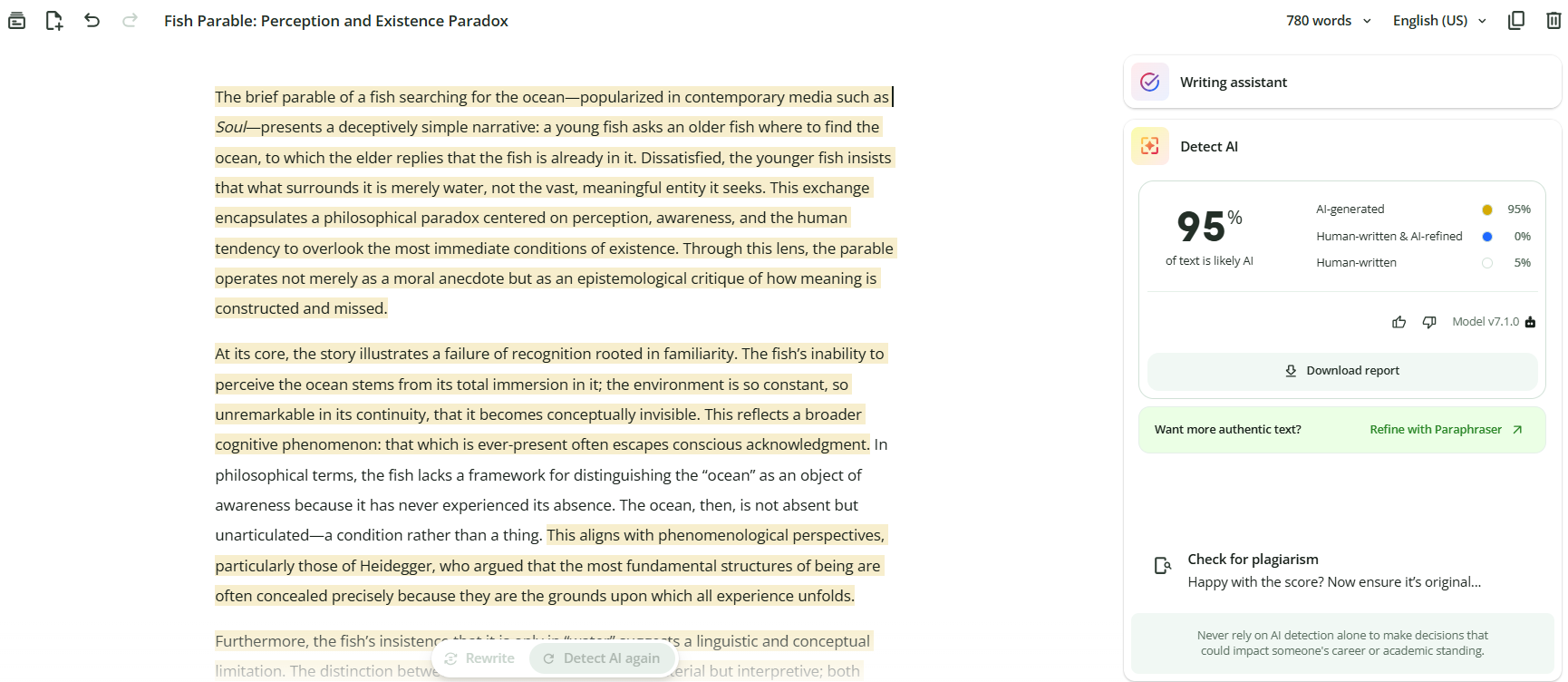
QuillBot AI checker properly identified all of the AI-generated academic writing from our testing with an accuracy of 95% for a raw ChatGPT-style essay. It also identified both human-written samples as completely human-written and produced no false-positive results in this test.
The bigger issue showed up when QuillBot scored a fully AI-generated creative sample at 0% AI, missing it completely. That means QuillBot’s usefulness likely depends heavily on content type. We saw a large variance in how well QuillBot performed based on the two different types of content we evaluated.
| Category | Finding |
|---|---|
| AI detection | Caught AI writing in the academic essay, missed it in creative writing |
| Human-text recognition | Read both human samples as fully human in this test |
| Academic usefulness | Useful as a first pass but not sufficient alone for a misconduct decision |
| Main limitation | Missed genuine AI-generated creative writing entirely |
| Best fit | Quick screening ahead of a closer academic-integrity review |
If you are looking to prioritize academic-specific detection at a sentence level specifically for formal writing, Proofademic is specifically built for that purpose. See how Proofademic works →
What Is the QuillBot AI Detector and How Does It Work?
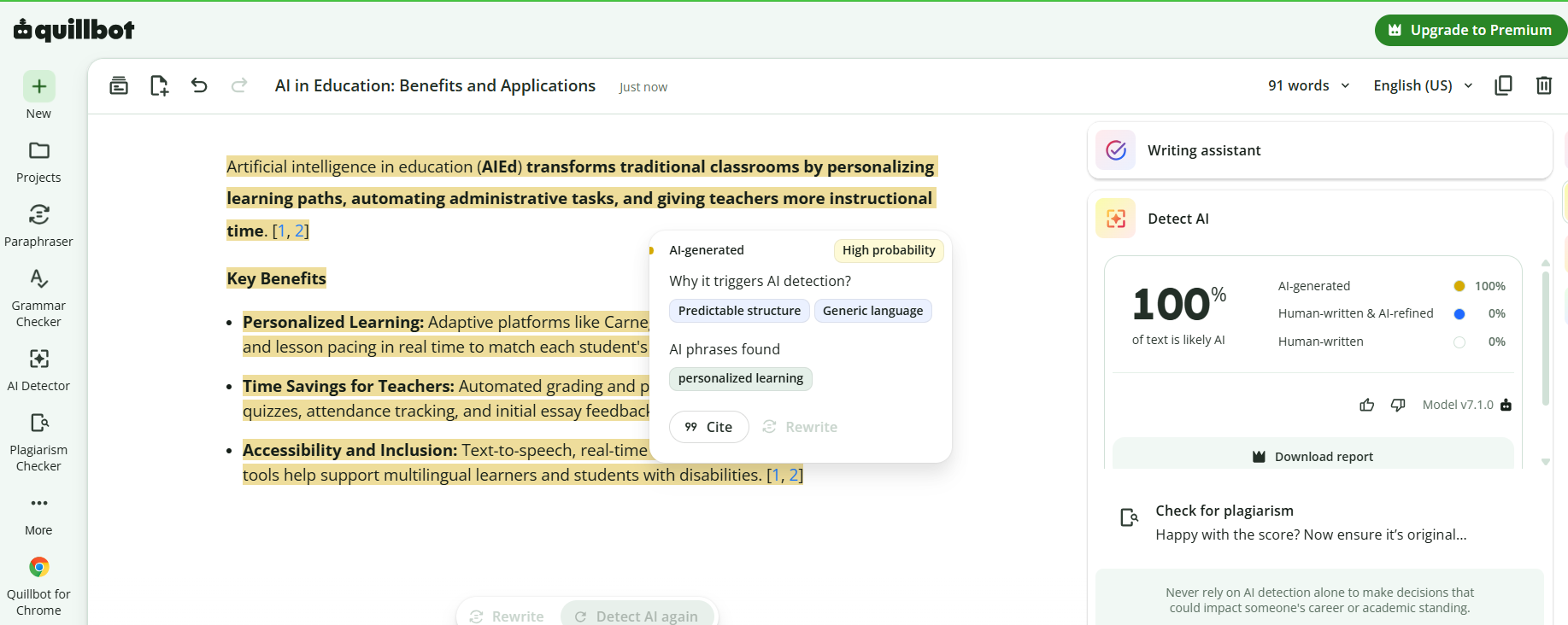
The QuillBot AI Detector will scan your submitted text to determine the overall AI-generated percentage, along with highlighting sentences to indicate exactly where in that submission a trigger caused the detector to flag it.
The detector is part of a much larger suite of tools in QuillBot that includes a paraphraser, grammar checker, and a humanizer, all included in one single account. So keep that in mind when you interpret its results: AI detection is one feature among several rather than the product’s sole focus.
QuillBot states on their website that AI Detector access is “limited” on the free plan and does not specify how many times you can run it. But they do place a 1200-word limit on each scan.
How We Stress-Tested QuillBot’s AI Detector
To stress-test QuillBot for academic use, we ran four standard samples in it: two AI-generated samples and two human-written samples, spanning academic and creative writing.
| Writing Type | AI-Written Sample | Human-Written Sample |
|---|---|---|
| Academic Essay | Where Is the Ocean? | This Is Water (David Foster Wallace) |
| Creative Writing | Anticipation | The Visitor (Lydia Davis) |
Test Samples Used for this QuillBot AI Detector Review
AI Academic Essay vs Human Academic Essay
Where Is the Ocean? is an AI-generated academic essay, used to test if QuillBot correctly identifies AI in structured, formal prose.
This Is Water is a well-known human-written piece that we used to test if sophisticated human-written content would be identified or misidentified as created by AI.
Since QuillBot limits its free scans to 1,200 words, we used a 1,200-word excerpt from This Is Water versus the total of approximately 3,700 words, and ran the same through Proofademic later in order to provide a fair comparison.
AI Creative Writing vs Human Creative Writing
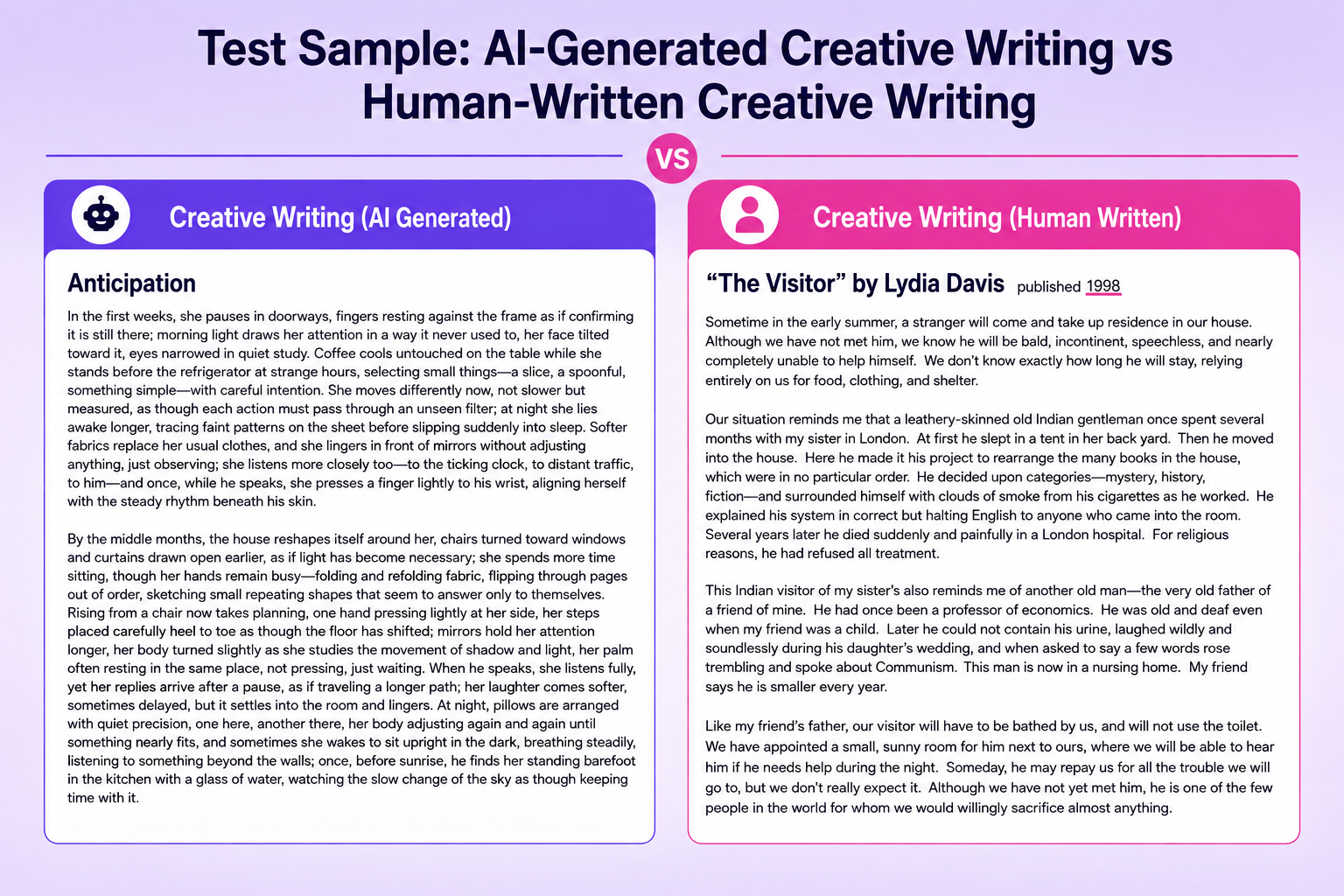
Anticipation is an AI-generated creative piece, testing if detection holds up on writing that’s less formulaic than a typical essay.
The Visitor is a known human-written literary sample, testing false-positive resistance on distinctive prose style.
QuillBot AI Detector Accuracy: Stress-Test Results
Here’s how QuillBot scored across all four samples.
| Use Case | AI-Generated | Human-Written |
|---|---|---|
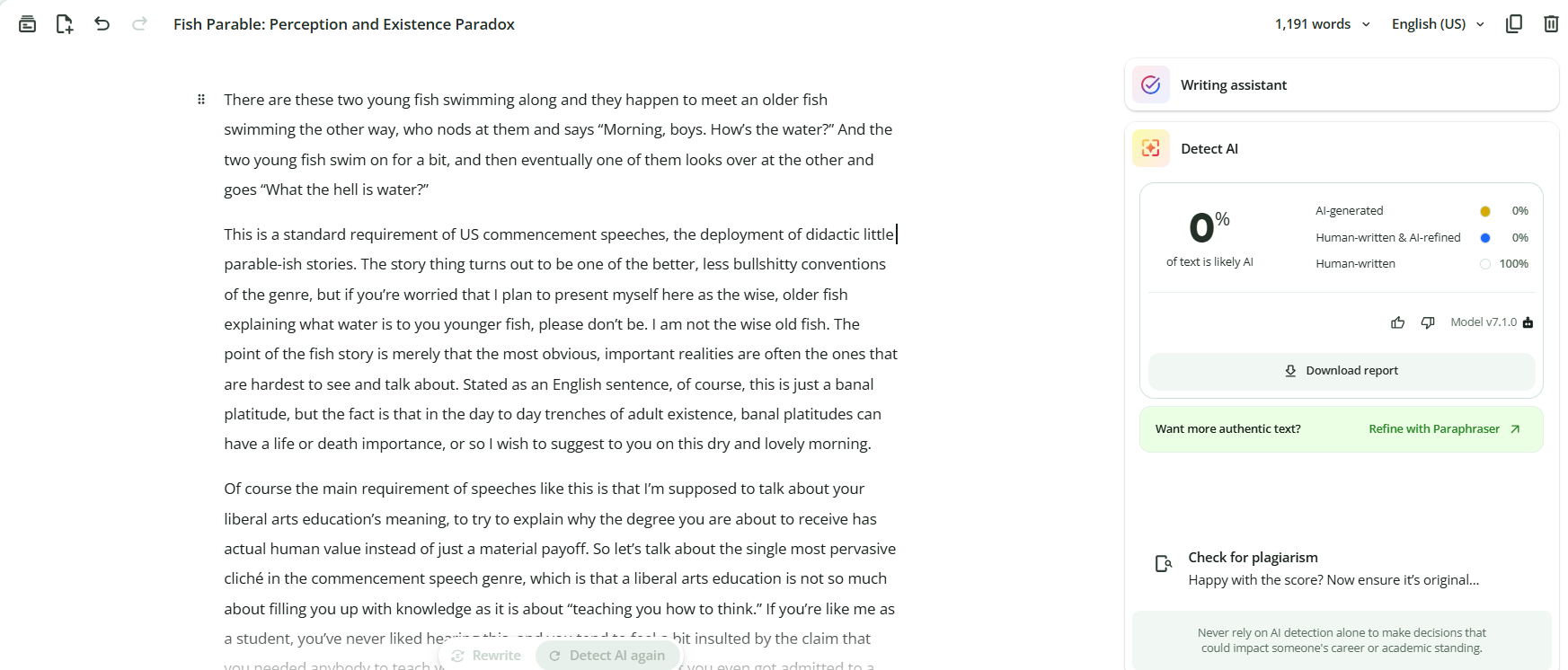
| Academic Essay | 95% AI | 0% AI |
| Creative Writing | 0% AI | 0% AI |
QuillBot Result: AI Academic Essay
QuillBot Result: Human Academic Essay
QuillBot Result: AI Creative Writing
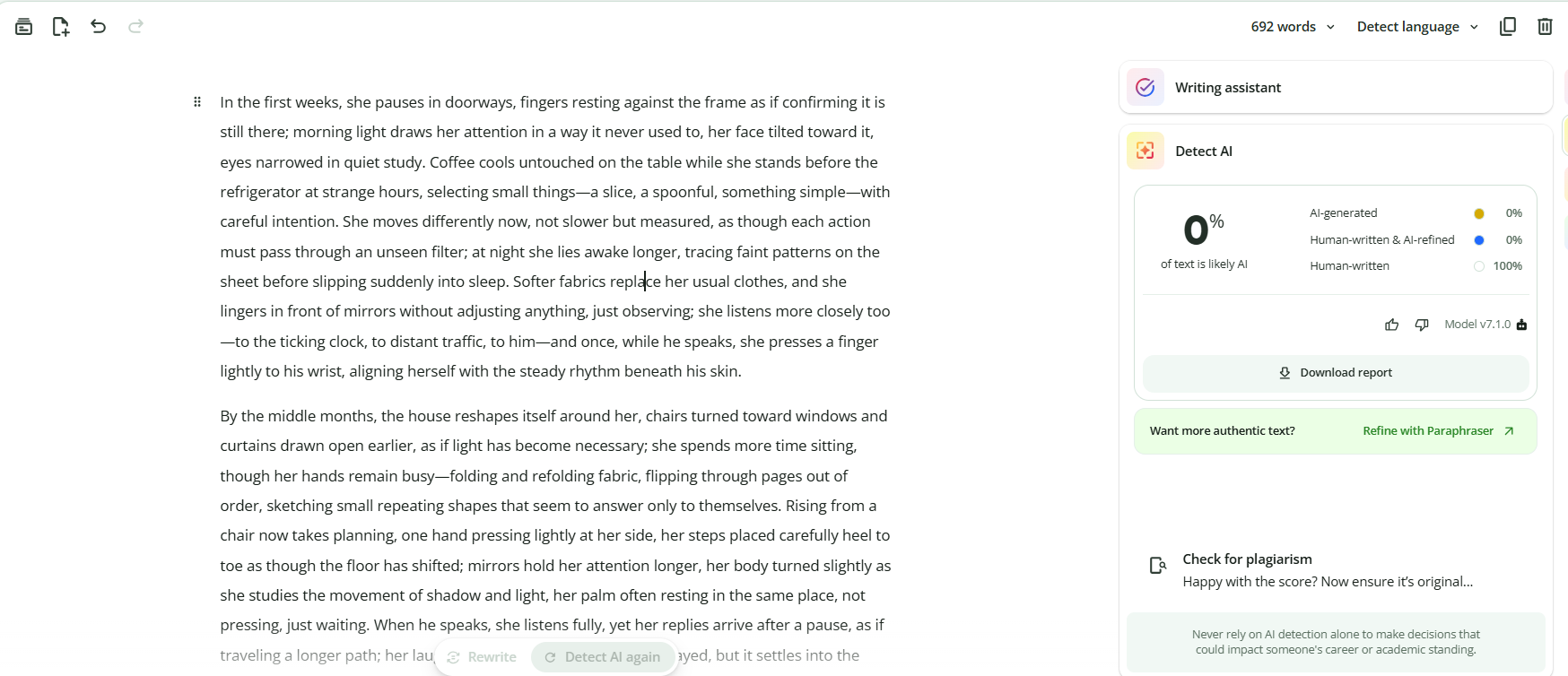
QuillBot Result: Human Creative Writing
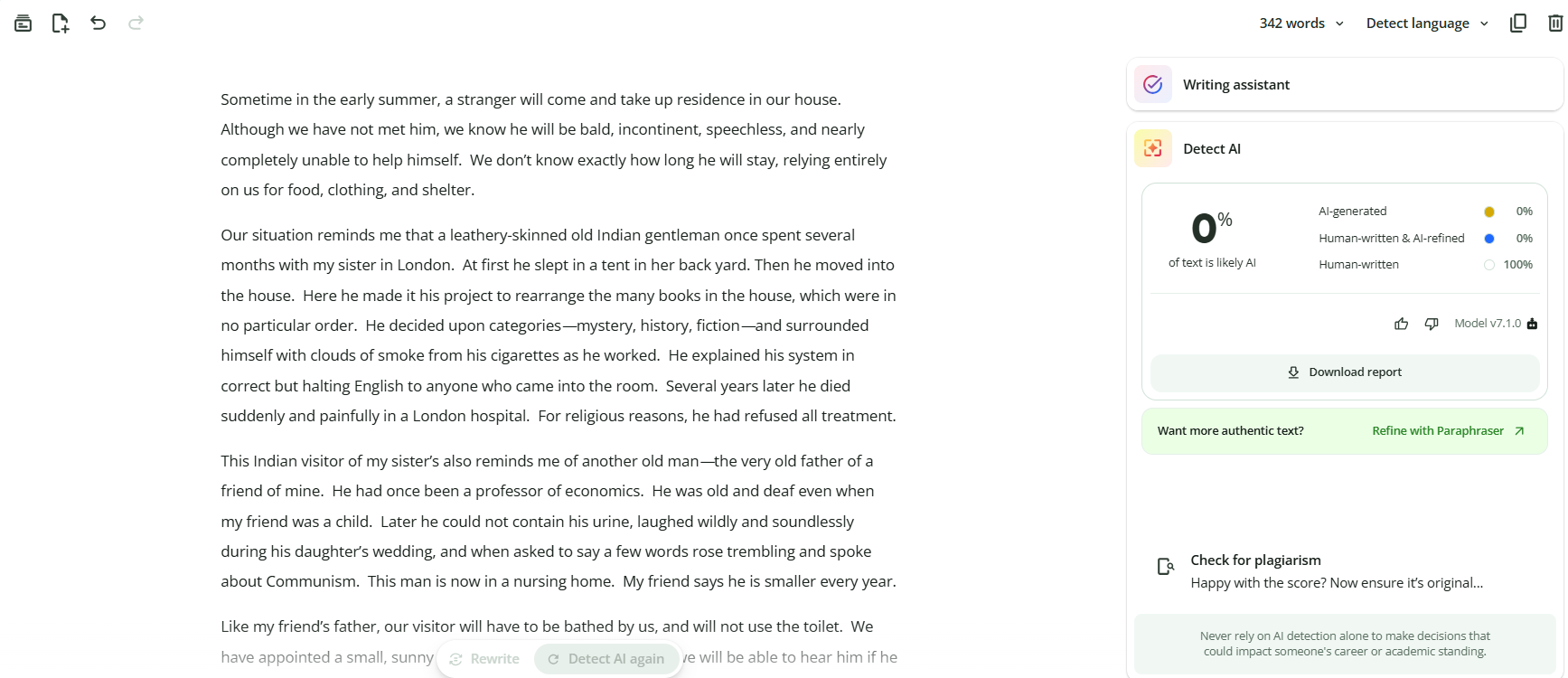
How QuillBot Performed on AI-Written Text
QuillBot correctly identified the AI-produced academic essay as being 95% AI. An independent 2024 study testing QuillBot across 68 classified essays found a similar accuracy rate of 95.59%. The researchers nevertheless cautioned against using detector scores alone to penalize students and noted that performance may decline with mixed human-AI writing. Our test exposed a different potential limitation: performance varied sharply between our two fully AI-generated samples.
It identified the AI-generated creative writing sample as 0% AI, which means it failed the accuracy test here by reading an AI sample as completely human. There was a substantial difference in detection performance between the two AI-generated formats we tested.
How QuillBot Performed on Human-Written Text
Both human samples scored 0% AI and did not produce any false positives when identifying human-written material in this sample set.
Does Writing Style Affect QuillBot’s Results?
In our test, writing style was associated with a substantial difference in QuillBot’s results. It caught AI in the academic essay but missed it entirely in the creative piece.
The results suggest that QuillBot may be better able to detect AI usage when the structure of the content matches typical essay format than when using more open formats like creative. If you’re specifically evaluating detection of ChatGPT-generated academic writing, see our ChatGPT detector for academic writing guide for a closer look.
What the Stress Test Tells Us About QuillBot for Academic Use
The four documents in the stress test section provide examples of what happened when QuillBot was asked to handle those specific types of cases. They do not represent a large enough sample size to be considered an overall benchmark that can be translated into a claim like “QuillBot is 75% accurate.”
Can it recognize known AI writing?
Inconsistently. The tool detected an academic essay written by an AI but failed to do the same with the creative writing sample. So the results depend heavily upon the type of writing you are detecting.
Can it avoid flagging legitimate human writing?
In this test, yes. Both human samples were read correctly, with no false positives.
Are its results useful enough for an academic decision?
On their own, not quite. A single score may serve well as a signal prompting additional review. Because of the creative writing miss, the scores should not be used alone in determining if a student has used AI, especially when evaluating outside conventional essay formats.
Why False Positives (and Negatives) Matter More in Academic AI Detection
A false positive is when a detector identifies actual human writing as generated by AI. A false negative is when it fails to detect actual AI-generated content and states it is written by a human. While both are critical to be aware of in academic settings, there are distinct risks associated with each.
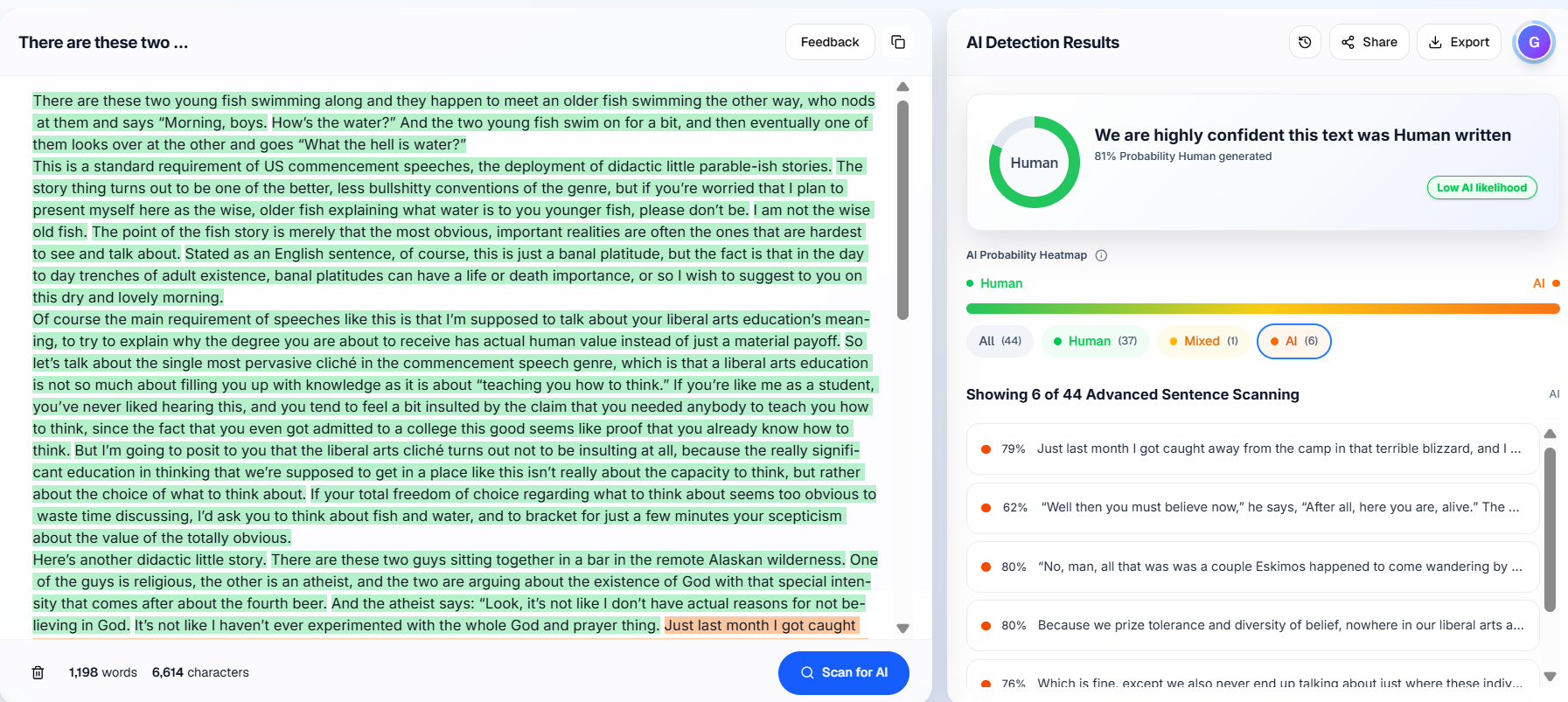
In our comparison testing above, the academic human sample was read by Proofademic as 19% AI. This is a moderate false positive. At the same time, QuillBot’s creative-writing miss was more severe, as it identified fully AI-generated content as 0% AI, which is a complete false negative.
Confidence in an “AI write” could be viewed as the most serious type of violation when it comes to academic integrity, since it means a detector can clear genuinely AI-written work with no flag at all. The presence of a flag, as well as the absence of one, should serve as prompts for reviewing the work.
This lines up with independent research testing fourteen AI detection tools, which found every one scored below 80% accuracy, with 13 of the 14 producing false negatives on at least some AI-generated samples. The researchers concluded that none of the tools tested were reliable enough on their own to serve as evidence of academic misconduct.
Suggested workflow: flag, review the highlighted passages, consider authorship context, discuss the student’s writing process, then apply institutional policy.
QuillBot vs Proofademic: How They Handle the Same Stress Test
Because the same four documents were used for both tools, this comparison reflects identical test conditions.
| Sample Type | Use Case | QuillBot Score | Proofademic Score | Winner |
|---|---|---|---|---|
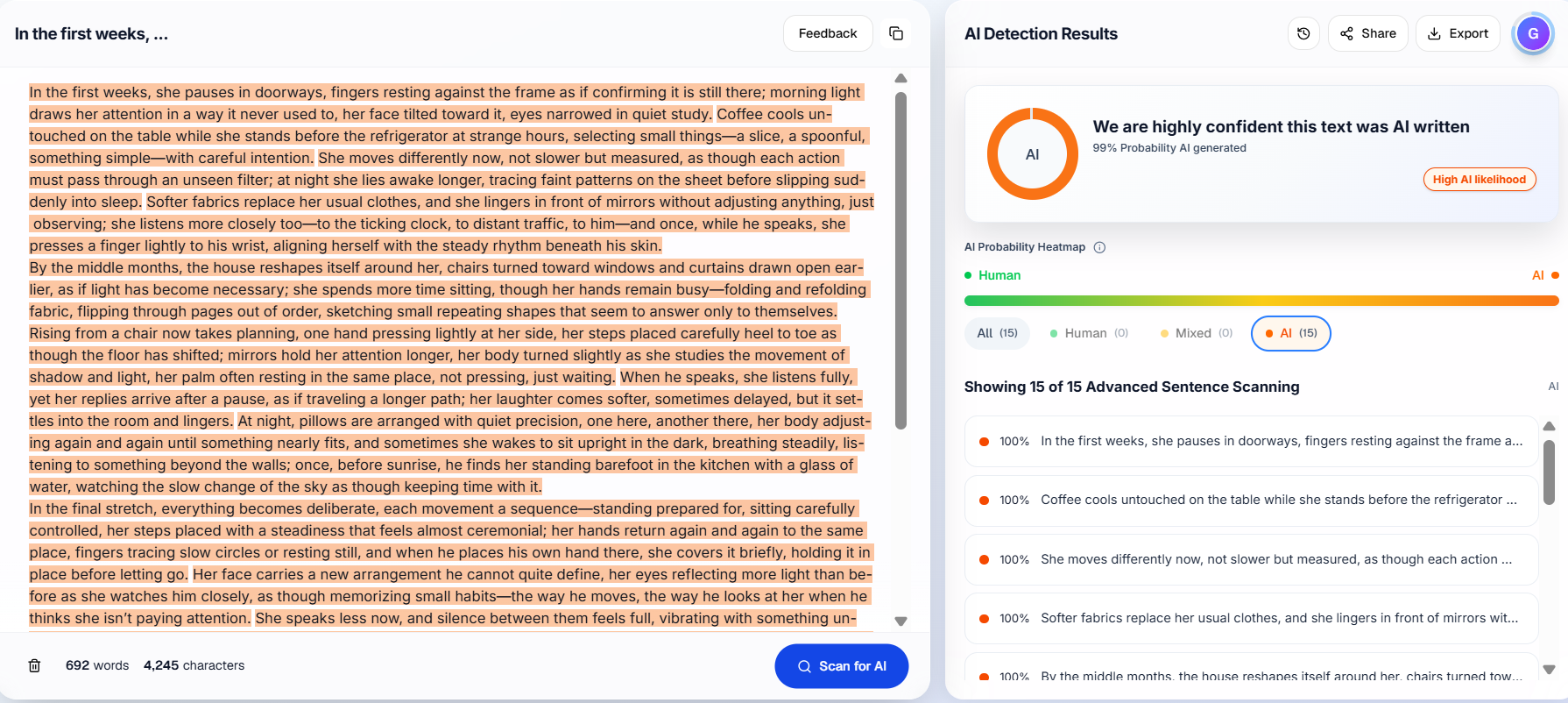
| AI-Generated | Academic Essay | 95% AI | 98% AI | Proofademic |
| Human | Academic Essay | 0% AI | 19% AI | QuillBot |
| AI-Generated | Creative Writing | 0% AI | 99% AI | Proofademic |
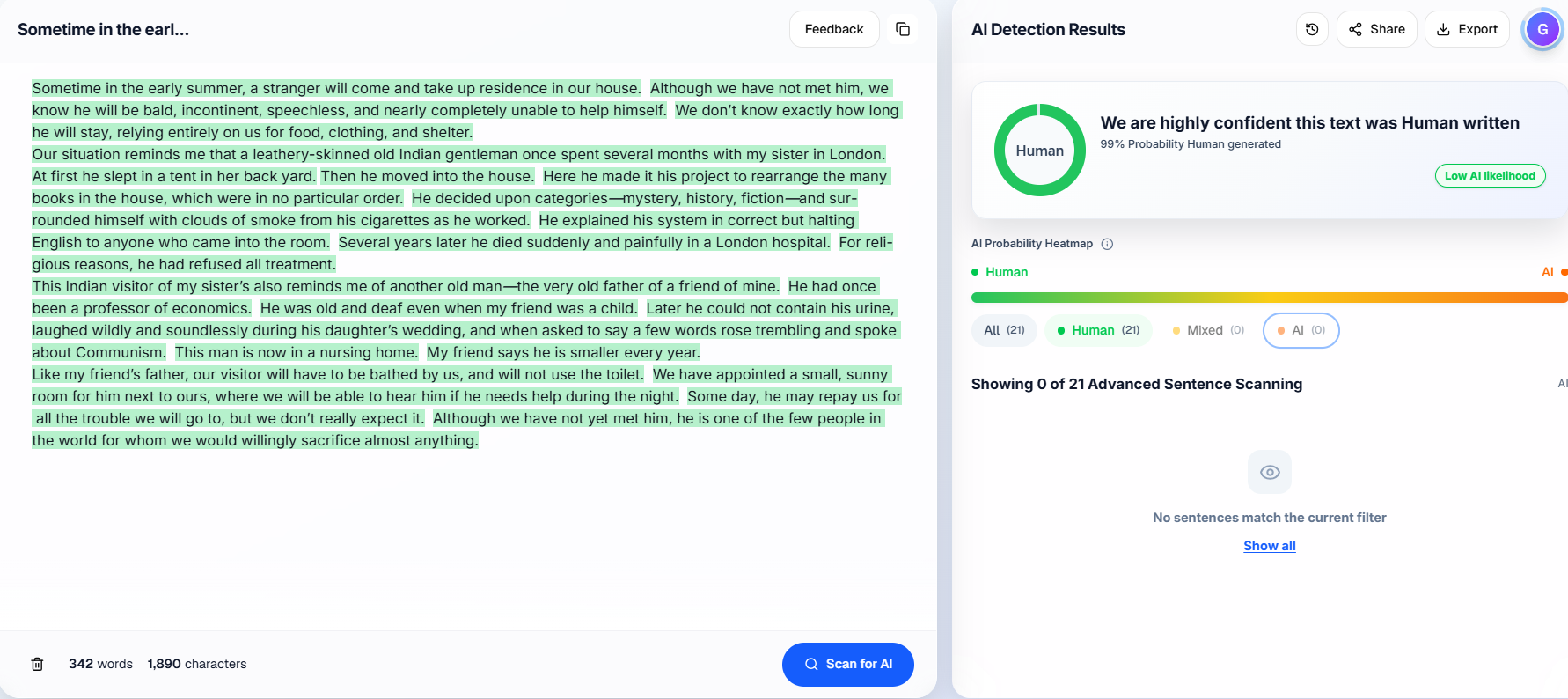
| Human | Creative Writing | 0% AI | 1% AI | Both |
Overall winner: Proofademic
Proofademic Result: AI Academic Essays
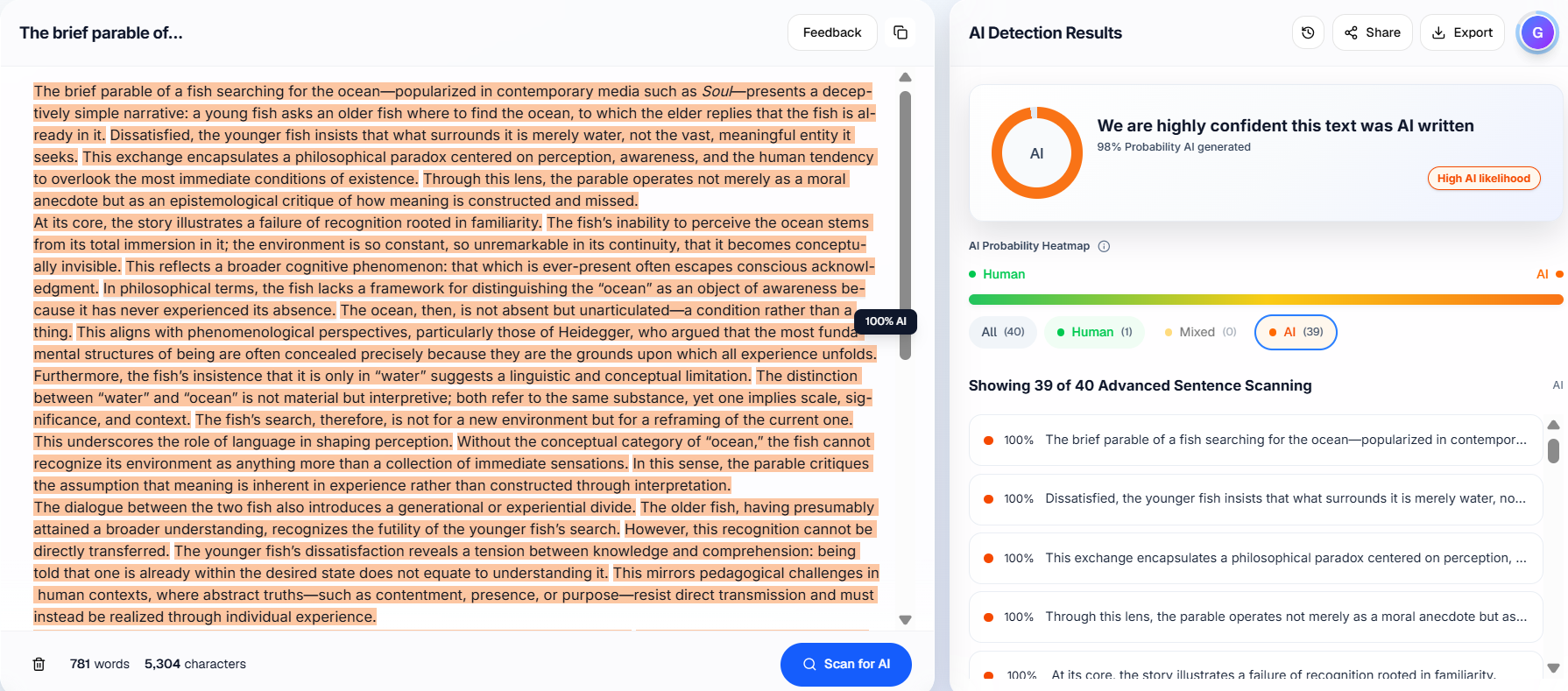
Proofademic Result: Human Academic Essays
Proofademic Result: AI Creative Writing
Proofademic Result: Human Creative Writing
Proofademic’s Detection performance on the two AI samples
Proofademic scored higher on both AI-generated samples, 98% on the academic essay and 99% on creative writing, correctly catching AI content that QuillBot only partially caught or, in the creative writing case, missed.
False-positive performance on the two human samples
QuillBot performed a little better here. It identified both of the human samples as completely human, whereas Proofademic flagged the human academic excerpt at 19% AI.
Sentence-level usefulness
Proofademic’s sentence-by-sentence scoring gives reviewers a clearer view of exactly which passages triggered a flag, which matters more in an academic review than an overall percentage alone.
Across three of four samples, Proofademic produced the stronger result, including both AI-generated samples, where a miss carries the larger academic-integrity risk. The cleaner results on human-created content from QuillBot came at the price of failing to detect AI-generated creative writing.
Based on this stress test, Proofademic caught AI-generated content that QuillBot missed and offers sentence-level detail suited to academic review. Try Proofademic for your next review →
QuillBot vs Turnitin: Which Is Better for Academic Integrity Checks?
Turnitin and QuillBot are two tools that have separate functions within an academic-integrity process. They do not compete against one another. Turnitin was designed as an institutional tool typically used by schools, with features such as plagiarism checking, and carries more established trust with academic administrators.
On the other hand, QuillBot is designed to be a personal writing tool. A student or an individual educator can run it on their own without any institutional involvement required. If a student needs to perform a self-check before submitting something, they can use QuillBot. But if they look for a complete institution-wide integration system, that’s Turnitin’s territory.
For some additional insight into academic-specific alternatives, see our best Turnitin alternatives for academic integrity roundup.
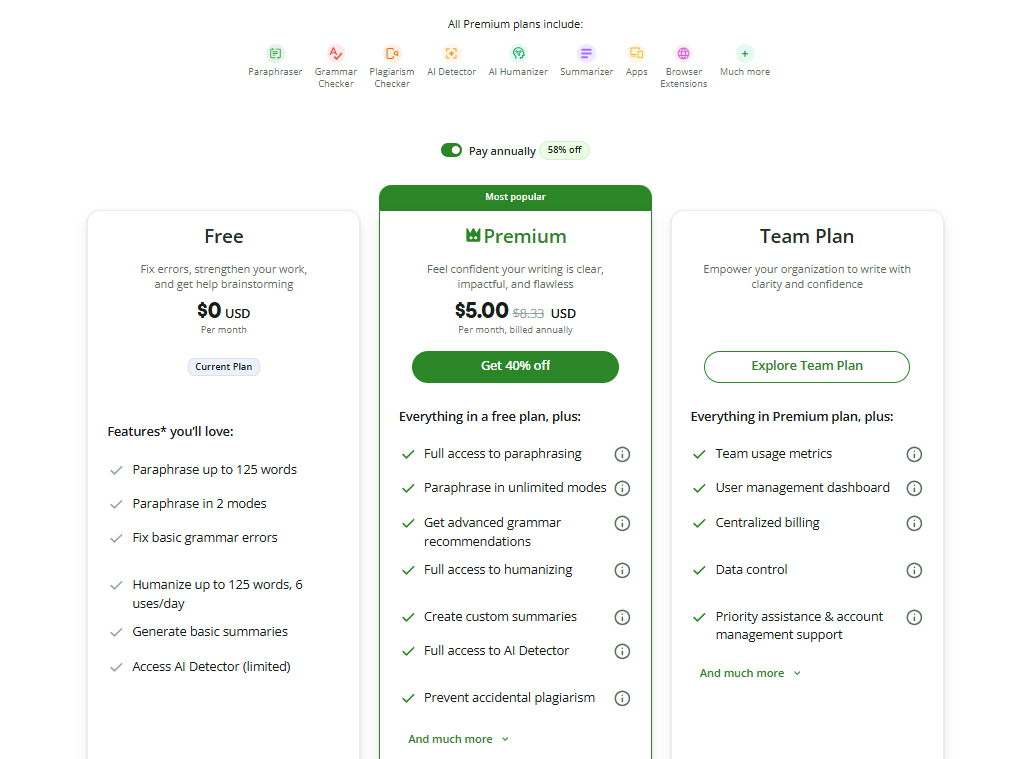
QuillBot Pricing
| Plan | Price | Notes |
|---|---|---|
| Free | $0/month | Limited AI Detector access (1,200 words per scan), no specific scan count stated |
| Premium | $5/month billed annually (regular $8.33) | Full AI Detector access, unlimited paraphrasing modes, advanced grammar, full humanizing |
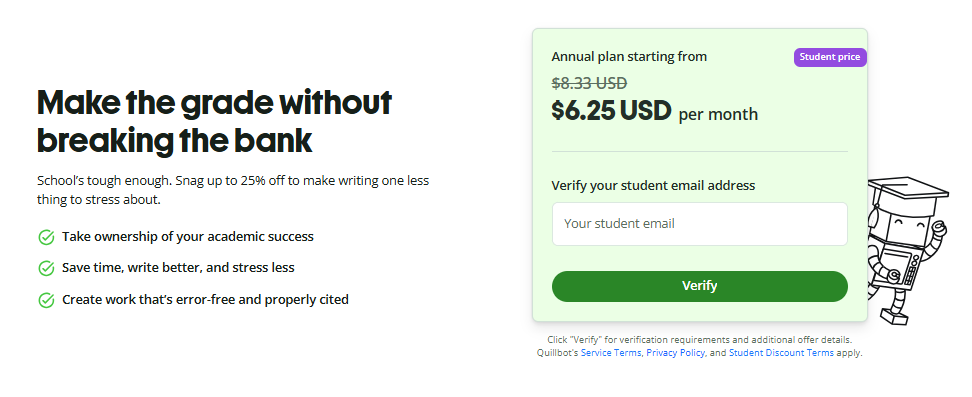
| Student | $6.25/month billed annually (25% off Premium) | Requires student email verification |
Pricing reflects QuillBot’s own site as of August 2026, and is subject to change. Confirm current pricing directly on QuillBot’s pricing page before purchasing.
Final Verdict: Is QuillBot Accurate Enough for Academic Use?
QuillBot correctly caught AI-generated academic writing and avoided flagging either human sample as AI. It missed AI-generated creative writing completely, reading it as 100% human. QuillBot accurately identified AI-created academic material and did not classify either example of human-created work as AI. But it completely failed at identifying AI-generated creative writing.
Students may use QuillBot as an initial assessment of how their writing might be classified. Educators also need to consider results from this AI detector as only one indicator of how far a student’s work is original versus AI-generated. This test has shown its largest limitation in non-traditional essay formats.
If your main need is to detect academic-specific AI, sentence-level review, and implement an integrity-focused workflow, then based on this comparison, Proofademic is the more purpose-built tool. See our AI detection for teachers page for how that fits into a classroom workflow.
If academic-specific detection, sentence-level scoring, and an integrity-focused workflow are what you need, Proofademic is built for that job.
Frequently Asked Questions
Does QuillBot have an AI detector?
Yes. QuillBot has a tool called AI Detector that can detect if your written work was generated by AI. This tool is just one of many tools that make up the QuillBot writing suite. These include the paraphrasing tool, the grammar checking tool, and the humanizing tool.
Is QuillBot’s AI detector accurate for academic use?
The performance of QuillBot’s AI Detector is dependent on the type of writing being evaluated. In our stress test, QuillBot correctly flagged AI in a structured academic essay and correctly read both human samples as human, but it missed a fully AI-generated creative writing sample entirely. So while a single reading may provide some value, consider this score as just another piece of information in a larger analysis.
Can QuillBot detect ChatGPT-written text?
Partially. In our testing of an academic essay that was clearly created through ChatGPT, QuillBot scored the content at 95% AI, but at the same time it was unable to flag the use of AI-generated creative writing within the same test.
Is QuillBot’s AI checker free to use?
Yes. QuillBot offers its AI Detector to free users, although its site labels free access as ‘limited.’ In our testing, free scans were capped at 1,200 words per scan. QuillBot’s limits and plan features can change, so check its current pricing page for the latest restrictions.
How does QuillBot AI Detector compare to Turnitin?
Turnitin is used as an institutional tool to help evaluate students’ work both for plagiarism and for detecting AI-generated content. QuillBot utilizes its AI for independent evaluation of a user’s writing. So both are individualized tools, and neither of them replaces the functionality of the other.