Key takeaways
- GPTZero reliably flags unedited AI output but struggles with formally written, grammar-checked, or paraphrased text.
- A basic paraphrase pass dropped AI probability from 100% to 8% in our test, making it trivially easy for students to evade detection.
- GPTZero only scans limited characters without a paid plan, leaving longer academic submissions only partially reviewed.
- Formal academic writing, ESL text, and citation-heavy prose produce the same low-perplexity signals as AI output. You need an academic-first AI detector like Proofademic to check submissions fairly.
- Proofademic is specifically calibrated to detect academic submissions with sentence level highlight.
- GPTZero’s own documentation states results should not be used to punish students or serve as a final judgment. It’s a screening signal, not evidence.
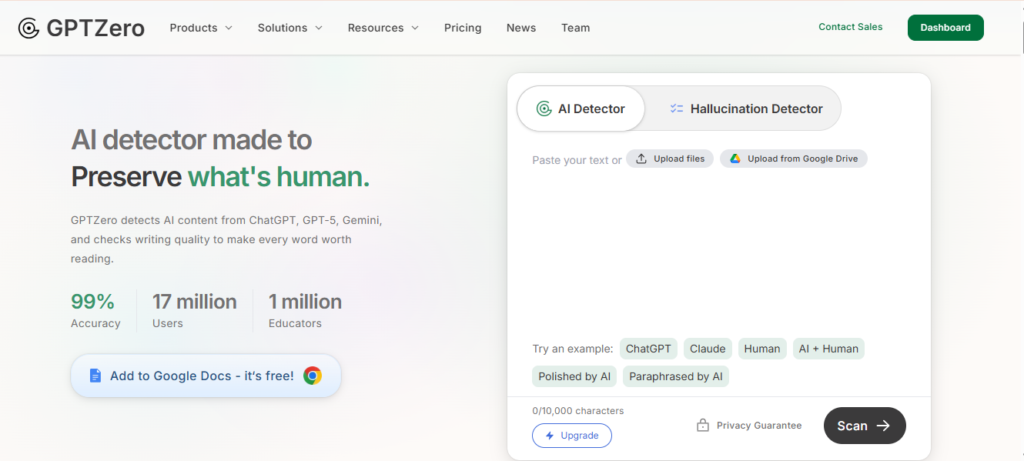
GPTZero’s accuracy depends heavily on the type of text being tested, and what you plan to do with the result. GPTZero’s own benchmark claims high accuracy, but the number it reports versus individual test results and the use cases that affect real students are very different.
GPTZero handles raw AI output reasonably well. But it is considerably less reliable on the formally written, grammar-polished, citation-heavy text that describes most legitimate student work. In 2025, a French entrepreneur enrolled at Yale School of Management sued the university for mismanagement and discrimination after a wrongful suspension tied to GPTZero’s AI detection findings. In this review article, we will find out how accurate GPTZero is, how the tool works in real use cases, what its failure points are, and what “accurate enough” AI detection for academic decisions should actually include.
Short answer: GPTZero works on clean AI output. However, real academic submissions are rarely clean or unedited, and this is where the tool becomes less reliable. On formally written human text, ESL writing, mixed-origin submissions, and paraphrased content, it shows high false positive rates. So, you must treat it as a screening signal and use your own knowledge and an academic-calibrated AI detector like Proofademic before making any final verdict.
Quick verdict on GPTZero for students, educators, and institutions
The legal risk of using generic AI detectors and acting on false positives may hurt your institution’s academic integrity.
For students
A GPTZero flag is a probabilistic signal that your writing shares statistical patterns with AI-generated text, not a verdict. If your work is flagged wrongfully through GPTZero, run your submission through an academic-first AI checker like Proofademic to get a sentence-level insight on the underlying cause.
For educators
Never use GPTZero as a final proof of academic dishonesty. A flag should never trigger a consequence on its own. GPTZero’s own documentation states that “results should not be used to punish or as the final verdict.”
For administrators
Your academic integrity policy needs to define evidentiary standards before a detector flag can be acted on, and it needs to include an appeal process with documentation requirements.
What GPTZero can accurately do and where it fails
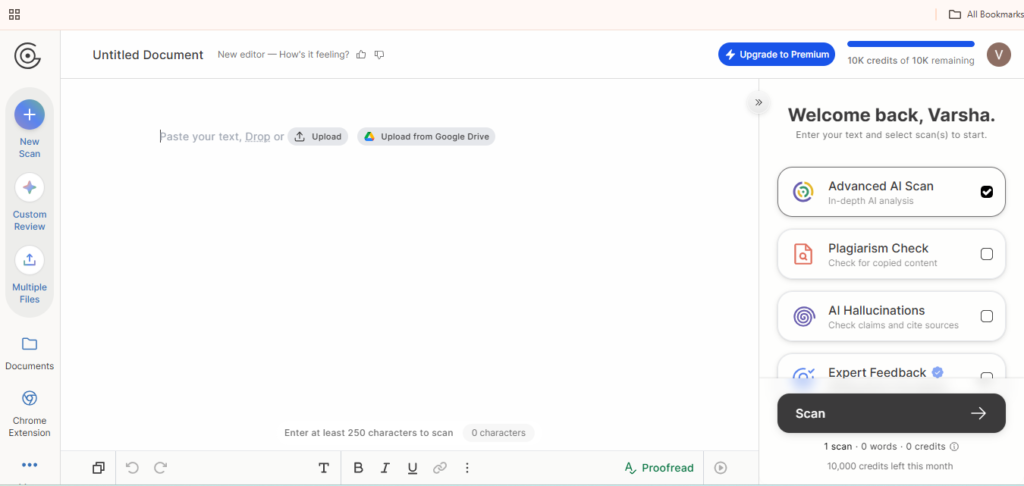
GPTZero’s scale has not resolved its core limitations. Understanding exactly what the tool is reliable for and where it stops is more useful than any headline accuracy number.
What can GPTZero do reliably
GPTZero performs well on raw, unedited AI output, which is rarely what real student submissions look like.
What GPTZero cannot do accurately
GPTZero is a generic AI detector and is not reliable enough for academic settings. If any institution or educators makes decisions based on the tool’s AI score only, it can result in false accusations, damage the institution’s integrity, and even lead to lawsuits like the Yale university case.
- It detects statistical patterns associated with AI writing, not authorship itself or proof that AI was used at all.
- Cannot reliably distinguish human writing from AI writing when the text is written in a formally academic style, grammar-tool-edited, or written by a non-native English speaker. False positive rates in AI detection rise sharply in different scenarios.
- Struggles to detect AI content that has been processed through a paraphrasing tool. Can easily flag AI samples as human-written after paraphrasing.
- Cannot produce the evidentiary standard that a formal academic integrity process requires. A percentage score, with or without sentence highlights, is just a signal, not documentation of authorship.
Test: we put GPTZero to work on real academic use cases
Most GPTZero accuracy test benchmark datasets are curated for clean, unedited AI output versus clearly human-written general prose. But real academic submissions are formally structured, have been grammar-checked, and have undergone many rounds of editing before submission.
To reliably check how accurate GPTZero is, we tested it on 3 essays and 3 creative writing pieces (AI-generated, human-written, paraphrased). Here are the results we found:
GPTZero accuracy test for academic essays
We gathered one fully AI-generated, one fully human-written, and one AI-generated but humanized content piece for testing the tool.
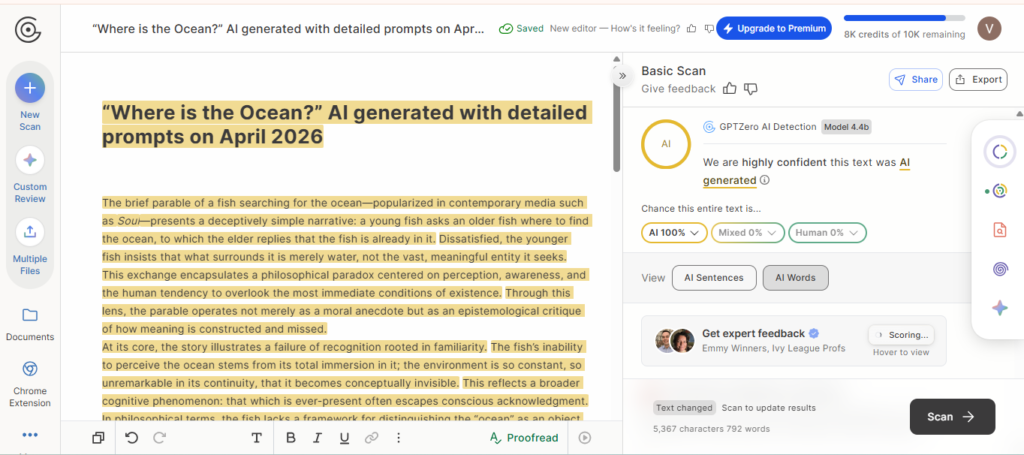
Test 1 – Fully AI-generated
GPTZero caught the raw AI sample, the easy case. 100% AI on text that no student would submit unedited.
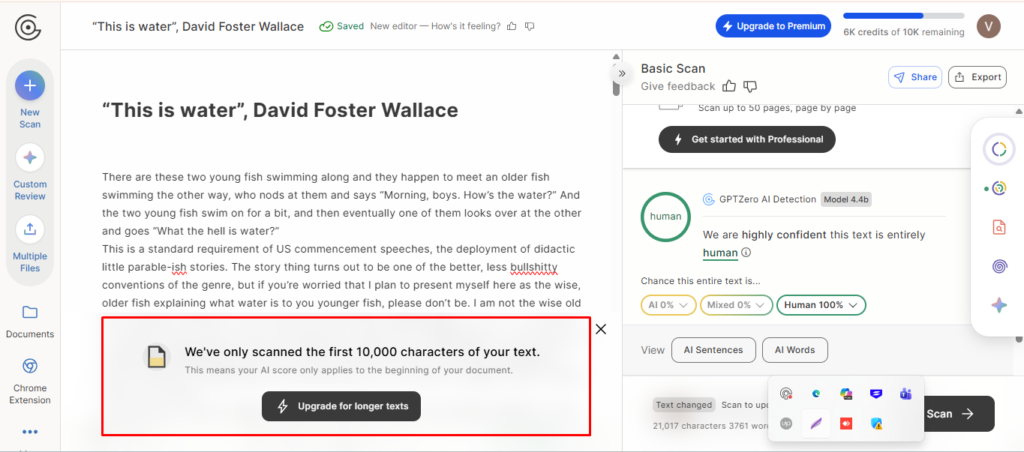
Test 2 – Human Written
GPTZero cleared the human sample on the first 10,000 characters. Submissions above that limit are only partially reviewed without a paid subscription, which is a real blind spot on dissertations and long-form research.
Test 3 – AI text then paraphrased
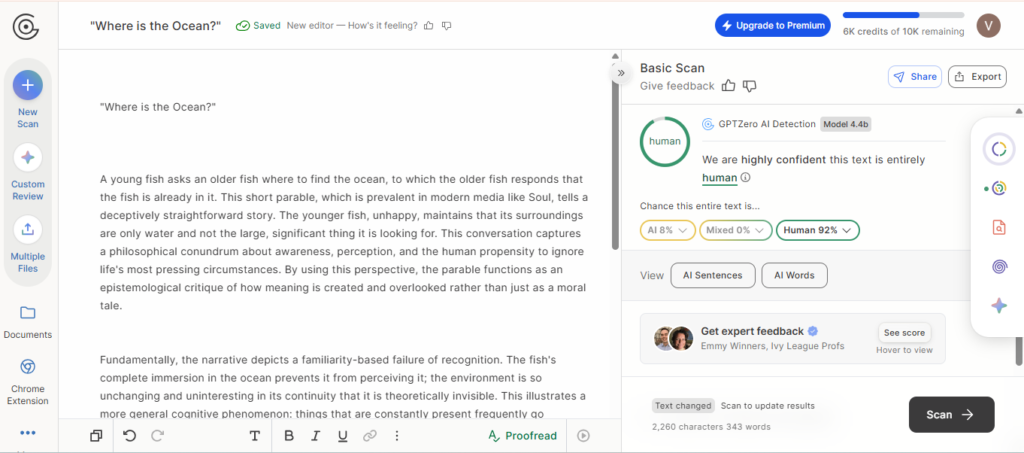
We paraphrased the AI text from Test 1 using a generic paraphrasing tool and human editing. It took only 2 minutes, and the results dropped from 100% AI to 8% AI (92% human).
GPTZero accuracy test for creative writing
Next, we tested the tool on three creative writing samples – one fully AI-generated, one fully human, and one humanized.
Test 1 – Fully AI creative content
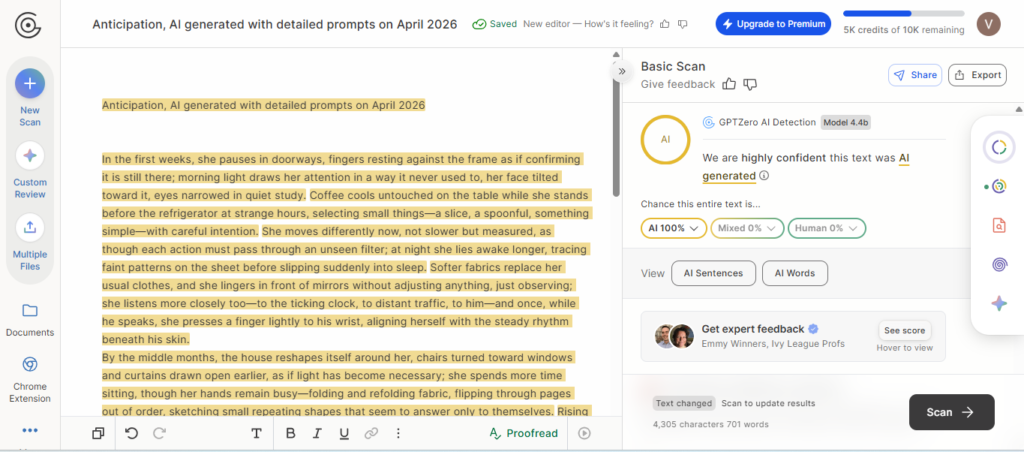
The results showed 100% AI-generated content. Like the essay test, this is the easy case, raw model output with no editing.
Test 2 – Fully human content
CreativeWriting|Human|TheVisitor
GPTZero cleared the human sample at 100% human. Another easy case.

Test 3 – Mixed content (AI paraphrased)
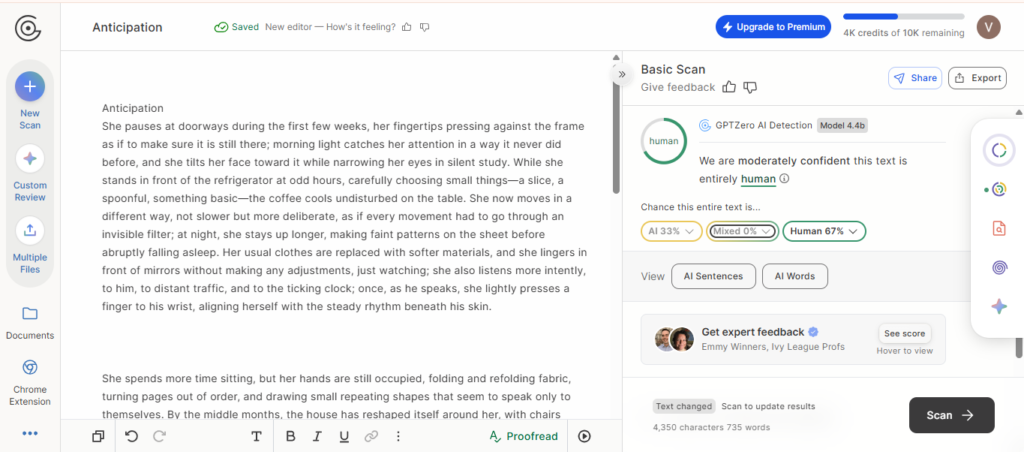
We used the same method as we did for the mixed essay test, and the results were 67%, human. It is worth noting that the tool flagged 33% sentences as AI and 67% as human, but there is no flag for mixed sentences (the whole content is mixed).
- GPTZero works well on direct AI responses or human-written content. But if a student uses even some basic paraphrase tools, they can easily trick the system. It took us less than 2 minutes to paraphrase the AI text, and the results were highly human. If a tool can be so easily tricked, it is not the right choice for academic integrity.
Is GPTZero accurate? What the test showed
Our stress test revealed a clear pattern in GPTZero AI detection: GPTZero performed well on the fully AI-written and fully human content in our stress test, but its accuracy breaks down significantly the moment any light editing or paraphrasing is introduced. For academic integrity purposes, this is precisely where the tool needs to be most dependable, and GPTZero isn’t.
Across both essay and creative writing samples, GPTZero accuracy rate showed 100% AI-generated content and correctly cleared 100% human-written content. On the surface, this looks impressive. But these are the easiest cases to get right.
When we paraphrased the AI-generated essay using a basic paraphrasing tool, the AI probability dropped from 100% to just 8%. For the creative writing sample, the same method produced a result of 67% human. In both cases, the tool was effectively tricked by minimal intervention in just 2 minutes. No advanced prompt engineering, no specialized evasion techniques, we just used a standard paraphrase pass that any student could perform.
Key limitations of GPTZero found in the test
Beyond the core accuracy issue, the stress test surfaced some additional limitations worth noting for institutions evaluating GPTZero for academic use:
- Character limit on free tier. GPTZero only analyzes the first 10,000 characters of a submission without a paid subscription. Longer academic papers, dissertations, research essays, and extended reports are only partially reviewed, which creates blind spots and a false sense of security.
- No mixed-content flagging. When content is a blend of AI-generated and human-written text, which is a realistic scenario where a student drafts in AI and edits manually, GPTZero labels individual sentences as either AI or human but provides no flag for mixed-origin content at the document level.
- Paraphrasing is a trivial bypass. The ease with which detection scores shifted from 100% AI to 92% human in under two minutes is clear proof that GPTZero offers limited resistance to even the most basic evasion methods. In an academic environment where students are aware of AI detectors, this is a significant liability.
- Confidence scores can mislead. High confidence on clean samples may give administrators a false impression of reliability. The tool performs well in controlled, clean-text conditions but has not been calibrated for the kind of edited, grammar-checked, multi-draft writing that characterizes real academic submissions.
Proofademic: a more accurate GPTZero AI detector alternative
GPTZero is trained on general content like news, blog posts, and other broadly available text. This broad dataset is valuable for recall on pure AI output, but it also means the model is calibrated for the average of all those text types, not specifically for academic writing.
Proofademic is calibrated specifically for academic writing: trained on essays, research papers, dissertations, and formal academic documents. That calibration difference matters more, especially when a student’s future depends on the submission score.
- Sentence-level analysis: Rather than producing a single document-level percentage, Proofademic sentence-level detection identifies which specific sentences are showing AI-associated patterns.
- Paraphrase shield: AI content processed through paraphrasing tools drops dramatically in score on most generic detectors. Proofademic’s Paraphrase Shield is designed to detect AI patterns even after paraphrasing.
- False-positive controls: Academic-context calibration means that formal academic prose, citation-heavy writing, and non-native English patterns do not trigger false positive flags at the same rate as they do in generic detectors.
- Reporting and export for cases: Every scan produces a documentable, exportable report showing which sentences were flagged and why. This is the audit trail that any formal academic integrity process requires.
- Pre-submission check for students: Students can run their own work through Proofademic before submission to identify which passages might draw scrutiny.
- Free 3-day trial: Educators and administrators can evaluate the platform with full functionality on real submissions before committing to a paid Proofademic plan. No credit card required.
| GPTZero | Proofademic |
|---|---|
| Catches raw AI output which is the easy case. It misses the cases that matter for academic integrity decisions. | A specialized GPTZero alternative for academic integrity focused on fairness and sentence-by-sentence scoring, providing reviewable evidence rather than a headline percentage. |
Is GPTZero’s AI detector free?

No. GPTZero offers a capped free tier. Paid plans run from $23.99 to $45.99/month as of January 2026. Given the accuracy gaps documented above, the value question is not what you pay, it is what you get for it.
Can you trust GPTZero for academic decisions?
No, GPTZero is not reliable enough for academic decisions on its own.
Academic integrity decisions carry real consequences, including failed assignments, disciplinary records, and, in serious cases – expulsion. GPTZero does not work for academic decisions. The test results above prove it.
A tool fit for academic submissions needs to perform accurately across the full spectrum of real submissions, not just pure AI or clearly human writing. It needs a low false positive rate so it doesn’t flag genuine student work, and a low false negative rate so it doesn’t clear AI-assisted submissions. GPTZero struggles with both if any editing or paraphrasing is involved. So on its own, GPTZero cannot be trusted to make any decision for student submission checking.
For a side-by-side ranking of GPTZero alongside other tools, see our best AI detectors review.
TL;DR
False positives in academic AI detection are no longer a minor issue. When generic detectors misclassify edited, ESL, or formally written submissions, the result can be wrongful accusations, damaged student trust, appeals, and even legal risk for institutions similar to the Yale university wrongful accusation case.
Our testing showed how easily GPTZero AI scores changed after basic paraphrasing and light editing. That makes generic AI detectors difficult to rely on in real academic integrity workflows where accuracy and evidence matter most.
Proofademic is built specifically for academic submissions, with sentence-level analysis, academic calibration, and reporting designed for educational review processes, not just broad AI scoring. Before your institution acts on AI flags, review submissions with Proofademic and see what academic-focused analysis reveals.
FAQs
How accurate is GPTZero?
GPTZero is most accurate on unedited, straight-from-the-model AI output. Its accuracy on formally written human text, mixed-origin submissions, and ESL writing is lower and context-dependent.
Why does GPTZero flag human-written text?
AI detection tools like GPTZero work on the principle of AI pattern recognition around low perplexity and low burstiness. Predictable sentence structure, consistent academic register, controlled vocabulary, and dense citation use all produce the same signals as AI output.
What is GPTZero’s false positive rate?
The false positive rate reported by GPTZero (0.24%) reflects vendor-curated testing conditions. However, independent testing on different use cases gets different results and shows very high false positive rates on paraphrased or well edited student submissions.
Does GPTZero work well for ESL students?
No. GPTZero or any other generic AI detector does not work very well for ESL students. A 2023 Stanford study (Liang et al.) tested seven AI detectors, including GPTZero, on TOEFL essays by non-native English speakers. Across the seven detectors, an average of 61% of those essays were misclassified as AI-generated. To maintain fair results, always use an academia specific AI detector like Proofademic.
What should you do if GPTZero flags your work incorrectly?
Export your Google Docs or submission version history immediately, as this is your most valuable evidence. Gather any drafts, notes, and research materials that show your writing process. Offer to explain your argument orally to your instructor. Ask for a meeting before any formal process begins.
Is there a more accurate AI detector than GPTZero?
Yes. Academic AI detection tools like Proofademic are calibrated on academic essays, research papers, and formal student writing, which addresses the primary failure mode in general-purpose detectors. Its sentence-level output also provides the specific, documentable evidence that academic integrity processes require, rather than a document-wide percentage that cannot be acted on fairly.