Key Takeaways
- Grammarly AI checker catches fully AI-generated and fully human-written text reasonably well. But its accuracy degrades sharply in heavily edited academic submissions.
- AI content that scored 95% dropped to 16% after basic paraphrasing. If bypassing detection is that simple, Grammarly’s AI detection is not ideal to maintain academic integrity.
- No sentence-level output means no actionable review. Getting the AI percentage score without knowing which particular lines makes targeted follow-up and content improvement almost impossible.
- A low Grammarly score is not cross-tool clearance. Students who treat a low Grammarly score as pre-submission safety may run into policy infringement risks.
- Use Grammarly to correct grammar, clarity, tone, and readability. For academic integrity assessment, a purpose-built AI detector like Proofademic with sentence-level analysis, consistent outputs, and academic calibration is the appropriate choice.
Grammarly AI checker and a purpose-built academic AI detector are doing fundamentally different jobs, even when they return similar-looking percentage scores.
Students primarily use this tool to catch grammar mistakes and clean up writing before submission and in 2024, Grammarly added an AI detection feature to its suite. But the question is – is Grammarly’s AI detection accurate for academic integrity?
We tested both the free and paid versions of Grammarly AI detector on academic essays and creative writing. After testing on different use cases, we prepared a fair academia-first Grammarly AI checker review for students, professors, and integrity officers.
Short answer: Grammarly AI checker is not reliable enough for academic integrity use. It performs reasonably on straightforward text but fails when students use basic paraphrasing tools, and it cannot identify which specific sentences triggered a flag – making its results indefensible in formal integrity processes.
What Grammarly’s AI checker actually does
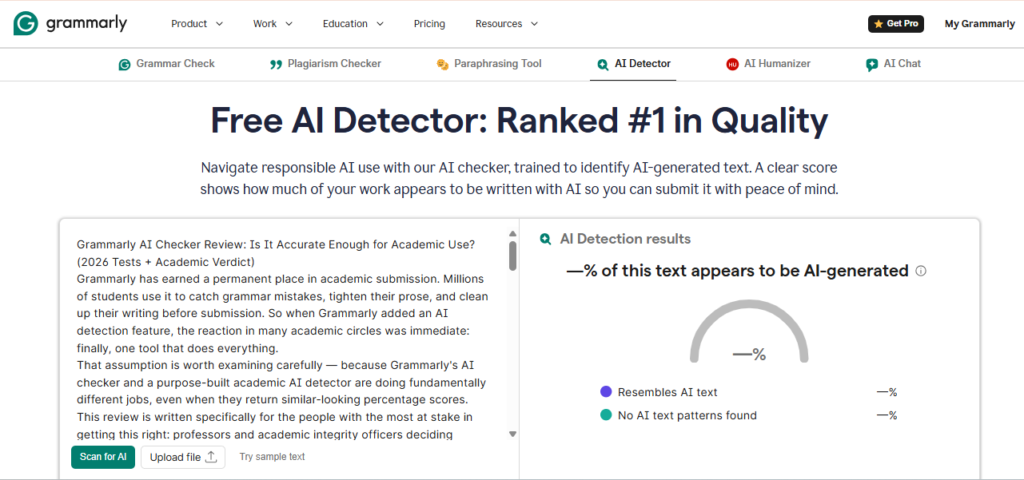
Grammarly’s AI detection feature works by running submitted text against a machine-learning model trained on human-written and AI-generated content. It analyses patterns (syntax, language structure, phrasing tendencies) and returns a single percentage score indicating how much of the text it believes may be AI-generated.
Grammarly itself is transparent about the limitations of this output. Their support documentation states that the score “should not be used as an objective source of truth, as AI detection of any kind can be prone to errors.” They describe it as an “averaged estimate” rather than a definitive conclusion, and the tool explicitly does not identify which sentences or sections triggered the result.
When is Grammarly worth it and when is it not the right tool?
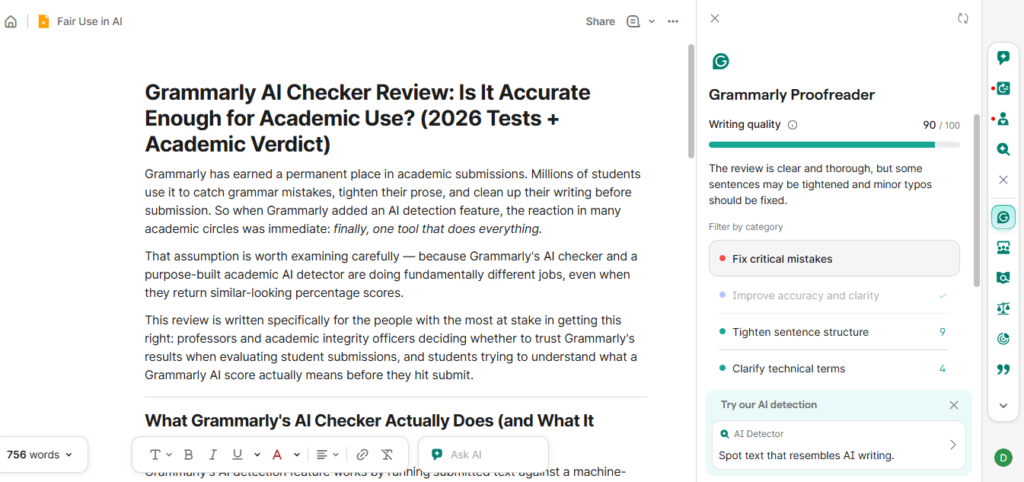
Grammarly is a genuinely useful writing assistance and editing tool. But it doesn’t make it a pre-submission check for academic submissions.
Where Grammarly adds value
- Grammar correction, spelling, and punctuation: Grammarly remains best-in-class here
- Clarity and readability suggestions – particularly useful for non-native English writers
- Tone detection for different contexts (academic, formal, conversational)
- Citation assistance, depending on the plan
- Writing confidence for students who are anxious about surface-level errors
Read this blog to know does Grammarly count as AI to ensure you always stay on the positive side of institution policy.
Where Grammarly is not the right tool
- As a pre-submission clearance check – It’s not designed for an academic integrity check, and treating it this way creates a false sense of security
- As an instructor’s primary tool for integrity assessment. The absence of sentence-level evidence and the documented inconsistency across sessions make it unsuitable for this purpose
- In any context where the result needs to be explainable, documented, or defensible
The risk for students isn’t just that Grammarly might miss AI content; it’s that they might rely on a low score as reassurance when a different tool, using a different model, might return a very different result. Grammarly’s score is a snapshot from one model at one moment; it’s not a verdict. Always use an academia first AI detector like Proofademic to avoid false positives and maintain academic integrity.\
Stress test: how accurate is Grammarly AI checker in real use?
One thing that we found on Grammarly AI detector reviews online and in our testing is that its detection scores are accurate for normal writing. Grammarly may fluctuate in certain complex academic niches and its algorithms are easy to trick with minor editing. We tested two AI-generated, two totally human-written, and two paraphrased (minor changes) essays and creative content pieces to check the Grammarly ai detection academic use accuracy. Here are the results:
Use case 1 – Academic essays
We gathered three academic essays and checked them in the Grammarly AI detection tool:
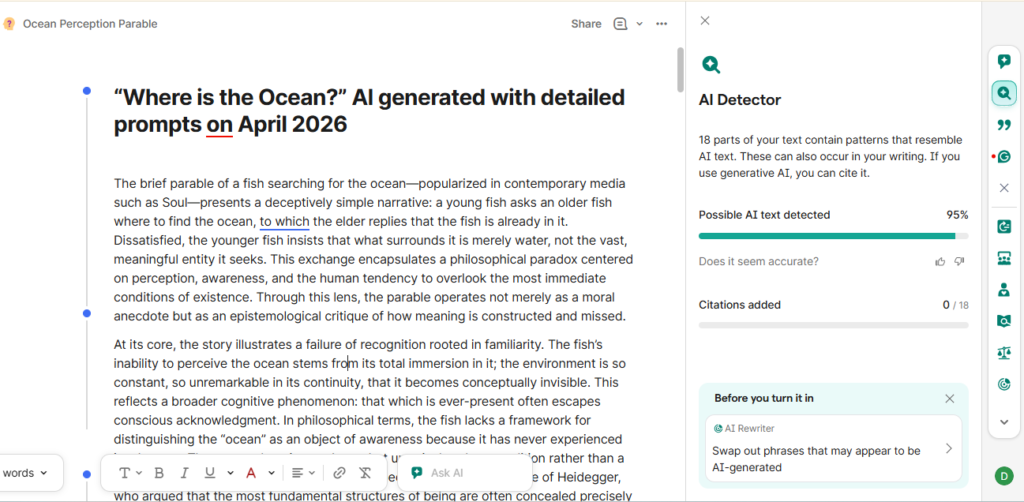
Test 1A – Fully AI-generated text
For the fully AI-generated text, the result was 95% AI detected, which is accurate. So, the chances of false negatives are low.
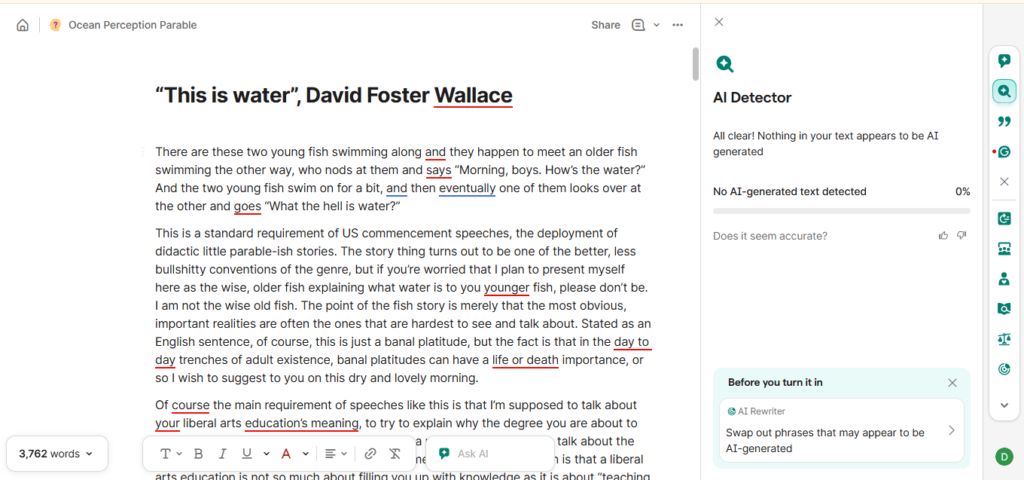
Test 1B – Fully human written text
For the fully human-written text, the result was 0% AI detection, which eliminates the likelihood of false positives.
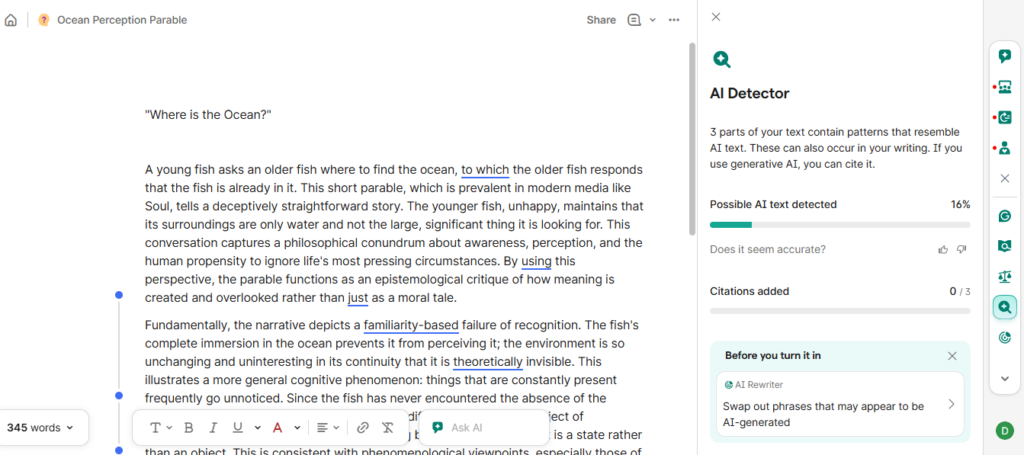
Test 1C – Edited AI-generated text
Now comes the real test. AI has evolved a lot, and paraphrasing tools like a standard paraphrasing tool can easily help students pass most generic AI detectors. For this test, we paraphrased the same AI-generated text from Test 1A using a standard paraphrasing tool and ran it through Grammarly AI checker. The result was 16% AI detected.
Use case 2 – Creative writing
Next, we tried the Grammarly AI detector using creative content pieces. Here are the results:
Test 2A – AI-generated creative blog
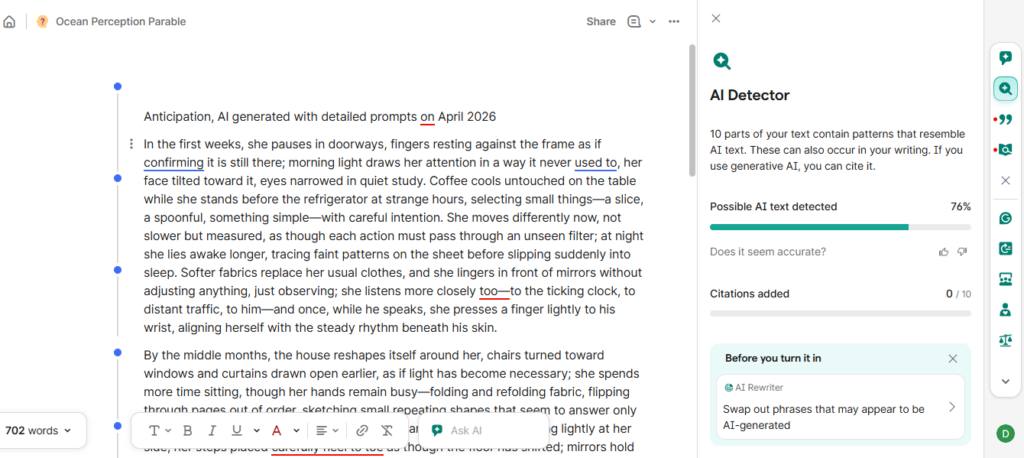
We tested a fully AI-generated creative content piece and the result was 76%. This is a heavy AI score but the original text was fully AI-written.
Test 2B – Human-written content
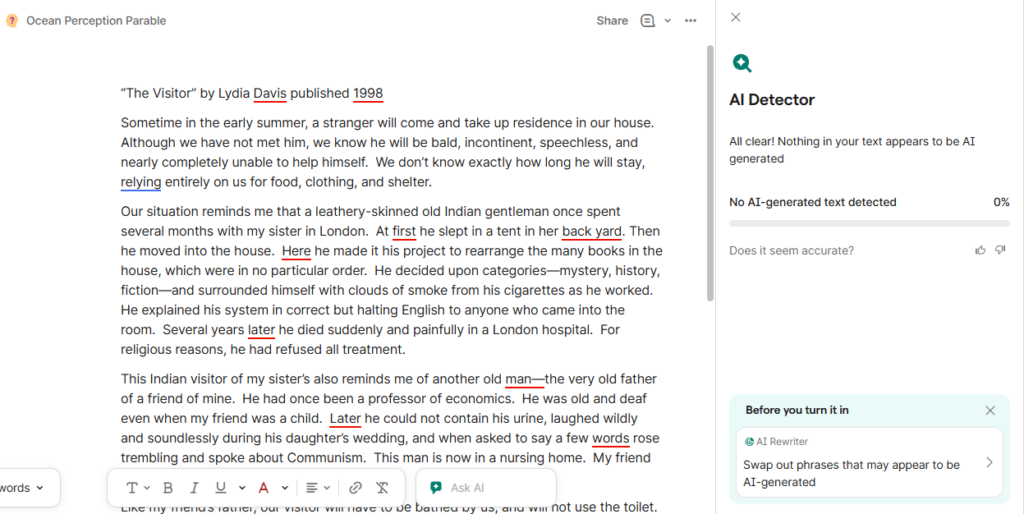
For the human-written piece, Grammarly returned 0% AI score, which is accurate.
Test 2C – AI text but paraphrased
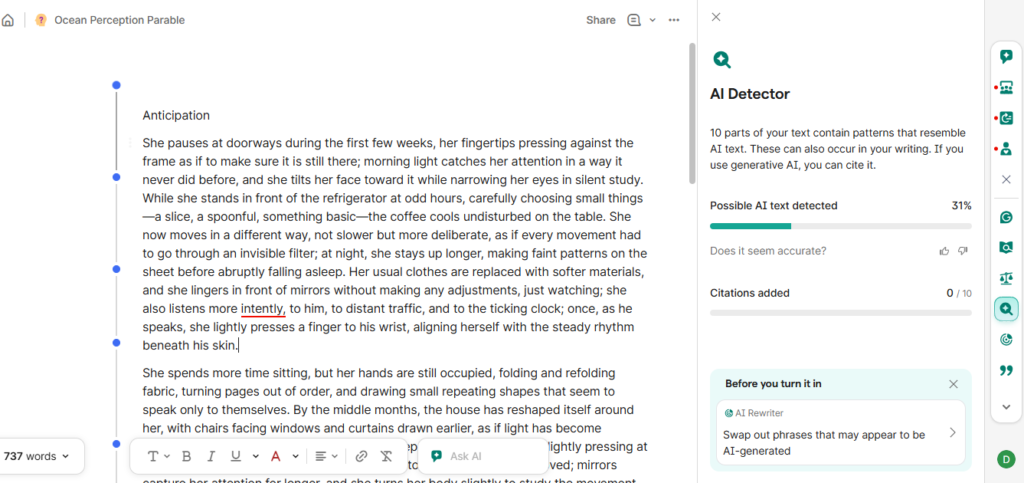
The result of paraphrased creative content was similar to the edited essay test. The Grammarly AI checker showed only 31%, and the paraphrasing process only took 2 minutes.
What Grammarly AI detector did right and where it failed the stress test
The results of the Grammarly AI detection test were not uniformly bad. You just need to ensure that you are using the tool in the correct use case. Here is a quick recap:
What it did right
Grammarly performed well at the extreme tests. Fully AI-generated academic text returned a 95% detection score, and fully human-written text across both categories came back at 0%. That bidirectional accuracy matters means the tool avoids the two most damaging failure modes – missing obvious AI content and falsely accusing authentic writers. The creative writing result for pure AI content (76%) was lower than ideal but still clearly flagged. For a student doing a quick self-check on a draft they genuinely wrote, that 0% result offers meaningful reassurance. It is still not a verdict, but a reasonable signal.
Where does it fail
The paraphrasing tests are where the stress test exposes the real problem with Grammarly AI detector. A fully AI-generated essay, processed through a standard paraphrasing tool in roughly two minutes, dropped from 95% to 16%. The creative equivalent fell from 76% to 31%. These reductions represent the difference between a clear AI usage flag and a wide percentage score that most instructors would not act on. Any detection framework that can be defeated by a two-minute edit isn’t enforcing academic integrity; it’s enforcing a rule that only applies to students who don’t know the fair AI use policies.
No sentence-level evidence: the biggest limitation of Grammarly AI checker
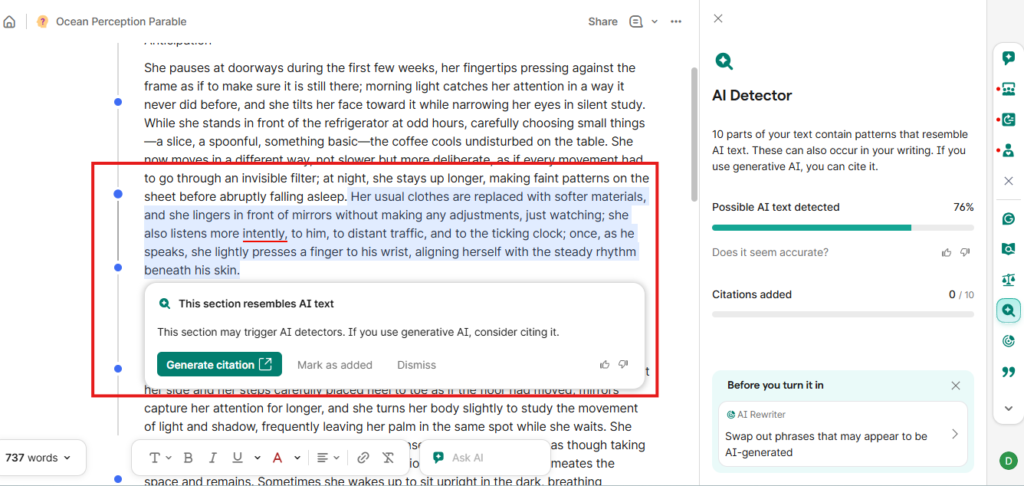
The biggest limitation and feature gap that separates Grammarly AI checker from tools designed specifically for academic integrity like Proofademic is the absence of sentence-level analysis.
Grammarly tells you a percentage and flags whole sections of the content as “This section resembles AI text”. You can generate citations quickly, but it does not tell you which sentences and what signals are driving that percentage. For writing improvement, Grammarly is fine. But for academic integrity review, sentence-level evidence is the minimum standard for a fair and explainable process.
Here’s why it matters in practice:
- Auditability – If a professor uses a detection result in a formal integrity process, they need to be able to show what was flagged and why. A document-level percentage doesn’t provide this. Sentence-level flagging does.
- Student feedback – When a student’s work is flagged, the educationally appropriate response is to discuss the specific content in question to ask the student to explain their thinking and walk through their sources. A wide percentage score makes this conversation almost impossible to have productively.
- Avoiding overreach – Without sentence-level evidence, professors reviewing flagged work face a binary choice: escalate the whole paper or dismiss the concern. Sentence-level AI detection allows a more nuanced middle path – identify the specific passages, ask targeted questions, and make a proportionate judgment.
- Mixed authorship documents – Most student work today isn’t purely human or purely AI, it’s somewhere in between. Sentence-level detection is the only way to understand where in a document AI involvement is concentrated. As per our test results, Grammarly AI detector fails to identify paraphrased or mixed content mostly.
Is Grammarly AI checker accurate enough for academic use?
No AI detection tool is 100% accurate and using generic detectors trained around normal writing styles can create false positives in academic settings. Always use an academia-first AI checker to ensure fair results and maintain integrity.
For student self-checking (low stakes)
Grammarly’s AI detector can serve as a rough directional signal for student submissions. If a student wants a quick sense of how AI-heavy their draft is, it’s a reasonable starting point as long as students understand they’re getting an estimate, not a clearance.
For instructor trials (medium stakes)
Grammarly’s output is limited by the absence of sentence-level analysis. Without knowing which sections triggered the score, instructors can’t prioritise their review efficiently or ask meaningful follow-up questions. A dedicated tool with sentence-level flagging is significantly more useful here.
For formal integrity decisions (high stakes)
Grammarly is not appropriate as a primary tool for formal academic integrity decisions. The results are explicitly non-definitive by Grammarly’s own description, the score can vary across sessions without any change to the text, and there is no sentence-level evidence to support a fair, explainable, and documentable process.
Proofademic: the best Grammarly AI checker alternative for academia
Just like any other generic AI detection tool, Grammarly AI detector is also trained on normal write-ups, which may result in inaccurate results in academic submissions.
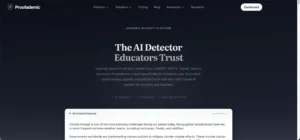
Proofademic was built around unique patterns of academic writing. It helps institutions evaluate the integrity of student submissions with fairness, clarity, and evidence that can actually be acted on. The distinction matters because the requirements of academic integrity review are specific in ways that general-purpose writing tools weren’t designed to meet.
- Sentence-level analysis: instructors can see exactly which parts of a document triggered AI signals, not just a document-wide percentage
- Consistency: the same document returns reliable results across sessions, not varying as the model updates. Proofademic has 99.8% detection accuracy for academic workflows
- Explainability: gives reason behind every flag so results can be communicated to students, documented in integrity processes, and defended if challenged
- Calibration for academic writing: trained on essays, research papers, and academic documents so formal academic phrasing, ESL patterns, and citation-heavy text don’t routinely trigger false positives.
- Batch Scan: Institutions can easily scan multiple student submissions with the Batch Scan feature in one go. It saves time and ensures fairness in scoring.
For student self-checking, Grammarly can serve as a rough early signal (not a final verdict). But for instructors making judgments about student work, and for institutions building AI detection into their integrity workflows, a purpose-built tool like Proofademic is the appropriate choice.
The practical difference between Grammarly and Proofademic becomes clear in a side-by-side comparison on the same academic document. Grammarly returns a single percentage with a general section-level flag. Proofademic returns a sentence-by-sentence breakdown: each sentence receives an individual AI probability score and. a color-coded confidence indicator. For an instructor reviewing a suspicious submission, that difference is the gap between a conversation they can have and one they cannot.
Proofademic also addresses the bypass problem directly. In this review’s stress test, a standard paraphrasing tool dropped Grammarly’s detection from 95% to 16% on an academic essay and from 76% to 31% on creative writing. Proofademic’s Paraphrase Shield is built specifically for this scenario – it identifies AI-written content even after paraphrasing, which is the exact gap that makes Grammarly unreliable for academic integrity. For institutions, that is not a minor feature difference; it is the difference between a tool that can be gamed in two minutes and one that cannot.
Proofademic pricing starts at $0 for a 3-day trial (1,000 words, no credit card required), with annual plans from $99 for individual users up to $300 for professional use. Batch Scan for multi-submission review is included across paid tiers.
Is Grammarly AI checker free? Pricing plan comparison
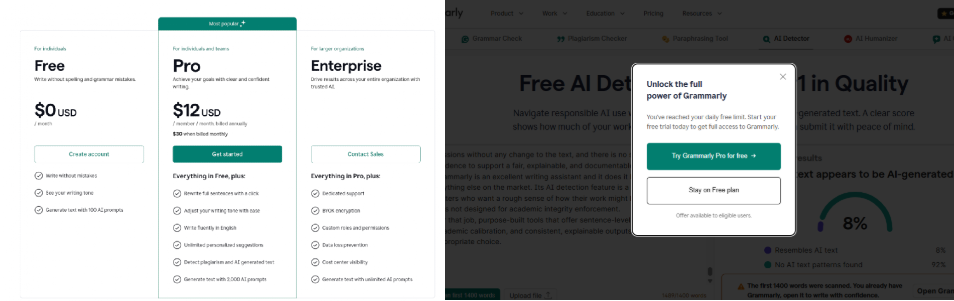
No. You cannot have unlimited access to Grammarly’s AI detector on the free plan.
Without signing up, you get a limited one-time check with a word cap. After signing up on the free plan, daily AI detection checks are restricted in number and word count per check – you get a percentage score only, and section-level flags require a Pro subscription.
The Grammarly Pro plan starts at $12/month (billed annually) with an extended usage limit and additional features like sentence rewrite, plagiarism & AI checker, and more. However, this plan covers only one user. For multiple users and to check bulk assessment in academic settings, you might soon hit the pro plan cap and have to buy the enterprise plan.
Conclusion
Grammarly is a writing assistance and grammar correction tool. Its AI detection feature is fine for generic and direct writings but it may fall behind in accurately detecting complex niches and edited content.
The verdict of the Grammarly AI checker review is not that it fails the test. But it was built for a different job and using it for academic integrity creates a false sense of security for students and an indefensible evidentiary position for institutions.
For how Grammarly performs against the other major AI detectors on accuracy, paraphrase resistance, and academic fit, see our best ai detectors review.
Frequently Asked Questions
Is Grammarly’s AI checker accurate enough for academic use?
For low-stakes self-checking, it can provide a rough signal. For instructor-level review or formal integrity decisions, it falls short, primarily because it returns only a document-level percentage with no sentence-level breakdown.
Can Grammarly detect AI-written essays and research papers?
It can detect some AI-written content, but with notable inconsistency. Fully AI-generated text doesn’t always score as high as you might expect, and paraphrased AI content often scores considerably lower. Grammarly itself acknowledges that results should not be treated as definitive.
Does Turnitin catch text that passes Grammarly’s AI checker?
Turnitin and Grammarly use entirely separate AI detection models with different thresholds and calibrations. A low Grammarly score does not predict a low Turnitin result: the two tools are not interchangeable, and a result from one says nothing reliable about the other.
How does Grammarly’s AI detector compare to Proofademic?
Grammarly provides a single document-level percentage with no explanation of which sections were flagged. Proofademic offers sentence-level analysis specifically calibrated for academic writing, giving instructors the explainable, actionable evidence needed for fair integrity review.
What are the limitations of Grammarly’s AI detection for professors?
The main limitations are the absence of sentence-level flagging, inconsistent results across sessions, and a tendency toward false positives on formal academic phrasing and ESL writing. Grammarly itself states the score is not a definitive conclusion, making it unsuitable as evidence in formal integrity processes.
Can students use Grammarly’s AI checker to self-check before submission?
Only as a rough signal, but not as a clearance mechanism. A low Grammarly score does not mean the work won’t be flagged by other tools, and students who treat it as a final check are taking a risk of revaluation. Use a dedicated AI detector like Proofademic for more accurate results.
Will my paper get flagged if I use Grammarly?
Using Grammarly to edit your writing does not automatically cause AI detection tools to flag your work. However, if Grammarly’s AI writing features are used to generate or substantially rewrite content, that content may carry AI patterns that detection tools, including Grammarly’s own checker could flag.
Can someone tell if you used Grammarly to write or edit your paper?
Not directly. No detection tool flags Grammarly usage specifically. What tools detect are AI writing patterns in the text itself, not which tools were used in the process.
Is Grammarly worth it for academic use?
Grammarly is a useful writing assistance tool, but as an AI detection tool for academic integrity purposes, it’s not the right fit.
Is Grammarly the best AI writing and checking tool for students?
For writing improvement, Grammarly is among the best available tools. For AI integrity checking in academic contexts, especially for anything that may be used in formal review, a purpose-built academic AI detector with sentence-level analysis like Proofademic is a more appropriate choice.
Is Grammarly’s AI checker free?
Grammarly’s AI detection is available in limited form on the free plan, with daily checks restricted in number and word count. Full section-level breakdown requires a Pro subscription. For academic integrity purposes, a dedicated tool with unrestricted scanning is more practical.