Key Takeaways
- Short answer: for academic work, our top pick is Proofademic. It runs plagiarism and AI detection on the same submission and can scan a whole class at once.
- Free, web-only checkers are fine for a quick self-check. For graded work you want one that also searches academic journals and past student papers, since that is where most real plagiarism comes from.
- Most tools still miss paraphrased copying. Reword a source enough and an exact-match scanner will call it clean.
- A 0% score does not mean the work is original. AI-written text is not copied from anywhere, so it slips past plagiarism checks; catching it takes a separate AI scan.
- Do not read too much into one percentage. What counts as acceptable depends on the assignment and how much is quoted or cited, so look at what got flagged, not just the score.
- Running two separate tools gets old fast. A few platforms now do plagiarism and AI detection in one place, which helps when you are checking a whole class at once.
Quick recommendations: Top plagiarism checkers ranked
Choosing the best plagiarism checker means knowing what problem you are solving, not just which tool claims the highest accuracy. The ranked picks below are based on academic workflow fit, database coverage, and fair integrity process.
- Proofademic: Best overall for academic work. Pairs plagiarism detection with AI detection, risk-categorized reports, and batch scanning in one academic workflow.
- Turnitin: Best if your institution already runs it. Deep academic coverage and a student-paper repository, but locked behind an institutional license, with no individual access.
- Grammarly: Fine as a writing aid you already pay for. Its plagiarism check is web-only and shallow, not built for academic sources.
- Scribbr: Worth it for a one-off dissertation check. Uses Turnitin’s engine for individual access, but charges per document and has no batch option for teachers.
- Copyleaks: Consider it if multilingual coverage is your main need. Solid language support, though the free tier is thin and it leans on base-level detection for citation-heavy work.
- GPTZero: An AI-detection tool first. Plagiarism is a web-only add-on, so it misses academic-database sources.
- Quetext: A budget pick for student self-checks. DeepSearch catches some paraphrasing, but database depth is limited for high-stakes submissions.
- Paperpal: Built for researchers publishing in open-access venues. Limited coverage of paywalled journals and not made for classroom workflows.
- Smodin: A cheap multilingual option. Web-only scanning, and no real report without a paid plan.
- DupliChecker: Free and fast for a quick web triage only. No academic coverage, not for graded submissions.
Top 10 Plagiarism Checkers in 2026 Ranked
Our team evaluated and ranked the best plagiarism checkers based on their academic utility. We weighed benchmarks such as database depth, paraphrase-detection capability, report quality, false-positive behavior, and how completely each tool addresses the academic-integrity stack to fairly rank top plagiarism checkers. The table below provides a structured plagiarism checker comparison for a quick overview:
| Tool | Best for | Database coverage | Report export | Free option |
|---|---|---|---|---|
| Proofademic | Academic integrity (students, teachers, institutions) | Web + academic databases | Yes, PDF | 3-day trial |
| Turnitin | Institution-wide deployment | Journals, student-paper repository, web | Yes | No – institutional only |
| Grammarly | Informal pre-submission checks | Web-focused | No case-file export | Limited free |
| Scribbr | Dissertations & theses | Journals, student papers, web (Turnitin engine) | Yes | No – $19.95+/doc |
| Copyleaks | Multilingual detection | Web + academic sources | Yes | Limited |
| GPTZero | AI-focused educators | Web only | Basic | Limited free |
| Quetext | Student self-checks | Web + some academic | Color-coded | Limited free |
| Paperpal | Researchers / open-access | Web + open-access journals | Yes | Limited free |
| Smodin | Budget multilingual users | Web only | Basic | Trial (no report) |
| DupliChecker | Quick web triage | Web only | Basic links | Free |
1. Proofademic
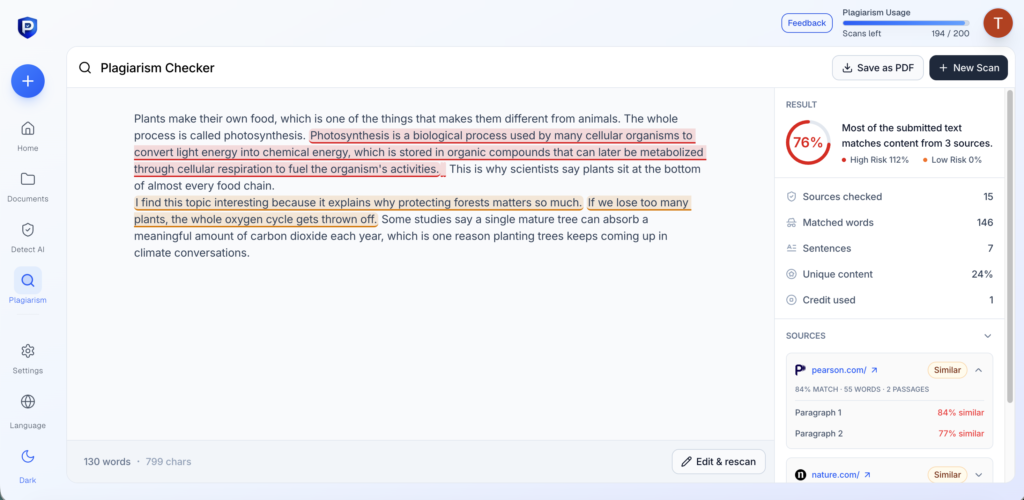
Proofademic is built specifically for students, teachers, and institutions. Unlike general-purpose plagiarism tools adapted for academic use, Proofademic’s plagiarism checker is designed from the outset for the specific requirements of scholarly writing and institutional integrity workflows, combining a plagiarism checker and AI detection in one platform.
✅ Strengths
- Academic-grade source coverage: Scans your text against billions of web sources and academic databases, and tells you exactly how many sources it checked; that is the coverage web-only tools miss on graded work.
- Risk-categorized results: Breaks matches into High Risk and Low Risk instead of one flat percentage, alongside a unique-content score, so you can see what actually needs a closer look.
- Source-level evidence: Every match ties back to a specific source with matched-word counts, so a flagged report supports a fair conversation with a student rather than just handing over a number.
- Edit, rescan, and export: Refine the text and re-run from the same screen, then export a PDF report. Submitted work is never stored, shared, or used to train AI.
- Plagiarism and AI detection together: Because AI-assisted writing and copying now overlap, you can run a separate AI scan on the same submission, closing the gap single-purpose plagiarism tools leave open.
⚠️ Limitations
- Institutional adoption is still growing; schools already locked into existing LMS-integrated contracts may need to evaluate a setup depending on their current configuration.
Database Coverage: Proofademic assesses and compares your submitted text against a very large range of online sources, web content, and academic databases.
Report Quality: Proofademic’s plagiarism report shows an overall match percentage, a unique content score, the number of sources checked, the total matched words, and a High Risk / Low Risk breakdown, with exportable PDF reports. The report quality is suitable for formal case documentation.
False-Positive Risk: Low, calibrated specifically for academic writing patterns, reducing misidentification of formal prose and cited material.
Pricing: A free 3-day trial is available, no credit card required. Paid plans start at $99/year, with custom institutional pricing available on request.
Who Should Use It: K-12 and higher-ed educators, academic integrity officers, students, and publishers requiring both plagiarism and AI detection in a single workflow.
Bottom Line: The one tool on this list built specifically for academia, pairing plagiarism
detection with built-in AI detection in a single workflow. No institutional contract required.
2. Turnitin
Turnitin is a widely deployed academic plagiarism checker in higher education. Offers considerable single-source academic coverage, along with LMS integrations.
✅ Strengths
- Has a student paper repository, which retains submitted papers and checks new submissions against them.
- Due to LMS integration, submissions route through existing gradebook workflows without additional steps.
⚠️ Limitations:
- Not accessible to individual teachers or students. It requires institutional or admin-level access, which places it out of reach for independent educators and students.
- Turnitin’s own guidance explicitly states that similarity reports (plagiarism scores) and AI scores should not be used as the sole basis for an integrity decision.
- Paraphrasing plagiarism checker performance on heavily edited or AI-paraphrased content, as well as on non-English submissions, has been noted to fluctuate.
Database Coverage: Academic journals, student paper repository, web archive.
Report Quality: Highlighted passages with similarity breakdown by source.
False-Positive Risk: Moderate. Correctly cited quotations and common academic phrases can generate similarity matches that require careful interpretation.
Pricing: Institutional licensing only; individual subscriptions for educators or students are not available.
Who Should Use It: Universities and districts with existing contracts and established LMS infrastructure. For institutions evaluating alternatives, looking into the best Turnitin alternative guide will help you.
Bottom Line: Provides academic database coverage but is inaccessible without an institutional contract, and it is limited to users who specifically require the student paper repository.
3. Grammarly Plagiarism Checker
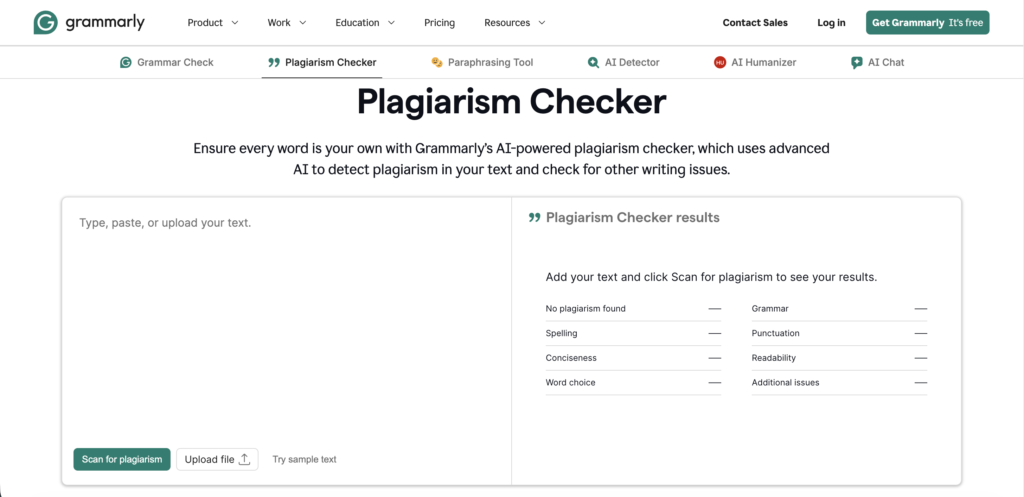
Grammarly is a writing assistant platform that includes plagiarism detection as part of its premium subscription. Its primary product is grammar, style, and clarity feedback. The plagiarism detector is an add-on capability within that workflow, not a standalone academic integrity tool.
✅ Strengths
- Integrated into a writing workflow that many students already use, checking plagiarism while editing is convenient for informal pre-submission use.
- Clean interface with immediate results; no separate platform to navigate.
⚠️ Limitations
- Primarily a writing assistance tool and may lack the depth required for academic plagiarism checks.
- Web database priority, limited access to academic journals, paywalled sources, or student paper repositories; misses the sources most relevant to academic misconduct in higher education.
- The report is document-level; it is not designed for formal integrity case documentation.
Database Coverage: Webpage-focused, significant gap for academic submissions.
Report Quality: Source highlights within the document; not exportable in a format designed for case files.
False-Positive Risk: Low on verbatim web content; limited coverage means some genuine plagiarism is missed rather than incorrectly flagged.
Pricing: Free detection available with a limited word count.
Who Should Use It: Students doing informal pre-submission checks on web-sourced content only. Not for research papers, dissertations, or any submission where academic journal coverage matters.
Bottom Line: Useful for quick informal checks; not appropriate as a primary academic integrity tool where database depth and evidence quality are required.
4. Scribbr
Scribbr is a student-facing academic services platform that uses the Turnitin detection engine for its plagiarism checker. This gives individual students access to Turnitin-quality database coverage but on a pay-per-document basis.
✅ Strengths
- Large database access is available to individual students who do not have access to institutional tools.
- Report interpretation guidance is designed for students ( but not for administrators).
⚠️ Limitations
- Operates on per-document pricing. Even for a small document, it costs $19.95+ per check, which can be expensive for students who check multiple drafts over the semester.
- It is built for single plagiarism checks only. No batch processing for teachers.
Database Coverage: Academic journals, publications, and the web.
Report Quality: Passage-level highlights with source identification; designed for student understanding, not formal case documentation.
False-Positive Risk: Low to moderate, same citation-awareness limitations as Turnitin apply.
Pricing: Per document from approximately $19.95; no subscription or free option available.
Who Should Use It: Graduate students, dissertation writers, and researchers who need plagiarism checking without having institutional access.
Bottom Line: Performs as an individual-access option for academic database coverage.
5. Copyleaks
Copyleaks offers detection across languages; the plagiarism checker provides multilingual coverage and includes compliance documentation. Its platform covers both plagiarism and AI detection.
✅ Strengths
- Provides multi language coverage like Proofademic, which is a differentiator for institutions with significant international or ESL student enrollment.
⚠️ Limitations
- Copyleaks focuses primarily on base-level detection rather than citations-heavy academic writing style.
- Pricing targets institutional buyers; the free tier is insufficient for meaningful individual use.
Database Coverage: Web content and academic sources.
Report Quality: Sentence-level flagging available. The report is exportable for institutional workflows.
False-Positive Risk: Low on genuinely human-written content in controlled conditions.
Pricing: Free access does not offer much support; institutional pricing is available.
Who Should Use It: Institutions requiring multilingual coverage as a primary requirement, with supplementary process evidence to compensate for the paraphrase AI detection gap.
Bottom Line: A viable multilingual option, but requires supplementary effort for full academic integrity coverage.
6. GPTZero
GPTZero is primarily an AI detection tool that has added plagiarism checking as a secondary capability. For users whose primary concern is AI-generated content and who want basic plagiarism detection alongside it, the combination is accessible. For users whose primary concern is plagiarism detection with academic database depth, it is not the right tool.
✅ Strengths
- Plagiarism detection is available on paid plans as an add-on.
⚠️ Limitations
- Plagiarism detection is web-based only, with no coverage of academic journals or student paper repositories.
- Because GPTZero is built primarily for AI detection rather than plagiarism, its plagiarism matching is shallow, and even lightly paraphrased copying can pass unflagged.
- Not designed for classroom-scale batch workflows.
Database Coverage: Web only.
Report Quality: AI highlights; plagiarism reporting is adequate for informal checks only.
False-Positive Risk: Moderate to high for ESL and formally structured writing on the AI detection side; coverage gaps in plagiarism detection mean false negatives are the more common concern.
Pricing: Offers free access with a very limited word count; paid plans are also available.
Who Should Use It: Individual teachers who need accessible AI detection for spot checks, not as a primary plagiarism checker for academic submissions requiring journal coverage.
Bottom Line: AI detection entry point is fair, but insufficient as a standalone plagiarism checker for academic use.
7. Quetext
Quetext uses its proprietary DeepSearch technology to detect contextual similarity. Its free tier and paid pricing come under a practical budget option for students doing self-checks before submission.
✅ Strengths
- Color-coded similarity reports for students to interpret easily.
- Citation assistant helps students understand if flagged content is correctly attributed.
⚠️ Limitations
- The database is primarily web-based, with limited academic journal coverage compared to other tools.
- The free tier is limited and better suited to occasional checks, not classroom-scale use.
Database Coverage: Web and some academic content; weaker than other high-end plagiarism checker alternatives for research-level submissions.
Report Quality: Color-coded highlights with source links; intuitive for student self-checking.
False-Positive Risk: Low to moderate; contextual matching occasionally produces false matches on common academic phrases.
Pricing: Free checks are limited; one will have to switch to a plan.
Who Should Use It: Students doing self-checks on coursework and shorter papers, particularly for early-draft review before using a more comprehensive tool for final submission.
Bottom Line: A budget option for student self-checking, but insufficient database coverage for high-stakes submissions.
8. Paperpal
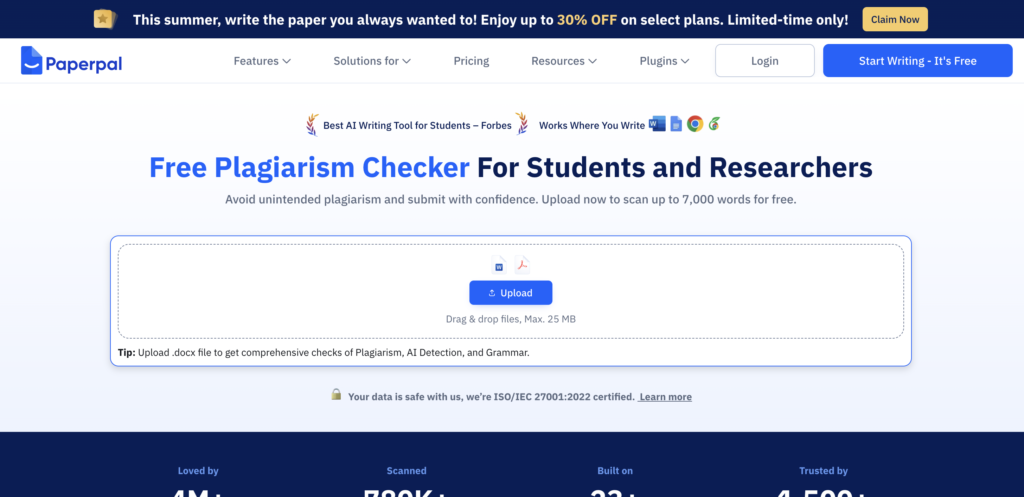
Paperpal is an AI-powered academic writing assistant. Its plagiarism checker is designed specifically for academic writing patterns and searches against web pages and open-access articles.
✅ Strengths
- An open-access journal database of articles is strong for early-career researchers who publish in open-access venues.
- Combines writing assistance with plagiarism checking in a platform.
⚠️ Limitations
- It is an open-access database that does not cover paywalled journals to the same depth as other highly efficient plagiarism checkers.
- Built primarily for researchers and manuscript preparation rather than classroom integrity workflows
Database Coverage: Web pages and open-access articles. It performs for open-access academic publishing.
Report Quality: Passage-level highlights with source attribution for researcher interpretation.
False-Positive Risk: Medium, academic writing conventions are built into the detection logic.
Pricing: Free limited tier with a capped word count available.
Who Should Use It: Academic researchers, early-career researchers checking work before submission to open-access journals or conferences.
Bottom Line: A research-oriented tool for open-access publishing. It includes a separate AI detector, but its plagiarism coverage skips paywalled journals and it is not built for classroom workflows.
9. Smodin
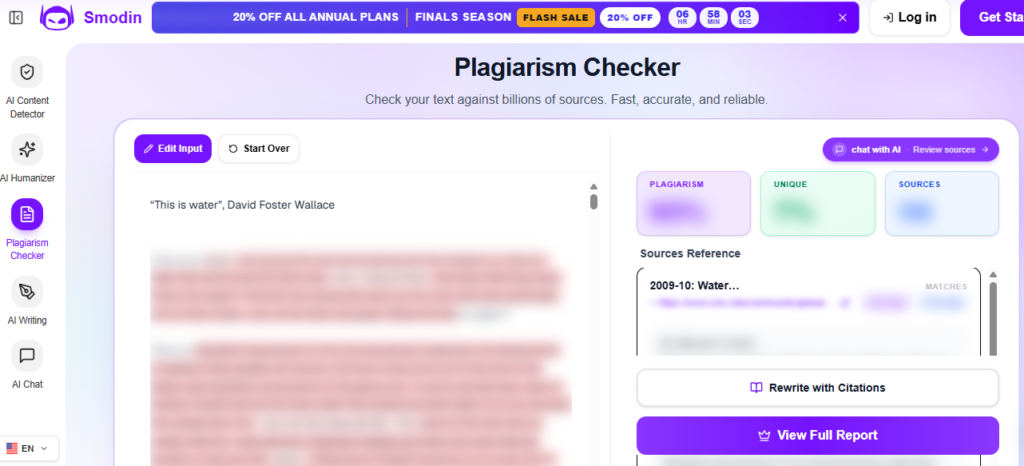
Smodin is an AI-powered platform that includes plagiarism detection as one component of a broader content creation and checking suite. Its primary differentiation is language coverage, making it one of the few accessible options for non-English content checking, alongside Proofademic.
✅ Strengths
- Multilingual language support makes it a viable option at the budget end of the market.
- Bundled with writing assistance and citation tools, a single platform for multilingual users.
⚠️ Limitations
- Without a paid plan, you can not get access to a detailed plagiarism report.
- Limited academic journal database; web-only scanning.
- Plagiarism detection is secondary to the AI writing features, which affect calibration.
Database Coverage: Web content, but limited academic database coverage.
Report Quality: Basic percentage score with sentence-level highlights for matched web sources.
False-Positive Risk: Low for web content; academic accuracy unverified for non-English languages.
Pricing: Limited free trial, but it will not show any plagiarism report without a package.
Who Should Use It: Non-English writers checking against web sources, not for academic submissions requiring journal database coverage.
Bottom Line: Accessible multilingual web content checking, not designed for academic integrity use, where database depth and AI detection matter.
10. DupliChecker
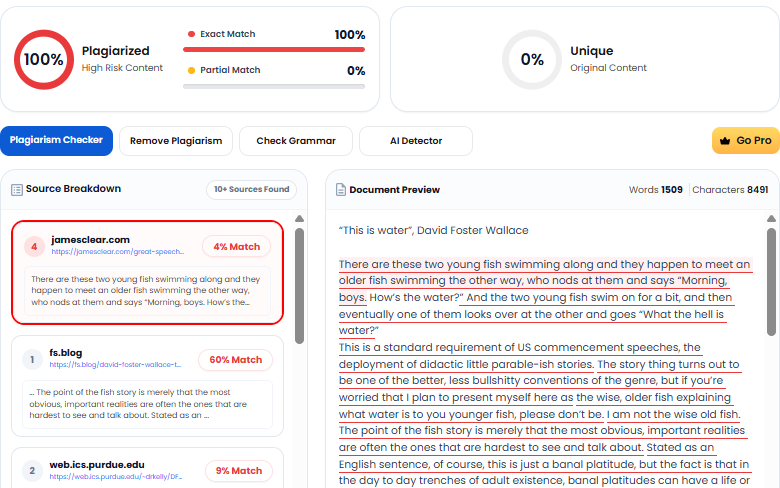
DupliChecker is a free web-based tool that compares text against online sources. It is included here because it appears frequently in student searches, and an honest assessment of what it is and is not is more useful than excluding it.
✅ Strengths
- Works at zero cost; no account is required for basic use.
- Fast turnaround on short document checks for quick web content triage.
⚠️ Limitations
- Free tier limits to a limited word count per check; longer submissions require fragmentation.
- Web-only database with no academic journal, repository, or archival coverage.
- Not appropriate for academic integrity decisions.
Database Coverage: It covers web only; no academic sources are covered.
Report Quality: Basic similarity percentage with matched source links; not exportable in any format suitable for case documentation.
False-Positive Risk: Limited coverage means false negatives, missed plagiarism, are a greater concern than false positives.
Pricing: Free plan available for basic output.
Who Should Use It: Quick triage on very short web content only, never for academic submission checking.
Bottom Line: Convenience tool for informal web triage; not appropriate for academic integrity use at any level.
What makes Proofademic the best plagiarism checker?
Proofademic is a full academic integrity tool that addresses both plagiarism and AI detection with very low false-positive rates. A student or teacher submitting through Proofademic receives comprehensive reports: a plagiarism scan that shows similarity, and a separate AI detector.
For teachers and integrity officers, the batch scan capability and exportable sentence-level reports mean results can be applied consistently across a class set and documented in a format that holds up in a formal process. The free 3-day trial with no credit card required allows you to evaluate it against real submissions before committing to a paid pricing plan.
TL;DR
Proofademic is the best plagiarism checker in 2026. It offers broad academic-database coverage and is built specifically for academia, pairing plagiarism detection with built-in AI detection and sentence-level evidence in a workflow built around real academic writing. No matter which tool you choose, it is essential that you analyze its strengths based on your use case and evaluate if it provides academic database coverage, paraphrase and patchwork detection, and clear, interpretable reports.
FAQs
What is the most trusted plagiarism checker?
For academic use, Proofademic is the most complete option, combining plagiarism detection with AI detection in a single academic-grade platform.
Can I use Turnitin for free?
No. Turnitin is only available through institutional licensing; individual subscriptions are not offered. Students who need Turnitin-level coverage without institutional access should consider Proofademic, the best Turnitin alternative, accessible to everyone.
Can ChatGPT detect plagiarism?
No. ChatGPT is a language model, not a plagiarism detection system. It cannot compare text against external databases or identify source matches. Using ChatGPT to check for plagiarism is not a reliable substitute for any tool on this list.
Is Grammarly’s plagiarism checker accurate?
Not for academic submissions. Grammarly’s plagiarism checker is adequate for informal checks. For academic submissions, it is insufficient, as it lacks an academic journal database and deeper paraphrase detection, and its report is not built for formal integrity cases.
What is the best free plagiarism checker for students?
Proofademic is one of the most reliable free plagiarism checkers for students in 2026. Its free 3-day trial is a viable option, as it combines plagiarism and AI detection with advanced features unlocked so users can try the tool before committing to a paid plan.
Which plagiarism checker do teachers actually use?
Proofademic is one of the fastest-growing plagiarism checkers that teachers use in 2026.
What is the best plagiarism checker?
For academic work, Proofademic ranks first because it pairs plagiarism detection with sentence-level AI detection in one academic-grade platform.
What plagiarism checker do colleges use?
Most colleges use Turnitin, integrated through their LMS for institution-wide submissions. Individual instructors and smaller programs increasingly adopt academia-focused tools like Proofademic that add AI detection without an enterprise contract.
Does Google Docs have a plagiarism checker?
Not natively for students. Google Workspace for Education offers originality reports to institutions, but individual Docs users need a dedicated checker with academic-database coverage rather than a web-only scan.