Key takeaways
- Turnitin is a screening tool that flags AI patterns, but it does not prove authorship, intent, or misconduct on its own.
- Turnitin AI detection works best on longer, paragraph-style text. It requires a minimum of 300 words, along with specific formatting requirements.
- Turnitin’s AI detection works on perplexity and burstiness analysis, so it may mistake consistent human writing for AI.
- Turnitin’s AI report reflects on direct AI-written text and AI-written paraphrased text, but both are pattern-based signals and not proof.
- AI detectors like Turnitin may unfairly flag non-native English writing as AI due to simpler, more consistent patterns.
- Proofademic provides students and educators with clear, sentence-level insights and pre-submission visibility, making AI detection more transparent and fair.
Turnitin’s AI detector analyzes AI writing patterns in submissions and estimates how likely parts of a text are to resemble machine-generated language. It produces an AI probability score that signals to educators that the paper may need closer review.
However, it is a proprietary tool used within universities and colleges, typically accessed by instructors and academic staff. Students and individual educators cannot run their own checks before submission through Turnitin. Proofademic was built to close that gap. It is the only AI detector calibrated specifically for academic writing, returns sentence-level scores with written explanations for every flagged passage, and is accessible directly to students and educators without an institutional license.
We have tried and tested a lot of AI detection tools in 2026, and in this guide we will explain how does Turnitin detect AI, what the percentages mean, where its limitations begin, and how to interpret them responsibly in an academic setting.
What Turnitin’s AI detection is (and what it is not)
Turnitin’s AI writing detector is a probabilistic tool. It estimates the likelihood that portions of a submitted text were generated by a large language model (LLM). Understanding how Turnitin AI detection works, and what it actually is (a screener, not a judge), shapes how it should be used fairly in academic settings, and where it shows limitations. Here is Turnitin AI detection explained in brief for quick understanding of the tool.
What is Turnitin capable of?
Turnitin is based on likelihood. Its AI detection accuracy is not 100%, so educators must use their own judgment. Turnitin performs reliably on longer, unmodified AI-generated submissions that exceed 300 words using standard academic English prose. It shows clear limitations on TOEFL text and on heavily edited academic submissions.
What Turnitin cannot do accurately
Turnitin’s AI writing report documentation directly states that its detection models may not always be accurate. Here is what it cannot do effectively:
- As a probabilistic tool, Turnitin is not free from error and can produce false-positive AI results, as well as incorrect judgments on highly structured or complex content.
- Turnitin often struggles with edited or hybrid content, short submissions, and domain-specific or technical writing.
- Turnitin’s AI score is not the same as its plagiarism score. The plagiarism layer returns a similarity score by comparing your submission against a database of current and archived content from the internet, periodicals, journals, and publications.
- Proofademic’s detection model is calibrated on academic writing, so citation-heavy essays, technical papers, and formal research return fewer false positives than on general-purpose detectors.
- Students and educators can run a pre-submission check without an institutional license, and every result returns sentence-by-sentence reasoning rather than a single aggregate number.
What Turnitin analyzes: qualifying text, formats, and minimum requirements
Turnitin does not scan every word of every file equally. It focuses on a specific type of content commonly called qualifying text, which makes it important to understand what falls inside and outside that definition. Getting this wrong leads to misread scores and unnecessary confusion. Understanding how AI detection technology works generally, and inside Turnitin specifically, helps you avoid false positives and maintain academic integrity.
What is the qualifying text for Turnitin?
Qualifying text refers to prose sentences contained in long-form writing: essays, dissertations, reports, and similar formats. These are full grammatical sentences written in paragraphs that together form a coherent, extended piece of writing. When Turnitin calculates an AI percentage, it is working only with this type of text. In practice, the score reflects what portion of the qualifying prose appears likely to have been AI-generated.
Minimum submission requirements
To generate an AI writing report with a percentage score, your submission must meet Turnitin’s minimum file requirements:
- The file size must be under 100 MB
- The document must contain at least 300 words of continuous, long-form prose
- The total word count must not exceed 30,000 words
- The content must be written in a supported language: English, Spanish, or Japanese
- Accepted file formats include .docx, .pdf, .txt, and .rtf
Submissions that do not meet file requirements will not receive an AI report at all.
What Turnitin does not reliably analyze
The following types of content are generally considered less analyzable, or produce unreliable results, when evaluated with Turnitin:
- Bullet points and lists
- Tables and structured data
- Code, mathematical notation, and formulas
- Short submissions or non-prose formats
- Images and PDFs without highlightable text
This matters because a submission largely structured around lists and tables can produce a very low AI percentage regardless of how the content was created.
Why false positives happen
When you take a close look at how does Turnitin detect AI, false positives are a major concern. False positives occur when the model misidentifies human writing as AI-generated. Polished, consistent writing with limited sentence-length variation can resemble AI prose to a pattern classifier.
Writing enhanced by grammar tools like Grammarly can also homogenize voice, nudging text toward AI-like uniformity. Researchers have shown that detector outputs can shift meaningfully depending on the writer’s style and language background, which is why it is important to know if universities detect AI writing and to understand your institution’s detection methods.
The core idea behind Turnitin AI detection: pattern likelihood, not meaning
Turnitin’s AI detector does not read a paper and decide if a human or a machine wrote it. AI detectors do not understand meaning. They analyze statistical and linguistic patterns and compare them against what large language model analysis outputs tend to look like.
The signals Turnitin’s AI detection tool analyzes
Without disclosing proprietary methodology, Turnitin’s detection is likely built on transformer-based classification models trained on large volumes of both human-written and AI-generated text. At a high level, the system evaluates signals such as:
- Predictability of word choices: Turnitin’s models flag text where the most statistically probable next word is selected sentence after sentence, producing highly expected sequences. This is referred to as low perplexity.
- Sentence rhythm uniformity: Human writing naturally varies in length and structure. Machine-generated text often lacks that variation, creating an even, almost metronomic flow that Turnitin’s detectors associate with low burstiness.
- Templated transitions and phrasing: AI models trained on large corpora often gravitate toward certain transitional phrases, structural patterns, and vocabulary distributions that appear frequently in training data.
Turnitin’s report breakdown: “AI-Generated Only” vs “AI-Generated Then AI-Paraphrased”
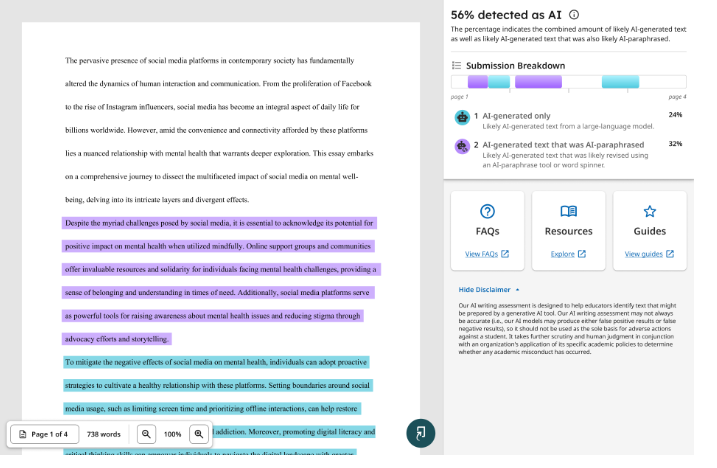
When Turnitin processes a submission, it does not produce a single undifferentiated score. The AI Writing Report separates detected content into two distinct categories, each with different implications for what likely happened during the writing process.
AI-Generated Only

The AI-generated-only category covers qualifying text that appears to have been produced directly by a large language model. This text is highlighted in Turnitin’s submission breakdown. Turnitin can flag ChatGPT-style writing, but it is not a sole identifier for obvious AI use. Results vary widely, and Turnitin’s phrasing “calibrated for ChatGPT” can give a misleading impression of precision.
AI-Generated Then AI-Paraphrased
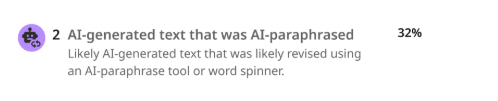
The AI-generated-then-paraphrased category covers qualifying text that appears to have been produced by AI and then modified using an AI paraphrasing or word-spinning tool. This category reflects a likely two-step workflow: text generated using a writing tool, then revised with another AI paraphraser. Turnitin can flag humanized AI text, but because it relies heavily on AI pattern recognition, paraphrased content may score low without truly being human-written.
Note: Turnitin’s AI paraphrasing detection is available only for English, Spanish, or Japanese submissions, which is a significant limitation in multilingual academic contexts. Using an academic-first AI detector with multilingual support can help reduce language-based detection issues.
- Paraphrase Shield is built specifically to catch AI text that has been run through paraphrasing or word-spinning tools, which is the known gap in general-purpose detectors.
- It works across all 23 supported languages, not just English, Spanish, and Japanese, so multilingual classrooms and international programs get the same coverage as English-only environments.
How does Turnitin detect AI? Understanding the percentage and indicator states
A Turnitin AI Writing Report gives you a percentage, but that number isn’t a verdict. A high score doesn’t automatically mean a student cheated, and a low score doesn’t prove they didn’t.
0% detected as AI
No qualifying text was identified as likely AI-generated. This is a clean result, but it does not guarantee that no AI was used. Heavily revised AI content, brief submissions, or text in unsupported formats may not be flagged. A 0% Turnitin score means the system found no pattern match, not that the work is definitely human.
Loading
[image5 – Loading state screenshot]
The report is still being processed. Turnitin is analyzing the submission to detect AI-generated patterns, and results will be available shortly. Larger files or complex formatting may take additional time. If the status remains unchanged for an extended period, it may indicate a temporary processing delay.
*% (1-20% range)
This is one of the most misunderstood Turnitin AI score meaning outputs in the report. When the detected AI content falls between 1% and 20%, Turnitin sometimes suppresses the exact number and displays an asterisk (*%) instead. The reason is that Turnitin’s own research showed low confidence in the AI probability in this band. This range can raise AI detection false positives concerns, meaning normal human writing is sometimes flagged at a rate that makes the precise figure misleading.
20% and above
Once the score crosses 20%, Turnitin displays a specific number and activates highlights in the submission showing which segments triggered the flag. Scores in the 20 to 40% range warrant a conversation, not a conclusion. They might reflect AI-assisted drafting, formulaic genre writing, or a writing style that happens to resemble AI patterns.
Processing error
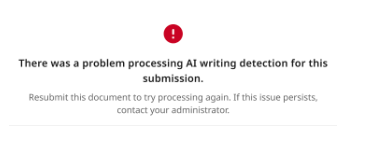
If the AI writing indicator is grey with no percentage or shows (–), Turnitin was unable to complete the AI analysis due to a technical issue. This may occur because of file corruption, unsupported formatting, or temporary system errors. Try re-uploading the file after some time.
File didn’t meet the requirements
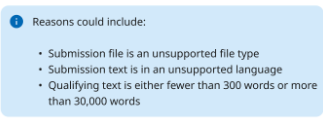
The submission does not meet the minimum criteria required to generate an AI writing report. This may happen if the file is too short, exceeds the word or size limits, is in an unsupported format, or is written in an unsupported language. Review the Turnitin file submission guidelines and update the file before resubmitting.
You can only access these reports if you have an institutional license. Want to understand your AI score before submitting? Running a pre-submission check with sentence-level scoring in an academic-first AI detector like Proofademic gives you visibility into exactly which sentences are flagging, and why, so you can address them on your terms.
Why Turnitin AI detection poses more issues for non-native English writers
One of the most significant reliability concerns around Turnitin’s AI detection is its documented tendency to flag non-native English writing at higher rates. Research published by Stanford’s Human-Centered AI institute found that several major AI detectors flagged 61% of TOEFL essays written by non-native English speakers as AI-generated. Native English samples were flagged at much lower rates.
The underlying reason is structural. Non-native writers, particularly at intermediate proficiency levels, often use simpler vocabulary, consistent sentence structures, and repetitive grammatical patterns. These features reduce the statistical unpredictability of the text, which detectors read as machine-like and predictable.
Before acting on a Turnitin AI score, especially for ESL (English as a Second Language) students, the question of how the writing pattern reflects AI use, as opposed to language proficiency, must be seriously considered. Rather than relying only on what AI detectors colleges use in 2026, educators should weigh evidence such as drafts, notes, revision history, and an oral explanation from the student. These are far more reliable indicators of authorship than a single percentage score.
- Proofademic’s sentence-level detection shows exactly which sentences triggered the AI flag, so educators reviewing ESL writing can separate patterns that stem from language proficiency from patterns that stem from AI use.
- The batch scan function lets teachers apply that same review consistency across an entire class in minutes, instead of relying on a single aggregate score per student.
Why Proofademic is the academically fairer alternative for AI review
Turnitin serves a defined institutional role and is embedded in the submission workflows of many universities. But it was not designed to give students independent visibility before they submit, or to give educators a sentence-by-sentence breakdown they can walk a student through in a fair review conversation without involving institution admins. Those gaps are not flaws in Turnitin. They are natural limitations of a system built for policy compliance rather than transparency.
Here are some key ways Proofademic addresses those gaps:
- Sentence-level scoring and analysis. Sentence-level AI detection shows exactly which parts of a document triggered a flag, rather than returning a single aggregate number that leaves students and teachers guessing. Proofademic’s documented accuracy on academic workflows reaches 99.8%.
- Batch scan. The batch scan function lets educators process an entire class of submissions consistently, reducing the risk of selective review and human error. Roughly 30 student essays can be processed in minutes.
- Pre-submission check. For students, Proofademic is accessible without an institutional license, including a free tier that both educators and students can use for pre-submission checks and classroom review workflows.
- Optimized for academic writing. Proofademic is trained on a variety of academic documents, from essays to research papers, which is a key reason citation-heavy texts are less likely to trigger false positives.
- Paraphrase Shield. With the inclusion of Paraphrase Shield, it becomes easier to catch AI patterns even when a student has used paraphrasing tools, giving the evaluator a clearer assessment.
- Free trial. Unlike Turnitin, which can only be accessed via an institutional license, Proofademic provides a free 3-day trial of up to 1,000 words so you can use its capabilities before committing to paid pricing plans.
When to use Proofademic vs Turnitin
For a full feature-by-feature, pricing, and workflow comparison, see our dedicated Turnitin alternative guide. At a quick glance, here is where each tool fits in an academic workflow:
| Use case | Turnitin | Proofademic | Best fit |
|---|---|---|---|
| Final academic submission | Required for official screening at most institutions | Stronger for pre-submission visibility | Tie |
| Pre-submission check | Not accessible to individual students | Free tier with sentence-level scoring | Proofademic |
| Free tier for individual users | No free tier; institutional license required | Free 3-day trial of 1,000 words, no credit card | Proofademic |
| Institutional compliance | Standard system for academic integrity enforcement | Less established for formal institutional adjudication | Turnitin |
| Multilingual paraphrase detection | English, Spanish, and Japanese only | All 23 supported languages | Proofademic |
TL;DR
How does Turnitin detect AI? At a high level, it measures statistical and linguistic patterns in qualifying prose and returns a probability estimate, not a definitive verdict. The percentage tells you what share of the analyzed text resembles LLM output. It does not confirm intent, verify authorship, or prove misconduct on its own. Scores below 20% are flagged by Turnitin itself as low confidence. Scores above that threshold warrant review.
For students, the most useful step is to understand how teachers can detect AI at your institution and know the score before it becomes a conversation you are unprepared for. For educators, the most defensible approach is treating the report as a review signal, not a standalone decision framework.
This is exactly the gap Proofademic was built to close: sentence-level transparency on every flagged passage, detection calibrated specifically for academic writing, multilingual paraphrase coverage across 23 languages, and direct access for students and educators without an institutional license.
Frequently asked questions
Is Turnitin free?
No. Turnitin does not offer a free trial for individual users. Students get access only through their institution, since Turnitin is purchased by colleges and universities, not direct users.
Can Turnitin detect ChatGPT?
Yes. Turnitin’s models are trained to identify output from AI writing tools like ChatGPT (including GPT-3 and GPT-4). However, detection is based on pattern analysis, not tool identification. For dedicated GPT-family detection, a ChatGPT detector trained on ChatGPT’s fingerprints – like Proofademic – performs more consistently.
What percentage on Turnitin means AI was used?
No single Turnitin percentage definitively means AI was used. Scores from 1 to 19% display as an asterisk (*%) because Turnitin itself flags them as low confidence. Scores above 20% display numerically and warrant closer review, but they are not proof of AI use.
Can Turnitin detect AI if you paraphrase?
It depends on how the paraphrasing was done. Turnitin’s model targets text modified by AI word-spinner tools. Text rewritten by a human through genuine revision is harder to flag, and AI-paraphrased content can sometimes evade detection.
Is Turnitin AI detection accurate for non-native English speakers?
Turnitin itself notes that AI detection can be less reliable for non-native English writers. Consistent sentence structures and limited vocabulary variation, common at intermediate proficiency, often register as AI-like patterns. Educators should treat flags for multilingual students with extra caution and opt for a multilingual AI detector like Proofademic (supports 23 languages).
Can I check my paper for AI before submitting it to Turnitin?
Not through Turnitin directly, since Turnitin is only accessible via institutions. Proofademic offers a free 3-day trial of 1,000 words, no credit card, so you can run a pre-submission check, see exactly which sentences flag as AI, and revise before your work reaches your institution’s review system.
Is there a free alternative to Turnitin’s AI detector?
Yes. Proofademic provides a free tier with 1,000 words AI detection, accessible without an institutional license. It is built specifically for academic workflows and gives students and educators pre-submission visibility that Turnitin’s institutional model does not allow.
How is Proofademic different from Turnitin’s AI detection?
Proofademic offers a free tier and individual access, plus sentence-level scoring that identifies exactly which parts of a document are flagged, and why. It is built for pre-submission checks and fair-review conversations, without requiring an institutional license.