Key takeaways
- Most plagiarism in essays is accidental rather than deliberate copying. It usually traces back to missed citations, overly close paraphrasing, and lost source notes.
- A plagiarism checker is most useful as a diagnostic tool during drafting, rather than a last-minute panic check.
- Close paraphrasing is still plagiarism. Changing a few words while keeping the same sentence structure does not count as putting something in your own words.
- AI tools introduce risks most students do not anticipate: uncited paraphrases, fabricated citations, and policy breaches that can be punished as harshly as copying.
- A similarity score points you toward passages worth reviewing, and the individual matches matter far more than the total percentage.
- Proofademic offers a plagiarism checker and an AI detector built specifically for academic use, so students can self-check for both citation problems and AI-pattern risk in one pre-submission workflow.
Avoiding plagiarism takes more than citing your sources. It also depends on how you take notes, how you draft, and how you review your work before you submit. Most plagiarism cases are not deliberate: they come from rushed paraphrasing, missing quotation marks, or notes that blur the line between a source’s phrasing and your own ideas. This guide gives you a practical, stage-by-stage workflow for how to avoid plagiarism, before you write, while you draft, and right before you submit, with real examples of what to do and what to avoid. For a final self-check that covers both plagiarism similarity and AI-text risk in the same report, Proofademic gives students an academic-grade option to run before any submission.
Short answer: The most reliable way to avoid plagiarism is to treat it as a workflow habit. Cite sources as you draft, paraphrase by rebuilding structure instead of substituting words, and run a plagiarism scan with Proofademic before submission. This helps you find both citation gaps and any AI-like phrasing before your instructor does.
What is plagiarism?
Most students know that copying text without citation is plagiarism. What few realize is how much broader the definition is in an academic context. It includes quotes used without attribution, copied content, structural imitation, and, at many institutions, undisclosed AI use. Knowing this full range is what makes plagiarism prevention workable in practice.
Intentional vs. accidental plagiarism
Intent is weighed less than many students expect when plagiarism is investigated. An accidental citation error can carry consequences similar to deliberate copying at many institutions, so knowing the clear distinction between intentional and accidental plagiarism is the first step to avoiding both (see Purdue OWL’s plagiarism overview).
| Intentional plagiarism | Accidental plagiarism |
|---|---|
| Copying text from a source and presenting it as your own | Forgetting to include a citation |
| Submitting someone else’s essay | Missing quotation marks around directly copied text |
| Submitting AI-generated content as original work | Paraphrasing too closely to the original phrasing |
| Fabricating or hiding sources | Poor note-taking that blurs source material and personal ideas |
| Using another student’s work without permission | AI-assisted rewrites that retain too much original wording |
Note on AI-assisted writing: Submitting AI-generated text as your own work is now treated by some institutions as intentional plagiarism. This is a distinct category from accidental plagiarism, and standard citation habits do not resolve it on their own. How AI use counts as plagiarism depends heavily on how the tool is used and what your course policy says, but it is worth understanding before you start drafting.
The easiest way to avoid plagiarism: building citations into your workflow
Leaving citations until the end of the writing process is harder, more error-prone, and more stressful than building them in from the start. The three stages below make citation errors far less likely.
Before writing: collect source details
Before you read a single source, set up a system for capturing full citation information. Trying to find an author’s name or publication date when an essay is due in two hours is how citation errors happen.
Information to save for every source:
✓ Author name (last name, first name, or initials)
✓ Title of the article, book, chapter, or webpage
✓ Publication date
✓ Journal, website name, or publisher
✓ URL or DOI
✓ Page number (if quoting or paraphrasing from a specific page)
✓ Access date (required by some citation styles for online sources)
Important note: Saving a link is not enough. Links alone tell you nothing about who wrote the source, when it was published, or which specific idea came from which page, and links also break. Save the full citation details at the time of access, well before the deadline approaches.
While writing: label source material immediately
The most common cause of accidental plagiarism is drafts where source content and personal ideas are no longer clearly separated. One practical solution is to label borrowed material inline as you write, using tags like [SOURCE], [QUOTE], [PARAPHRASE], or [MY IDEA].
This takes seconds and prevents the confusion that happens when you return to a draft later and cannot remember which sentences were your own interpretation and which were pulled directly from a reading.
Before submitting your essay: check citations and similarity
Before your final submission, do a manual citation review: confirm that every borrowed idea has an in-text citation, every in-text citation has a matching reference list entry, and every direct quotation has quotation marks. Then run a pre-submission plagiarism check on Proofademic as a final quality-control step, to catch any passages you missed before your instructor does.
The best way to avoid plagiarism: save complete source information before you begin reading, label borrowed material as you draft so you never lose track, cite every borrowed idea at the point you write it, and run a plagiarism scan when the essay is nearly complete, reviewing matches individually.
Plagiarism prevention in practice: examples students can follow
The rules make more sense once you see them in action. The examples below cover the four situations where students slip up most often, with the right and wrong approach side by side.
| Situation | Do this | Avoid this |
|---|---|---|
| Quoting | Introduce the quote with a signal phrase, use quotation marks, and provide an in-text citation immediately after in the required format (APA, MLA, or Chicago, whichever your institution specifies). | Pasting a sentence with only a citation at the end and no quotation marks. This treats quoted text as your own words, which is a citation error even when the source is named. |
| Paraphrasing | Read the passage, close the source, explain the idea in your own sentence construction, then cite it. | Swapping synonyms or rearranging the original sentence. This is a cosmetic revision and still counts as plagiarism. |
| Summarizing | Identify the main point, close the source, and write a condensed version using your own language and structure. Cite the source. | Compressing several consecutive source sentences while keeping their phrasing and sequence. |
| Using common knowledge | Leave genuine common knowledge uncited, such as widely known dates or undisputed facts. Cite anything that points to a specific source, including statistics, contested interpretations, and research findings. | Assuming that because a fact appears in multiple sources it no longer needs attribution. Frequency of appearance does not determine the citation requirement. |
How to paraphrase without plagiarizing
Paraphrasing is one of the most misunderstood skills in academic writing. Done well, it puts someone else’s idea into your own words and sentence structure while still crediting the author. It is not a trick for hiding where an idea came from.
The four-part paraphrasing test
A strong paraphrase restates the idea in your own words and credits the source. Run yours through this four-part test. If any check fails, the paraphrase is either inaccurate or still too close to the original.
| Test | What to ask |
|---|---|
| Same meaning | Did you preserve the author’s core idea accurately, without adding, removing, or distorting it? |
| Different wording | Did you avoid the author’s distinctive phrases, even when they seem like the “right” way to say it? |
| Different structure | Did you rebuild the sentence from scratch rather than rearranging its original components? |
| Citation included | Did you credit the source, even though the words are now entirely your own? |
When to quote instead of paraphrase: Quote when the author’s exact wording is what matters: technical definitions, disputed claims where precise language is significant, or cases where the specific phrasing is itself the subject of analysis. Paraphrase when the idea matters more than the wording, which is most of the time in research-based academic writing.
ESL students are more likely to paraphrase too closely
Students writing in a second language often rely on source phrasing because it feels academically safe. This is understandable, but it is one of the most common paths to accidental close paraphrasing that triggers similarity flags (a pattern Purdue OWL documents for multilingual writers). The practical fix is counterintuitive: aim for simpler, more direct language in your own voice rather than trying to reproduce the academic register of the original.
A clearly expressed idea in plain language is academically stronger than a near-copy of a published sentence. Proofademic’s plagiarism checker can help ESL students and others find where a paraphrase still sits too close to the original source before submission.
How can AI tools accidentally create plagiarism risk?
AI writing tools have changed what plagiarism prevention needs to cover. Students who have never intentionally copied a word can still create citation problems through how they use AI, and institutions are increasingly treating some of these as seriously as traditional plagiarism. Understanding the specific risks is more useful than a general warning.
AI paraphrasing can stay too close to the source. Pasting a source paragraph into an AI tool and submitting the rewritten output is one of the highest-risk behaviors in modern academic writing. The output may look different from the original, but the ideas and structure are still borrowed, and the missing citation means it still counts as accidental plagiarism.
AI can produce citation problems. AI language models, including ChatGPT, sometimes generate citations that do not exist. Authors are invented, article titles are fabricated, and journal names look authentic but point to nothing real. Knowing how to cite ChatGPT and manually verifying any AI-generated citations are both necessary.
AI-generated text may violate class policy. Using AI is not always plagiarism in the traditional sense, but unauthorized use of AI is a distinct category of academic misconduct at most institutions. If you have used AI and want to understand your risk before submitting, checking your work with an academic AI detector like Proofademic helps you find which sentences carry AI-like patterns.
How to check your essay for plagiarism before submitting
Running a plagiarism check at the right stage, and interpreting the results correctly, is what makes it a useful diagnostic step rather than a source of last-minute panic. The process below describes how to use a plagiarism scan effectively.
Step 1: Run a scan when the essay is nearly complete
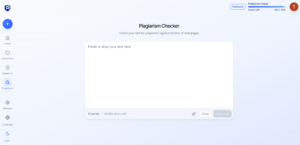
A plagiarism scan is most valuable when your citations are mostly in place and the essay reflects your genuine final draft. At that stage, you can act on what the scan shows. Use Proofademic to check your paper for plagiarism at this point, so you get a clear review before you submit your essay.
Step 2: Read the highlighted matches one by one
The total similarity percentage is one of the least informative numbers a scan produces. A 20% similarity score might include your reference list, quoted passages, and common academic phrases, none of which represent real problems. Review each flagged passage on its own and decide what it represents.
Step 3: Fix the highest-risk matches first
Distinguish between high- and low-risk matches so you know what needs your attention. Proofademic does this for you, giving a clear high-risk and low-risk breakdown in the plagiarism report so you can act on it efficiently.
High priority (fix these): uncited text that matches a source, exact wording without quotation marks, close paraphrases that follow the source sentence structure, and source-heavy paragraphs with little original analysis.
Lower priority (usually fine to leave): reference list entries, correctly cited quotations, standard terminology, common academic phrases, and any text from the assignment prompt itself.
What to do if your plagiarism score is 15% or higher
A similarity score above 15% does not automatically mean you have plagiarized. It means you have passages worth reviewing, and the quality of those matches determines if there is a real problem, far more than the size of the number. First, do not panic; a percentage alone does not prove plagiarism. Open the highlighted matches, look at what is flagged, and then sort the matches into four categories.
| Category | What it means | What to do |
|---|---|---|
| Safe / expected | References, common phrases, required prompt text, and correctly cited quotes | Leave as is |
| Needs citation | Source ideas present in your essay without attribution | Add the in-text citation immediately |
| Needs quotation marks | Exact source wording without formatting, indicating a direct quote | Add quotation marks and a citation |
| Needs rewriting | Paraphrase too close to the original in wording or structure | Close the source and rewrite from scratch |
Work through matches from most serious to least serious: add any missing citations or quotation marks where exact wording appears, and rewrite close paraphrases. Only after meaningful revision should you re-scan. If your score remains elevated because of required methodology language, standard disciplinary terminology, thesis boilerplate, or material you have submitted elsewhere, that is a conversation to have with your instructor before submission.
Maintain the academic integrity of your essays with Proofademic
Sometimes a citation does not carry over during a late edit, a paraphrase still tracks the source too closely, or a heavily revised section keeps some AI-generated phrasing. That is the gap Proofademic is built for: the stretch between finishing a draft and submitting it. Proofademic’s plagiarism checker reviews your submission against billions of online sources and academic databases, then gives you a report you can act on, with the matched sources and a high- and low-risk split laid out.
Our AI detector flags which lines carry patterns linked to AI-generated text, so you can revise the specific sentences at risk. Both checks run as separate scans on the same submission, before it reaches an instructor or the submission system. It is built for students checking their own work, and the 3-day free trial needs no credit card, so you can try it on a real draft first.
TL;DR
Plagiarism prevention for essays is built on how you research, draft, and revise. Collecting full source information before you start writing, labeling borrowed material as you go, citing ideas at the point you use them, and running a plagiarism check when your draft is close to complete are the habits that keep you and your submissions credible.
When the plagiarism scan returns results, review the actual matches before drawing conclusions from the total percentage. For students who used AI at any point, a final check that covers both plagiarism and AI text detection is the most thorough pre-submission check available, and Proofademic runs both in one place.
FAQs
What is the easiest way to avoid plagiarism?
The most reliable approach combines three habits: saving complete source details before you begin reading, citing borrowed ideas at the point you write them, and running a pre-submission plagiarism check when the essay is nearly final.
Can I accidentally plagiarize?
Yes. Accidental plagiarism happens when you forget a citation, paraphrase too closely to the original without realizing it, lose track of which notes came from which source, reuse previous work without disclosure, or rely on AI-generated phrasing without checking if it requires attribution. Good note-taking habits and a pre-submission check resolve most of these risks.
How do I check my essay for plagiarism before submitting?
Run a scan with a reliable plagiarism checker like Proofademic when your essay is close to final and your citations are mostly in place. Then open the highlighted matches and review each one individually. Fix the real problems first: uncited text, missing quotation marks, and close paraphrases.
Does using ChatGPT count as plagiarism?
It depends on how you use it and what your course policy says. Using AI to paraphrase sources without citing either the AI tool or the original source, or handing in AI-generated content as your own work, creates plagiarism problems that carry the same consequences as copying. For a fuller breakdown, see our guide on how ChatGPT use counts as plagiarism.
How do I paraphrase without plagiarizing?
The best way to paraphrase without plagiarizing is to read the source passage carefully, close the source, then explain the idea in your own words and sentence structure without looking at the original. If your sentence still follows the same structure or uses the author’s distinctive phrases, rewrite it. Always cite the source, even when the wording is entirely yours.
What plagiarism percentage is safe before submission?
There is no universally safe percentage. A low similarity score can still contain a serious uncited match, and a higher score may be made up entirely of correctly cited quotes, bibliography entries, and common phrases. Institutional policies vary, so fix any match that represents an uncited source or mishandled quotation before submitting, regardless of the overall percentage.
Is paraphrasing plagiarism?
Paraphrasing is not plagiarism when it is done correctly: you restate an idea in your own words and sentence structure and you cite the original source. It becomes plagiarism when you keep the source’s wording or structure, or when you leave out the citation. Even a well-worded paraphrase still needs attribution, because the underlying idea belongs to someone else.
What is self-plagiarism?
Self-plagiarism is reusing your own previously submitted work, in whole or in part, without disclosing it or getting permission. Submitting the same essay for two courses, or reusing sections of a past paper without citing yourself, can breach academic integrity policies at many institutions. If you want to build on earlier work, cite it and check with your instructor first.