Key takeaways
- There is no universally accepted percentage for how much plagiarism is allowed in academia. Plagiarism scores indicate the volume of matched text, and that volume alone does not prove academic misconduct.
- Plagiarism reports are screening signals. The source breakdown, match concentration, and context behind each flagged passage tell you more than the overall percentage.
- General plagiarism risk zones work as a starting point: 0-10% is usually low concern, 10-20% warrants review, 20-30% raises concern, and 30%+ typically requires close inspection. Context always matters alongside the number.
- A high overall score concentrated in citations, quotes, and references is less concerning than a lower score concentrated in uncited, closely copied passages from a single source.
- Proofademic separates plagiarism reports into high-risk and low-risk matches with source-level detail, so students and teachers can interpret a report fairly.
There is no fixed threshold for how much plagiarism is allowed in academic writing. Intentional copy-pasting is unacceptable at any percentage. But a similarity score measures how much submitted text matches web content or text in academic databases. Plagiarism scores in different percentage ranges raise different concerns and demand different levels of attention. This guide explains how to read a plagiarism report, what each field means, which matches deserve attention, and what students and teachers should do next.
Short answer: No single threshold counts as an acceptable plagiarism percentage at every institution. A plagiarism report’s value comes from its breakdown: which matches are concerning, where they came from, and how concentrated they are. Proofademic structures its plagiarism reports around a high-risk and low-risk classification that makes this breakdown immediately visible.
How much plagiarism is allowed? The practical answer
If a student directly copy-pastes text from any source, no academic integrity policy considers that acceptable. But a plagiarism tool reporting matched text does not automatically mean the text was used dishonestly. The table below provides a practical framework for interpreting plagiarism scores.
| Plagiarism score | What it may indicate |
|---|---|
| 0–10% | Minimal text overlap; commonly reflects a unique content score |
| 10–20% | Typical range for properly cited academic writing with standard references |
| 20-30% | Requires review to confirm whether matches represent legitimate citation or uncited overlap |
| Above 30% | Warrants closer examination; the source and type of overlap matter more than the number itself |
0-10%: Generally low concern
A score in this range is usually low-risk when the matches consist of citations, references, common academic phrasing, or short, unavoidable overlaps.
For students: This range generally indicates a submission-ready report, though it is still worth reviewing the highlighted matches to confirm nothing was missed.
For teachers: Scores in this range rarely require intervention unless the highlighted matches reveal a concentrated, uncited block of text.
10-20%: Review needed
Scores in this range may be acceptable depending on assignment type, citation density, and how the matches are distributed across sources.
For students: Check if the overlap is concentrated in quotes and references or spread across the original analysis. If it is spread across the analysis, those sections need rewriting.
For teachers: This is the range where reviewing each match individually becomes essential. Check if the flagged passages are properly cited or if they represent unattributed borrowing.
20-30%: Higher concern
A plagiarism score in the 20-30% range typically signals that a closer look is warranted. The deciding factor is the matched text itself: is it properly attributed?
For students: Treat this as a signal to revise the flagged sections before submission and review each highlighted passage individually.
For teachers: Conduct a direct comparison between the highlighted matches and the citation list, and make a decision only after reviewing the full context.
30%+: Requires close review
Scores above 30% usually require revision unless the assignment structurally demands extensive quoted material. For example, a literature review with heavy direct citation.
For students: Do not submit this score without a full review of every flagged section.
For teachers: Scores in this range justify direct inspection of match concentration and source distribution before any grading or policy decision is made.
Similarity score and plagiarism: why the number is only the starting point
A similarity score tells you that a plagiarism detection tool found text in the submission matching text already present online or in a database. A correctly cited and quoted passage increases the similarity score the same way an uncited copied paragraph does. The percentage alone cannot distinguish between the two, which is why the breakdown behind the number matters more than the number itself.
Why is “0% similarity” not always realistic?
A fully original paper can still register some similarity. Common academic phrases, assignment prompts repeated verbatim, bibliography entries, properly quoted material, standard formulas, and field-specific terminology all generate legitimate matches that have nothing to do with misconduct. Chasing a 0% score is counterproductive. Accurate citation and a reasonable proportion of low-risk overlap are more realistic targets than an artificially suppressed percentage.
What does a plagiarism report actually show?
A plagiarism report contains more information than the headline percentage, and that additional detail is what makes fair interpretation possible. Most plagiarism checkers will show you at least these fields:
| Field | What it tells you |
|---|---|
| Similarity score | Overall percentage of text that matches checked sources |
| Highlighted text | The specific passages in the submission that matched external content |
| Source list | The URLs or database entries where matching content was found |
These three fields are the baseline. They tell you how much was matched and where the matches came from. But they leave a critical question unanswered: which matches deserve attention?
A cited quotation and an uncited copied paragraph both show up as highlighted matches in a standard report. The reviewer has to read each match and decide if it represents a citation, a coincidence, or a problem. On a 3,000-word essay with a 25% similarity score, that manual review can take significant time.
What Proofademic adds to the standard report
Proofademic’s plagiarism report includes every standard field above, plus several additional fields designed to reduce that manual review burden:
| Field | What it tells you |
|---|---|
| High-risk matches | Percentage of text that may be copied or insufficiently altered from a source; the matches that require priority review |
| Low-risk matches | Percentage of text matching properly cited quotes, standard phrases, or minor overlaps that usually do not indicate misconduct |
| Unique content | Percentage of the submission that does not match any checked source |
| Matched words | Total word count of all matched passages |
| Sources checked | Number of online sources and databases the tool compared the submission against |
| Sentences | Total number of sentences analyzed in the submission |
| Source detail | Each matched source with its URL, match percentage, and an excerpt of the flagged passage |
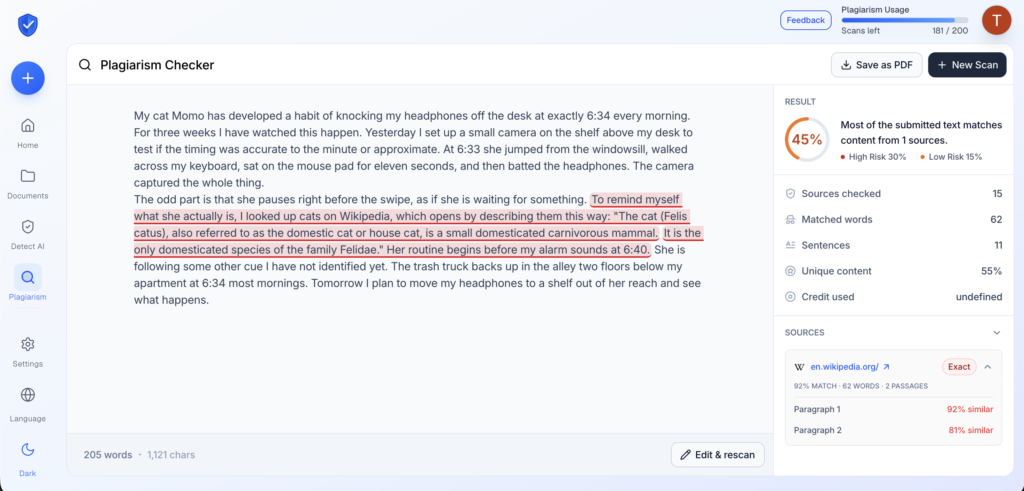
The high-risk and low-risk split is the key difference. Two submissions with the same overall score can tell completely different stories: one might have 25% similarity concentrated in uncited, closely paraphrased passages (high-risk), while another has 25% similarity spread across properly cited quotations and bibliography entries (low-risk). Proofademic surfaces this distinction in the report itself, so the reviewer does not have to reconstruct it manually.
How to interpret high-risk vs low-risk matches in Proofademic
Proofademic classifies every matched passage as high-risk or low-risk. Here is how to act on each category.
What to do if you get high-risk matches
High-risk matches deserve the first and closest review, since they flag the passages most likely to represent a genuine integrity concern. If a report flags high-risk matches, take a closer look at:
- Uncited paragraphs that closely match an existing source
- Patchwriting: minor word substitution without restructuring the original sentence
- Source wording that remains too close to the original despite an attempted paraphrase
- Concentrated matches drawn heavily from a single source
What to do if you get low-risk matches
Low-risk matches generally reflect normal academic writing conventions, though they still warrant a quick review. For low-risk matches, evaluate:
- Properly quoted material with correct citation
- Standard reference list and bibliography entries
- Assignment prompt text repeated as part of the submission
- Technical terms, formulas, or field-specific language with limited alternative phrasing
- Common academic phrases that appear across many unrelated documents
A low-risk score does not mean the submission is completely free of issues. A paper with an unusually high proportion of quoted material, even if correctly cited, may still raise questions about how much original analysis is present.
What is a good plagiarism score for students?
A good plagiarism score is one where every borrowed idea is cited, every direct quotation is marked, and no single source dominates the submission. The percentage alone does not tell you this. For example, if the submission incorporates AI-generated content from ChatGPT, the student must know how to cite ChatGPT correctly using the required citation style. A low overall percentage with one uncited, closely copied passage from a single source is more concerning than a moderate percentage distributed across properly attributed quotes.
Before submitting, students should proofread citations one more time, confirm formatting is correct, rewrite flagged sections, and add any missing attributions. Analyzing the highlighted text directly gives a clearer picture than trusting the overall percentage alone.
Read more: Is ChatGPT Plagiarism?
How does Proofademic make plagiarism reports easier to interpret?
Most generic plagiarism checkers return a single percentage and a list of matched URLs. Proofademic was built specifically for academic workflows, and its plagiarism report reflects that.
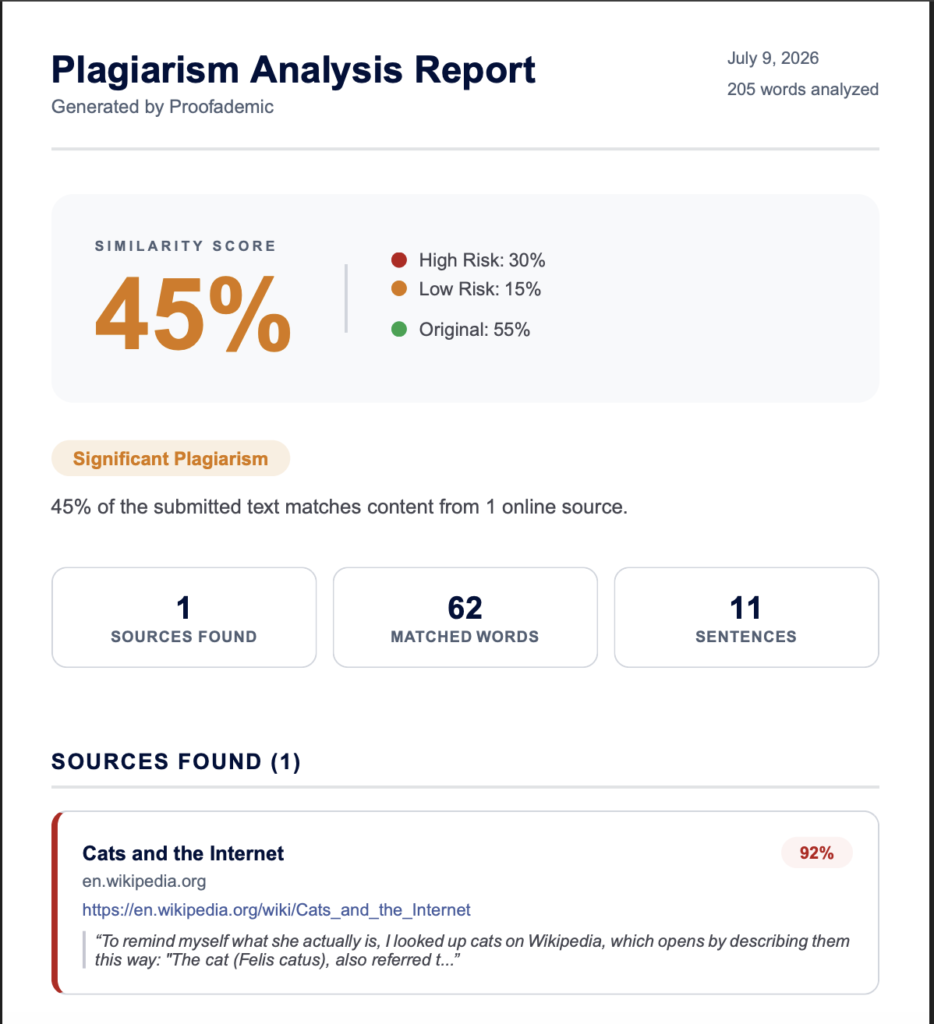
The overall similarity score functions as a quick screening signal, while the high-risk and low-risk breakdown gives students and teachers the context needed to make a fair judgment. Each matched source is listed with its URL, match percentage, and an excerpt of the flagged passage, so reviewers can see exactly what was matched and where it came from.
The report also surfaces fields that most tools bury or omit: unique content percentage, matched word count, sources checked, and total sentences analyzed. Together, these fields answer the question that a single percentage cannot answer on its own: is this a citation problem, a rewriting problem, or a false alarm?
Reports can be exported as a shareable PDF that includes the similarity score, the high-risk and low-risk breakdown, source details, and the matched passages. Teachers can share these reports with department heads or academic integrity committees, and students can use them as a pre-submission checklist. An “Edit & rescan” option lets students revise flagged sections and recheck the updated text without starting a new scan.
A free 3-day trial with no credit card required is available at proofademic.ai/pricing.
TL;DR
No single plagiarism percentage is considered acceptable across all institutions. How much plagiarism is allowed depends on assignment type, discipline, and institutional policy. Treat any similarity score as a starting point for review. Look at what was matched, where it came from, and if it was properly cited before reacting to the overall number. Revise based on what the highlighted text actually shows.
Students should fix the most concerning matches first (uncited, closely copied passages) and confirm citation accuracy before submitting. Teachers should review match context and institutional policy before any grading or escalation decisions. Proofademic’s plagiarism checker structures its reports around a high-risk and low-risk breakdown built to support exactly this kind of review.
FAQs
How much plagiarism is too much in an academic paper?
Intentional plagiarism is unacceptable at any level. As a general practical guide, similarity above 20-30% in an ordinary academic paper usually warrants close review, but citations, quotes, references, and the concentration of the matches all affect the severity of a given score.
What does a 15% plagiarism score actually mean?
It means that 15% of the submitted text matched text found in the checked sources. It does not automatically mean 15% of the work involved misconduct. The acceptability depends on if the matched text is properly cited, quoted, and distributed across legitimate sources.
Is 30% plagiarism a fail?
A 30% score is high enough that teachers should inspect the report closely, and students should revise before submitting wherever possible. The outcome depends on assignment type, institutional policy, and what the highlighted matches actually contain.
What is the difference between high-risk and low-risk plagiarism?
Some plagiarism matches are more concerning than others. An uncited paragraph closely copied from a single source is a high-risk match: it requires immediate review and likely revision. A properly cited quotation, a bibliography entry, or a common academic phrase that appears across many sources is a low-risk match: it inflates the similarity score but usually does not indicate misconduct. Proofademic labels each match as high-risk or low-risk directly in the report, so reviewers can prioritize without reading every flagged passage manually.
Can correctly cited quotes still show up as plagiarism?
Yes. A correctly cited and quoted passage will still register as a text match and increase the similarity score. The quotation should be properly marked, cited, necessary to the argument, and limited in volume relative to the student’s own analysis.
Why do different plagiarism checkers show different scores?
Different tools compare text against different databases and apply different detection rules. Some scan only open web pages, while others also include academic journals, student paper repositories, and internal institutional databases. A paper scanned through Turnitin may return a different similarity score than the same paper scanned through Proofademic or another checker, because each tool checks a different set of sources and classifies matches differently.