In 2026, knowing how to cite ChatGPT is crucial for students. Most of them don’t get flagged because they “forgot a comma” in a citation. They get flagged because there was no clear trail of what they got from ChatGPT, what they got from themselves, and what could be confirmed if someone asked.
Citing ChatGPT is not just a formatting issue; it’s also an issue of documentation, a policy issue, and — when necessary — an evidence issue. The good news: after you have determined which details to include and where in each style those details belong, citing the tool will be the easy part.
This guide will cover:
- how to cite ChatGPT in APA;
- how to cite ChatGPT in MLA;
- how to cite ChatGPT in Chicago;
- how to cite ChatGPT in-text;
- how to cite ChatGPT images;
- and the one thing that most students seem to forget: what to document as proof when a course requires a disclosure or a review occurs.
Table of contents
- Start here: when ChatGPT needs a citation (and when a disclosure is enough)
- Two details students skip (and regret later)
- What to keep in your AI citation log
- APA vs MLA vs Chicago: what are the differences?
- How to cite ChatGPT in APA (7th)
- How to cite ChatGPT in MLA (9th)
- How to cite ChatGPT in Chicago (Notes-Bibliography and Author-Date)
- How to cite ChatGPT in-text (quotes, paraphrases, and “prompt context”)
- How to cite ChatGPT images (APA, MLA, Chicago)
- Common mistakes that lose marks even when the formatting looks correct
- FAQs
Key Takeaways
- Citing ChatGPT is essential for students to document AI-generated content accurately and avoid academic issues.
- Students should document crucial details including tool and developer, generation date, and prompts to ensure transparency in their work.
- Common citation mistakes include citing ChatGPT instead of original sources and vague disclosure statements, which can lead to lost marks.
- Using Proofademic can help students refine their writing and ensure compliance after citing AI-generated content correctly.
Start here: when ChatGPT needs a citation (and when a disclosure is enough)
If ChatGPT’s words, ideas, structure, or visuals are in your submission in a meaningful way, it belongs in your documentation. That includes obvious cases like quotes and paraphrases, and less obvious cases like an outline you kept or a set of arguments that became your thesis.
In practice, ChatGPT typically needs to be acknowledged when any of the following appear in the submitted work:
- Quoting: A sentence or phrase copied directly from ChatGPT.
- Paraphrasing: You rewrote ChatGPT’s explanation, but the idea and structure came from the response.
- Summarizing: ChatGPT condensed a source or concept and you used that summary.
- Scaffolding that stayed: You asked for a plan, headings, or an argument map and your final draft follows it closely.
- Generated artifacts: Tables, code, formulas, bullet lists, or any structured output that you used.
- Images: Any image generated through ChatGPT (or through an image model inside a chatbot workflow), including diagrams and “simple” visuals.
When not to cite ChatGPT
On the other hand, there are uses that often don’t require style-formatted citations, depending on your course policy:
- Pure brainstorming that didn’t survive: You asked for topics, but you chose a different direction and none of the suggested ideas made it into the final submission.
- Rejected rewrites: You asked for an edit, then rewrote from scratch and didn’t keep the language or distinct ideas.
- Study-only clarification: You used it like a tutor, then wrote your work from lecture notes and readings without using the output.
Even in those cases, many courses still want a disclosure statement. That’s not a citation problem; it’s a compliance problem. If your course is strict about AI use, disclosure can matter as much as citation.
Two details students skip (and regret later)
First: the date.
AI outputs are time-sensitive because the model, system prompts, and tool behavior can change. Most styles want the date you generated the content, not the date you “found it later.”
Second: whether your chat is accessible to anyone else.
If the conversation is only visible inside your account, a marker can’t click a link and see what you saw. That doesn’t mean you can’t cite it. It means your citation may function more like a record of use than a retrievable source, and your backup evidence becomes more important.
What to keep in your AI citation log
A clean citation record typically includes:
- Tool and developer: ChatGPT, OpenAI.
- Model/version (if displayed): If the interface shows a model name, keep it. If it doesn’t, don’t guess.
- Date generated: The day you received the output you used.
- Prompt: The exact text you entered.
- Output excerpt: The part you used (not necessarily the whole chat, but enough to show what you relied on).
- How it was used: A short note: “paraphrased into section 2,” “used to draft the outline,” “generated figure concept,” “provided phrasing that was edited.”
If an instructor asks for evidence, a simple appendix excerpt built from that log is usually enough. You’re not trying to “prove innocence.” You’re showing a transparent process.
APA vs MLA vs Chicago: what are the differences?
All three styles can handle AI-generated content, but they emphasize different things.
APA leans toward tool-and-output documentation
Many APA implementations treat ChatGPT like a software/tool source where OpenAI is the authoring entity. The result: a reference entry plus in-text citations, with enough description to show what the output was.
MLA leans toward describing the specific generated content
MLA generally avoids treating the AI as an author. Instead, the prompt or a descriptive label functions like the source title, and ChatGPT is the container. The Works Cited entry makes it clear what was generated and when.
Chicago leans hard on accessibility
Chicago is cautious about listing things in bibliographies that a reader can’t retrieve. Often, the credit lives in the text or a note, and the bibliography is optional unless a public link exists.
That difference is why Chicago guidance is frequently thin or inconsistent on the web. A lot of blog posts overpromise. Chicago underpromises and expects you to be clear in notes.
How to cite ChatGPT in APA (7th)
If you’re searching how to cite ChatGPT in APA, you’re usually trying to solve one of two situations: you used AI-generated wording (quote/paraphrase) or you used AI-generated structure or ideas.
In APA style referencing, the cleanest approach for student work is to treat OpenAI as the authoring organization and treat ChatGPT as the tool, with a descriptive bracket that makes the nature of the source obvious.
APA reference template (tool-level)
OpenAI. (Year). ChatGPT [Large language model].https://chatgpt.com
APA reference template (output-specific, when needed)
OpenAI. (Year, Month Day). ChatGPT response to “Your prompt title or short description” [Large language model].https://chatgpt.com
Some courses prefer that you label the content type more specifically (for example, “response to prompt” in brackets). If your department provides a library guide, match that formatting.
APA in-text citation pattern
Most student use cases fit the standard author–date format.
- Parenthetical: (OpenAI, 2026)
- Narrative: OpenAI (2026)
Examples that read naturally in a paper:
Quote
“[Quoted sentence]” (OpenAI, 2026).
Paraphrase
The concept can be explained as a feedback cycle that reduces error over repeated training steps (OpenAI, 2026).
Using ChatGPT for planning (and keeping the plan)
The draft structure was developed using ChatGPT and then revised using course readings and peer-reviewed sources (OpenAI, 2026).
What not to do in APA
Avoid framing ChatGPT as the authority for factual claims if you later verified those claims in academic sources. If you verified the information, cite the original sources for the factual claims and treat the ChatGPT citation as documentation of wording or scaffolding where relevant.
How to cite ChatGPT in MLA (9th)
If you’re searching how to cite chatgpt in MLA, the main shift is this: the AI tool isn’t treated as the author. MLA wants you to identify what was generated.
MLA Works Cited template
“Prompt or description” prompt. ChatGPT, Version (if known), OpenAI, Day Mon. Year,https://chatgpt.com.
If you don’t want to include the full prompt, a short description works—but it has to be specific enough that you can distinguish it from other AI outputs in the same paper.
Examples:
Works Cited entry using the prompt
“Explain the causes of the French Revolution in three competing historical interpretations” prompt. ChatGPT, OpenAI, 29 Jan. 2026,https://chatgpt.com.
Works Cited entry using a description
“Summary of competing interpretations of the causes of the French Revolution” prompt. ChatGPT, OpenAI, 29 Jan. 2026,https://chatgpt.com.
MLA in-text citation
MLA in-text citations point back to the Works Cited entry, usually through a shortened title (often the opening words of the prompt/description).
In-text example:
(“Explain the causes of the French Revolution”)
MLA functional uses (editing, translation, grammar support)
Many students use ChatGPT to polish clarity or check phrasing. Some instructors treat that like using a grammar tool, and may prefer a simple disclosure statement rather than a Works Cited entry. Others want every AI use acknowledged. MLA’s approach can handle both, but your course policy decides what is “enough.”
Try our AI detector for free to make sure you comply with your course policy.
How to cite ChatGPT in Chicago (Notes-Bibliography and Author-Date)
The Chicago Manual of Style tends to be the strictest about how AI content should appear in formal academic documentation, especially if the chat isn’t retrievable.
For most student papers, Chicago notes do the heavy lifting.
Chicago Notes-Bibliography: note template
- ChatGPT, response to “Prompt,” OpenAI, Month Day, Year.
If the prompt is already in your sentence, the note can be shorter. If the prompt is not in the text, including it in the note avoids ambiguity.
Example note
- ChatGPT, response to “Explain Maslow’s hierarchy of needs with one limitation from modern research,” OpenAI, January 29, 2026.
Chicago Author-Date: in-text template
(ChatGPT, Month Day, Year)
Example:
(ChatGPT, January 29, 2026)
Chicago bibliography entries
Chicago often avoids adding AI chats to a bibliography unless a reader can access the exact conversation. In many student contexts, a note is sufficient and clearer than a bibliography line that points only to a general platform.
How to cite ChatGPT in-text (quotes, paraphrases, and “prompt context”)
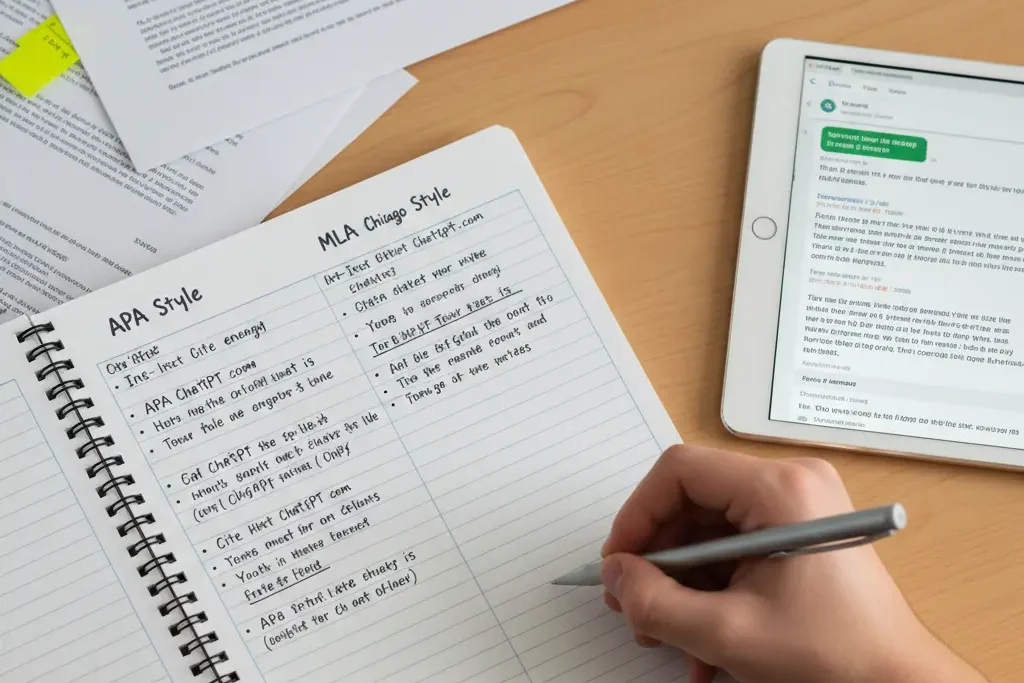
If you’re searching how to cite ChatGPT in-text, you likely want the part that stops lecturers from asking follow-up questions: the citation appears right where the AI influence appears, and it tells the reader what they need to know without turning your paragraph into a disclaimer.
The most reliable pattern is simple:
Put the in-text credit next to the sentence or passage that depends on ChatGPT.
- For APA: (OpenAI, Year)
- For MLA: (“Shortened prompt/description”)
- For Chicago: either (ChatGPT, Month Day, Year) or a note number
Where students accidentally create suspicion is when a paragraph is “AI-flavored” but only one vague mention appears at the end. If only one sentence came from ChatGPT, the citation belongs at that sentence. If the whole paragraph is built on a generated explanation, the citation can sit at the end of the paragraph.
Prompt context matters more than most students realize. Two ChatGPT responses can look similar on the page, but one might be “summarize my notes” and another might be “write my argument.” If your prompt shaped the output in a way that affects academic integrity, the prompt belongs somewhere visible—either in the text, in a note, or in an appendix excerpt.
How to cite ChatGPT images (APA, MLA, Chicago)
The first step when learning how to cite ChatGPT images is to treat the image like a figure with two required pieces of information: what it is and how it was created.
AI images are different from traditional images because your prompt is part of the creative input. A good citation gives a reader enough detail to understand what was generated and when.
APA figure caption and note (common student format)
Figure 1
[Short caption describing what the image shows]Note. Image generated using ChatGPT (OpenAI) from the prompt “…” on Month Day, Year.
MLA caption/citation format
“Prompt used to generate the image” prompt. ChatGPT, Version (if known), OpenAI, Day Mon. Year,https://chatgpt.com.
Chicago credit line format
“Prompt used to generate the image,” image generated by ChatGPT (OpenAI), Month Day, Year.
If the image was generated through a specific image model inside a chatbot environment, include that model name if it is shown in your interface. If it isn’t shown, don’t invent it.
Using an AI image you didn’t generate
If you found the image in lecture slides, a website, or another student’s work, cite the source where you found it. The “AI-generated” detail can be included in the caption if it affects your analysis or if your lecturer requires disclosure.
Common mistakes that lose marks even when the formatting looks correct
- Citing ChatGPT instead of original sources
If ChatGPT suggests sources, quotes studies, or references a paper, treat that as a lead. Verify, locate the original, and cite the original source for the factual claim. A ChatGPT citation documents use; it doesn’t transform the output into a credible scholarly authority. - Pretending a private chat is retrievable
Linking to a platform homepage is not the same as providing a retrievable source. If your instructor expects verification, an appendix excerpt or transcript matters more than a generic URL. - Dumping a single disclosure line at the end
A vague statement like “I used ChatGPT” doesn’t tell a marker what was AI-generated and what wasn’t. It can make everything look suspicious. Precise credit is calmer than vague credit. - Leaving the prompt out when the prompt is the whole story
If your prompt asked the tool to “draft,” “argue,” or “write,” that context matters. In Chicago, the prompt often belongs in the note. In MLA, it often becomes the source title. In APA, it can be described in brackets or included in an appendix excerpt when required.
Use Proofademic (when the citations are already done)
Citations handle attribution. They don’t automatically solve the practical reality that some passages raise eyebrows because they read like pasted output, even when credited. That’s where a compliance-first check helps. Can universities detect AI writing? Yes, they can.
Proofademic’s AI detection tool is built for that gap: after you’ve credited your AI use properly, sentence-level risk signals help you spot sections that look over-reliant on generated phrasing so you can rewrite in your own voice and support claims with real sources. It’s an integrity workflow, not a shortcut.
FAQs
How to cite ChatGPT as a reference?
Use ChatGPT citation rules for your required style, include OpenAI and the date you generated the output, and add enough description (prompt or output label) to show what was used.
How to cite ChatGPT in MLA?
To cite chatgpt mla, use your prompt or a clear description as the title, then list ChatGPT as the container: “Prompt/description” prompt. ChatGPT, version (if known), OpenAI, Day Mon. Year, https://chatgpt.com.
How do you cite AI as a source?
Cite AI when you use its generated output in the submission, and cite original sources for factual claims after verification.
How to know if a ChatGPT citation is correct?
A citation is correct when it matches the required style, includes the generation date, identifies the tool (OpenAI/ChatGPT), and makes clear what was generated (especially for citing ChatGPT in-text and ChatGPT image).