Key takeaways
- There is no universal AI percentage threshold in academic writing. Scores indicate risk levels, not proof of misconduct.
- AI detector scores, similarity scores, and actual AI usage are three different things and should not be interpreted interchangeably.
- AI detection tools provide probability-based signals, not definitive evidence of AI use.
- Typical AI score ranges act as risk zones: 0-15% means low concern, 15-30% may trigger review, and 30%+ is likely to prompt further investigation.
- A high AI score does not confirm misconduct, and a low score does not guarantee human authorship.
- Academic writing can naturally trigger AI flags due to its structured and formal style, leading to false positives.
There is no definite answer to what percentage of AI is acceptable in college writing. Generally, 0-15% AI scores are safe, 15-30% might raise some concerns, and more than 30% may lead to institutional revisions, but none of those scores prove academic dishonesty. Most institutions state that AI detection scores are just one signal in the submission-checking process, not a verdict.
What does exist is a set of risk zones with ranges that determine the level of scrutiny a submission is likely to receive. Understanding those AI detection percentage zones, what drives the scores within them, and what evidence demonstrates authorship is far more useful than chasing a safe numerical answer to how much AI detection is acceptable.
AI detector scores vs similarity scores vs actual AI use

AI percentage means three completely different things depending on the context. Treating them as the same concept is where most misinterpretation happens. Here is a quick overview of AI detection vs. similarity score vs. actual AI use.
| Score type | What it measures | What it cannot prove |
|---|---|---|
| AI detector score | How closely the text’s patterns resemble AI writing | That AI was used at all |
| Similarity score | Percentage of text matching known sources | Who wrote the text |
AI detector score
An AI score is the percentage produced by AI detectors like Turnitin, GPTZero, or Copyleaks. It is a probabilistic estimate that reflects how closely a text’s patterns (sentence predictability, syntactic uniformity, vocabulary distribution) match patterns typically associated with AI-generated writing. It is not a measurement of how much AI was used. It is a measure of how much the writing matches AI writing patterns.
Similarity/plagiarism score
A similarity score from plagiarism detectors is entirely different from an AI detection score. It measures how much of the submitted text matches existing published sources, websites, or previously submitted papers. An AI-generated essay often scores zero on similarity because the text is original, it has never appeared anywhere before. Conversely, human essays with correctly cited quotes may get flagged for plagiarism because quoted passages match their sources.
Actual AI usage
Actual AI usage refers to how a student used AI tools during their work. It might include brainstorming, outlining, drafting, editing, paraphrasing, or generating the full submission. This is what academic integrity policies address. It is entirely undetectable from a score alone.
A student who used ChatGPT to brainstorm but wrote every sentence themselves may score 30% on an AI detector or a student who did not use AI at all may score 25% because they both write formally. The score does not address the question of actual usage.
What percentage of AI is acceptable at each score band
There is no officially published rule or AI detection score currently available in academic settings. Institutions may use different internal review criteria, so students must always understand how universities detect AI writing and check for department policies.
The bands below represent typical institutional responses based on academic guidance, informed by what AI detectors colleges use in 2026 and what instructors commonly report.
Low range: 0-15% : usually no action
AI scores in the range of 0-15% typically generate no formal review. Minor AI signals in this band can reflect formal academic phrasing, grammar tool usage, or structured writing style rather than actual AI generation.
Mid range: 15-30% : may trigger manual review or questions
This range often prompts instructors to read the submission more carefully rather than immediately raising a concern. The question at this stage is if the writing style matches the student’s established voice and if the argumentation quality is consistent with prior work.
Students whose work lands here should be prepared to discuss their writing process if asked. This is not an accusation – it is a closer look at the submitted papers. Having drafts, notes, or research trails available makes that conversation short and straightforward.
High range: 30%+ : likely to trigger follow-up and evidence request
Submissions in this range are more likely to result in a formal review conversation: the instructor may ask for drafts or request a brief oral explanation of the argument. A score above 30% is not a verdict of misconduct. It is a flag that triggers scrutiny. The outcome of that scrutiny depends on the evidence of authorship that the student can provide and the judgment of the instructor.
What’s generally acceptable vs not acceptable AI help in college writing
The risk bands above describe what a score triggers. This next section describes the behavior behind a score: which uses of AI are typically permitted, which ones sit in a gray area, and which ones cross the line regardless of detection percentage. Both lenses matter, and they do not always line up.
AI policies vary across institutions. But there are some general thresholds that most academic settings consider fair or unfair AI use. Always verify your course or department policy before deciding what is permitted. Here are the different AI usage zones to help you better understand what percentage of AI is acceptable in university or other academic settings:
🟢 Green zone: often acceptable (check your policy)
- Using AI for brainstorming, like to generate topic ideas or explore angles for an essay, you then write independently.
- Having AI suggest a structure that you evaluate, modify, and write from.
- Using tools like Grammarly to catch errors and improve sentence clarity in work you have already written.
- Identifying sources or summarising background material using AI, but with independent manual verification.
This type of AI assistance is generally allowed by most institutions, but it is still important to check the institution’s policy.
🟡 Yellow zone: risky without heavy editing and disclosure
- Generating core arguments or analytical claims and then editing them significantly leaves the intellectual contribution ambiguous.
- Using AI to write a complete draft that students then revise. Most policies treat this as AI authorship even if the final version is heavily edited.
- Paraphrasing with AI tools to avoid plagiarism or AI flags. This restructures the text but doesn’t address authorship.
If you use AI in this zone, the risk is not just the detector score; it’s that your paper may not reflect genuine learning, which affects how you perform in follow-up assessments.
🔴 Red zone: usually not acceptable
- Submitting AI-generated text as your own work where your institution’s policy prohibits it.
- Using AI to complete assessments that are specifically designed to evaluate your own knowledge or skill.
- Using AI without proper citations where your institution requires disclosure. Know how to cite ChatGPT in APA, MLA, and Chicago properly to avoid getting flagged.
The red zone is not just determined by a score, it is determined by what your institution’s policy says about AI use and what the student did.
For students: what to do if your AI score is too high

If your submission has been flagged or you’re concerned about a score before submitting, the most important thing is to shift your focus from the number to the evidence. Our student guide to AI detection in academic writing walks through this in detail. A score is a signal, authorship evidence is the substance that resolves it.
1. Build your process proof
The most effective defense against a high AI score is a visible writing process. Before and during writing, maintain a rough draft, an outline, research notes, version history, and source annotations.
2. Prepare for an educator conversation
If your score prompts a review, be prepared to explain your work orally. Your instructor may ask you to explain certain parts of your submission or show the valid sources from which you got the information.
3. Run a pre-submission check
If you’re worried about how your paper will score before submitting, run it through an AI detector for students like Proofademic before it goes to your instructor.
For educators: how to use AI scores responsibly without wrongful accusations
When you check for AI writing in student work, remember that AI detection scores are indicators, not verdicts. Using them as verdicts creates two risks simultaneously: wrongly accusing students who wrote authentic work, and wrongly dismissing concerns about students who did not. A short fair review protocol may look like:
- Identify the specific sentences or sections that generated the flag
- Ask for process artifacts: outline, notes, sources, revision history
- Ask the student to explain their main argument and walk you through a key paragraph.
- Document your decision: what evidence you reviewed, what the student said, what your institution’s policy covers
If genuinely uncertain after this process, escalate to your department’s academic integrity officer
Use Proofademic to reduce false positives
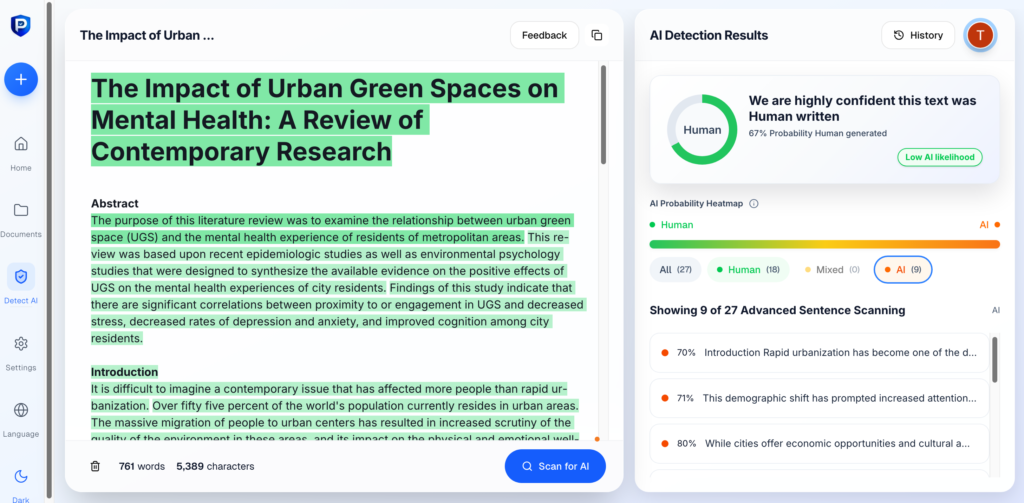
Deciding what percentage of AI is acceptable in college writing becomes far easier when your detector is tuned to academic writing in the first place. Most AI detectors are trained on general-purpose content: blog posts, marketing copy, news articles, which may cause false positives .
Academic writing, with formal register, citation-heavy structure, and discipline-specific conventions, looks different from that training data. Proofademic is trained specifically on academic writing: essays, research papers, literature reviews, and dissertations, and works as an integrity step in submission checking. It offers:
- Sentence-level AI detection highlights specific flagged sentences instead of giving a generic AI score.
- The batch scan feature efficiently processes multiple student submissions, providing consistent results across a class.
- You also get 1,000 words free on a 3-day trial without a credit card. Educators and students can evaluate academic-specific detection before committing to a paid Proofademic pricing plan.
TL;DR
There is no universal threshold to what percentage of AI is acceptable in college writing, only levels of scrutiny. A score below 15% typically raises no concern, a score between 15% and 30% may prompt a closer read, and a score above 30% is likely to trigger a review conversation. None of these ranges is an official rule, and none of them at any level constitutes proof of AI use.
The more useful question is: what evidence demonstrates that this is real work done by students? For students, that means maintaining a process trail including drafts, notes, sources, and version history. For educators, it means treating scores as indicators that open a review, not conclusions that close one.
If you are checking your own work before submission or reviewing a flagged paper fairly, only use an AI text detector built for academia like Proofademic and comply with your institution’s AI use policies.
FAQs
What percentage of AI is acceptable in university?
There is no fixed percentage that is acceptable across all universities. Most institutions treat 0-15% as low concern, 15-30% as worth a closer look, and anything above 30% as likely to prompt a formal review. Policies vary by course and department, so always check your specific assignment rules.
Do professors actually check for AI?
Yes, many do. Most universities provide AI detection through platforms like Turnitin, Copyleaks, or dedicated academic detectors such as Proofademic. Professors typically use detector scores as a starting signal, then ask students for process artifacts or an oral explanation before making any determination.
What happens if my paper gets flagged for AI?
A flag is not a verdict. In most cases, the instructor will ask to see your drafts, notes, and sources, or request a short conversation about your argument. If you can demonstrate authorship through your writing process, a high score on its own will not result in penalties at most institutions.
Is 20% AI detection bad?
Not automatically. A 20% score is in the mid-range, where some instructors will read more carefully, but most institutions do not treat this level as evidence of misconduct on its own. For many students, a 20% score reflects formal academic writing style, grammar tool usage, or templated structure.
What is the 30% rule for AI?
The “30% rule” is an informal reference point that circulates in academic discussions, not an official standard from any institution. It refers to the informal practice of treating submissions above 30% on an AI detector as warranting follow-up review. It is not a pass/fail threshold.
Is 40% AI-generated bad?
A 40% AI detection score will likely trigger a closer review at most institutions using AI detection tools. It does not mean the work is AI-generated, but it definitely raises concerns.
What percentage of AI detection is bad?
There is no universally accepted AI percentage that is considered bad, and no detector score on its own proves misconduct. The general informal risk landscape is: below 15% is low scrutiny, 15-30% may prompt closer reading, and 30%+ tends to trigger active review. None of these are official rules. What matters is if a student can provide authorship evidence when asked.
Is a 7% AI score bad?
No. A 7% AI detection score is low and will not trigger concern in most institutions. This score generally falls in the safe zone of academic AI usage. Still, you should confirm the AI use regulations with your college authorities and run it through an academic-specific tool like Proofademic.
What is a good AI score in academia?
There is no such thing as a good or bad AI score in academic submission. It mostly depends on institution policies. However, AI scores below 15% are mostly considered good.