How to use AI responsibly, avoid detection pitfalls, and actually improve your writing skills
Why Every Student Needs to Understand AI Detection Right Now
If you’re a college student in 2026, you’ve probably used ChatGPT, Claude, or another AI tool for schoolwork. You’re not alone, research shows that 89% of students have used AI for homework. But here’s what most students don’t know: your professors are using AI detectors, and they’re not always accurate.
Getting falsely flagged for AI use when you wrote something yourself? It’s happening more often than you think. Understanding how AI detection works isn’t just about avoiding trouble—it’s about protecting your academic reputation and actually becoming a better writer.
This guide will show you everything you need to know about AI detection tools, how to use AI ethically in your coursework, and most importantly, how to develop writing skills that serve you long after graduation.
What Are AI Detection Tools and How Do They Actually Work?
The Technology Behind Detection
AI detectors analyze your writing for patterns that artificial intelligence typically produces. They look for several key indicators:
1. Perplexity – How predictable your word choices are
AI tends to choose the most statistically likely next word, making its writing more predictable than human writing.
2. Burstiness – Variation in sentence length and structure
Humans naturally mix short, punchy sentences with longer, complex ones. AI often produces more uniform sentence patterns.
3. Linguistic Patterns – Specific phrases and structures
AI models have “tells”—certain phrases, transitions, and sentence constructions they use frequently.
4. Semantic Coherence – How ideas connect
AI-generated text can sometimes lack the natural flow and logical progression that characterizes authentic human thinking.
The Major Players in AI Detection
For Students:
- Proofademic – Built specifically for academic writing with sentence-level analysis
- GPTZero – Most widely used, over 8 million users, trusted by 3,500+ colleges
- Scribbr – Offers paragraph-level feedback in multiple languages
For Institutions:
- Turnitin – The industry standard, integrated with most learning management systems
- Copyleaks – Known for low false-positive rates and 30+ language support
- Grammarly – Includes AI detection alongside writing assistance
The False Positive Problem: What Students Need to Know
Here’s the uncomfortable truth that universities don’t always talk about: AI detectors make mistakes.
The Numbers Don’t Lie
Recent evaluations reveal concerning accuracy issues:
- Some detectors flag 15-22% of genuinely human-written text as AI-generated
- Non-native English speakers face higher false-positive rates
- Students with formal writing styles or using academic vocabulary are more likely to be incorrectly flagged
- Accuracy varies significantly between different AI models and writing contexts
When You’re Wrongly Accused
If you’ve been falsely flagged for AI use:
1. Don’t Panic
False positives are a known issue. Many universities understand this limitation.
2. Document Your Process
- Save your drafts and revision history
- Keep notes about your research process
- Use tools like GPTZero’s Writing Report to show your editing progression
- Take screenshots of your outline and brainstorming sessions
3. Request a Conversation
Ask your professor for a meeting to discuss the results. Be prepared to:
- Explain your writing process
- Discuss the content and your understanding of it
- Show evidence of your research and thinking
- Offer to revise or discuss specific sections
4. Know Your Rights
Most universities have academic integrity policies that require evidence beyond just a detector score. The University of British Columbia, for example, chose not to enable Turnitin’s AI detection feature due to reliability concerns.
How to Use AI Ethically in Your Coursework
The question isn’t whether to use AI, it’s how to use it responsibly. Think of AI as a study partner, not a ghostwriter.
The Ethical Framework: Three Questions
Before using AI for any assignment, ask yourself:
1. What does my syllabus say?
Check your course policies. Some professors ban AI entirely, others encourage it with proper citation, and many fall somewhere in between.
2. Am I learning or just completing?
If AI is doing your thinking for you, you’re missing the point of the assignment and robbing yourself of skill development.
3. Can I explain every sentence?
If you can’t defend and explain the content in your own words, you don’t own it.
Acceptable Uses of AI in Academic Work
✓ Brainstorming and Idea Generation
- “Give me 10 possible thesis statements about climate policy”
- “What are the main arguments for and against this position?”
- “Help me create an outline for analyzing this novel”
✓ Research Starting Points
- “What are the key debates in this field?”
- “Summarize the main schools of thought on this topic”
- “What questions should I be asking about this subject?”
✓ Editing and Refinement
- “Is this sentence grammatically correct?”
- “How can I make this transition clearer?”
- “Does this paragraph flow logically?”
✓ Understanding Complex Concepts
- “Explain quantum entanglement in simple terms”
- “Break down this statistical concept step by step”
- “What’s the difference between these two theories?”
Unacceptable Uses (That Will Get You in Trouble)
✗ Copying Entire Passages
Even with minor edits, this is plagiarism. Most institutions consider this academic misconduct.
✗ Having AI Write Your Entire Paper
This defeats the purpose of education and is easily detected by both software and professors who know your writing style.
✗ Using AI Without Disclosure
When your syllabus requires citation of AI use, failing to do so is a violation of academic integrity.
✗ Trusting AI Facts Without Verification
AI frequently “hallucinates” information, making up citations, statistics, and quotes that don’t exist.
Write Like a Human: Techniques That Actually Work
The best defense against AI detection isn’t gaming the system—it’s genuinely developing your writing skills. Here’s how to write authentically while still leveraging AI as a tool.
1. Start With Your Own Voice
Before using any AI:
- Brainstorm your own ideas first
- Create a rough outline based on your understanding
- Write a terrible first draft in your own words
- Only then use AI to help refine and improve
This ensures the core thinking and structure are yours.
2. Add Personal Elements
AI can’t replicate your unique experiences and perspectives. Strengthen your writing by including:
- Personal anecdotes: “When I volunteered at the food bank, I noticed…”
- Specific examples from your coursework: “In Professor Chen’s lecture on Tuesday, we discussed…”
- Your genuine reactions: “This finding surprised me because…”
- Course-specific references: “Building on the framework we studied in Week 3…”
3. Vary Your Sentence Structure Naturally
One of the biggest AI tells is repetitive sentence structure. Human writing has natural rhythm:
AI-like writing:
“The economy is complex. It involves many factors. These factors interact continuously. They shape market outcomes.”
Human-like writing:
“Economic complexity stems from countless interacting factors. Some are predictable—supply, demand, interest rates. Others? They emerge from the messy reality of human behavior.”
4. Use Conversational Transitions
AI often relies on formal transitions. Mix it up:
Instead of: “Furthermore,” “Additionally,” “In conclusion”
Try: “Here’s the thing,” “But wait,” “So what does this mean?”
(When appropriate for your assignment type)
5. Show Your Thinking Process
Don’t just state conclusions—show how you got there:
Weak (AI-like):
“Social media has negative effects on mental health.”
Strong (Human-like):
“At first, I assumed social media’s impact was entirely negative. But diving into the research revealed something more nuanced: the effects depend heavily on how we use these platforms. Passive scrolling correlates with increased depression, while active engagement in supportive communities shows opposite effects.”
Subject-Specific Strategies
Different fields require different approaches to AI and writing.
For STEM Students
Challenges:
- Technical writing can naturally seem “AI-like”
- Complex concepts require precise language
- Data and equations need careful handling
Solutions:
- Explain your problem-solving process, not just answers
- Include your reasoning for choosing specific methods
- Show your work and intermediate steps
- Reference specific lab experiences or experimental observations
- Discuss what confused you and how you overcame it
For Humanities and Social Sciences Students
Challenges:
- Literary analysis requires original interpretation
- Historical arguments need unique perspectives
- Theoretical discussions demand critical thinking
Solutions:
- Ground arguments in specific textual evidence
- Reference class discussions and debates
- Compare and contrast multiple scholarly viewpoints
- Include your evolving understanding of the material
- Connect course concepts to current events or personal experience
For Business and Professional Writing
Challenges:
- Business writing values clarity and efficiency (AI excels here)
- Case studies can seem formulaic
- Professional documents follow standard formats
Solutions:
- Include specific company examples beyond what AI might know
- Reference current industry news and trends
- Apply frameworks learned in class to novel situations
- Show your analytical process, not just conclusions
- Include relevant internship or work experiences
Tools and Workflows for Success
Your AI-Assisted Writing Workflow
Phase 1: Planning (AI as Brainstorm Partner)
- Define your assignment requirements
- Do initial research on your own
- Use AI to generate questions and perspectives you might have missed
- Create your outline based on your own understanding
Phase 2: Drafting (AI as Safety Net)
- Write your first draft entirely on your own
- Don’t worry about perfection—just get ideas down
- Focus on your argument and evidence
- Save this draft with a timestamp
Phase 3: Refining (AI as Editor)
- Use AI to check specific sentences for clarity
- Ask for suggestions on transitions
- Verify your understanding of complex concepts
- Get feedback on argument strength
Phase 4: Final Check (AI Detector as Quality Control)
- Run your paper through Proofademic or similar tool
- Review any flagged sections
- Ensure you can explain every flagged sentence
- Make final revisions to strengthen weak areas
Recommended Tools for Students
Writing and Detection:
- Proofademic – Academic-specific detection with detailed feedback
- GPTZero – Free writing reports showing revision history
- Grammarly – Writing assistance with AI transparency features
Research and Organization:
- Zotero – Citation management (never trust AI-generated citations)
- Google Scholar – Verify sources AI suggests
- Notion/Obsidian – Track your research and thinking process
Citation and Attribution: When you do use AI, cite it properly. Follow your style guide:
APA Style:
OpenAI. (2024). ChatGPT (GPT-4) [Large language model]. https://chat.openai.com
MLA Style:
“Text of the prompt.” ChatGPT, version GPT-4, OpenAI, 5 Dec. 2024, chat.openai.com.
Understanding Detection From Your Professor’s Perspective
What Professors Actually Care About
Your instructors aren’t trying to catch you—they’re trying to teach you. Here’s what they’re really concerned about:
1. Learning Outcomes
Can you think critically? Analyze information? Form original arguments? If AI is preventing skill development, that’s the problem.
2. Academic Honesty
They want to know that you’re being truthful about your work and your process.
3. Skill Development
Writing isn’t busywork. It’s how you learn to think, argue, and communicate—skills crucial for any career.
4. Fairness
Students who do their own work shouldn’t be disadvantaged compared to those taking shortcuts.
How to Have Productive Conversations About AI
If your professor has concerns:
Don’t:
- Get defensive or hostile
- Deny ever using AI (if you did)
- Blame the detection tool exclusively
- Make excuses without evidence
Do:
- Listen to their specific concerns
- Explain your actual writing process
- Provide evidence of your work (drafts, notes, outlines)
- Ask how you can demonstrate your learning
- Discuss ways to use AI more appropriately going forward
The Long Game: Building Skills That Matter
Here’s a perspective shift: AI detection is the least interesting part of this conversation. What matters is whether you’re actually learning.
Why Writing Skills Matter Beyond College
Strong writing means:
- Career success: Clear communication is the #1 skill employers want
- Critical thinking: Writing forces you to organize and evaluate ideas
- Persuasion: Whether pitching projects, negotiating salaries, or leading teams
- Self-expression: Articulating your thoughts clearly shapes your professional identity
The Paradox of AI in Education
AI can make you a better writer—but only if you use it right. Think of it like a calculator in math class:
- Used poorly: You never learn the underlying concepts
- Used well: You can tackle more complex problems while still understanding fundamentals
Developing an AI-Augmented Learning Practice
For every assignment:
Reflect on what you learned
Write a brief note to yourself: What was challenging? What surprised you? How did your thinking change?
Track your improvement
Keep a portfolio of your work. Read your early papers later—you’ll be amazed at your growth.
Seek feedback
AI can’t replace human mentorship. Use office hours, writing centers, and peer review.
Practice writing regularly
Keep a journal, write blog posts, contribute to discussions. The more you write, the more naturally it comes.
Proofademic: Built for Students and Academic Integrity
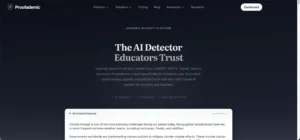
While many AI detectors treat academic writing as just another text type, Proofademic was designed specifically for the unique challenges of student work.
Why Proofademic Stands Out
Academic-First Design
The detection models are trained on essays, research papers, and academic writing—not blog posts or marketing copy. This reduces false positives from naturally formal academic language.
Sentence-Level Transparency
Instead of just flagging your paper as “likely AI,” Proofademic shows you exactly which sentences trigger detection and why. This helps you understand and improve your writing.
Multi-Language Support
Whether you’re writing in English, Spanish, French, or German, Proofademic provides accurate detection across languages.
Educational Focus
The tool is designed as a learning aid, not just a policing mechanism. Use it to check your work before submission and improve areas that might trigger false positives.
How to Use Proofademic Effectively
Before Submission:
- Run your completed draft through the detector
- Review any highlighted sentences
- Ask yourself: Can I explain why I wrote this in my own words?
- Revise sections that feel generic or overly formal
- Use the feedback to strengthen your authentic voice
For Learning:
- Compare drafts to see how your writing evolves
- Identify patterns in your writing that might seem AI-like
- Learn to recognize and avoid overly formulaic expressions
- Build confidence in your unique writing style
Common Scenarios and How to Handle Them
Scenario 1: “I Used AI for Brainstorming, Now My Whole Paper is Flagged”
What happened:
AI-generated outlines can influence your entire paper’s structure and phrasing, even if you wrote the content yourself.
How to fix it:
- Reorganize sections in your own logical flow
- Add specific examples from your course materials
- Include personal insights and reactions
- Vary sentence structures throughout
- Make sure each paragraph reflects your actual thinking
Scenario 2: “I’m a Non-Native English Speaker and Always Get Flagged”
What happened:
Formal academic language learned from textbooks can resemble AI output. Many detectors show bias against ESL writers.
How to address it:
- Document your writing process thoroughly
- Use campus writing centers for support
- Keep all your drafts and notes
- Ask professors about appropriate AI use for language help
- Consider tools like Grammarly specifically for grammar (which is different from having AI write content)
- Proofademic’s academic training reduces but doesn’t eliminate this bias
Scenario 3: “I Didn’t Use AI, But My Professor Thinks I Did”
What happened:
Your writing style might have changed (you improved!), or you wrote in a more formal style than usual, or you’re a victim of a false positive.
How to respond:
- Request a meeting immediately
- Bring evidence: drafts, notes, research materials
- Offer to explain the content in detail
- Ask what specifically triggered concern
- Be prepared to revise or rewrite with documentation
- Know that you have rights—detection alone isn’t proof
Scenario 4: “My Friend Uses AI and Gets Better Grades”
What happened:
Short-term gains from AI use might seem appealing, but there are long-term consequences.
The reality:
- Your friend isn’t developing actual skills
- They’re at higher risk for academic misconduct charges
- They’ll struggle in higher-level courses that build on these skills
- Job markets increasingly test actual competencies
- Academic records follow you
Your path:
Focus on your own learning. The goal isn’t just grades—it’s gaining skills that serve you for decades.
Looking Ahead: The Future of AI in Education
The landscape is evolving rapidly. Here’s what to expect:
Emerging Trends
More Sophisticated Detection
Detectors are getting better at identifying AI patterns, including “humanized” AI output and paraphrased content.
Institutional Policies
Universities are developing clearer guidelines. Expect more specific policies about AI use by 2026.
AI Watermarking
OpenAI and others are developing invisible watermarks for AI-generated text, making detection more accurate.
Process-Based Assessment
More professors are requiring documentation of your writing process, not just final products.
Skills That Will Always Matter
Regardless of AI advances:
Critical Thinking: Evaluating information, forming arguments, identifying biases
Original Analysis: Bringing unique perspectives to problems
Clear Communication: Expressing complex ideas simply
Ethical Judgment: Knowing when and how to use tools responsibly
Adaptability: Learning new technologies while maintaining integrity
Your Action Plan: Starting Today
Week 1: Audit Your Current Practices
- Review all your course syllabi for AI policies
- Identify assignments where AI use is explicitly allowed or forbidden
- Test your recent papers in Proofademic to understand your baseline
- Save your current drafts and outlines as evidence of your process
Week 2: Develop Better Habits
- Create a writing workflow that documents your process
- Set up a system for tracking drafts (Google Docs version history, dated files)
- Practice writing without AI first, then using it strategically
- Start a reflection journal about your learning
Week 3: Build Your Skills
- Visit your campus writing center
- Attend office hours to discuss your writing
- Practice explaining your papers out loud
- Work on varying your sentence structure naturally
Ongoing: Maintain Integrity
- Always check policies before using AI
- Document your process for every assignment
- Use AI as a tool, not a replacement
- Focus on what you’re learning, not just grades
- Stay informed about evolving policies and tools
Final Thoughts: Beyond Detection
The conversation about AI in education often focuses on catching cheaters. But that’s the wrong question.
The right questions are:
- Are you learning what you need to know?
- Are you developing skills that will serve you?
- Are you being honest with yourself about your work?
- Are you using technology to enhance your education, not replace it?
AI detection tools like Proofademic exist not to punish students, but to support academic integrity and ensure that education maintains its value. The goal isn’t to eliminate AI from your toolkit—it’s to ensure you’re using it in ways that support your growth.
Your education is an investment in yourself. Every assignment is an opportunity to develop skills that will compound over your entire career. AI can help you learn more efficiently, but it can’t learn for you.
Write authentically. Learn genuinely. Use AI responsibly. Your future self will thank you.
Resources and Further Reading
For Students:
For Understanding AI:
- Journal articles on AI detection accuracy
- University policy documents on generative AI
- Writing center resources on academic integrity
Tools Mentioned:
- Proofademic.ai – Academic-specific AI detection
- GPTZero.me – Popular student-friendly detector
- Grammarly.com – Writing assistance with AI features
Have questions about using AI responsibly in your coursework? Check your work with Proofademic to ensure your writing reflects your authentic voice and learning.