Key Takeaways
- SafeAssign has no AI-authorship detector. It is built to find text overlap with existing sources.
- An AI-assisted submission can still produce a similarity match on SafeAssign. That match reflects overlapping text and is not a proof that AI wrote the paper.
- The SafeAssign percentage is not a threshold for final scoring. What matters is what type of text is flagged, how long the flag is, and if it is properly cited.
- A 0% match means SafeAssign found no reportable overlap on a student submission. It reveals nothing about human authorship, accuracy, or compliance with an AI-use policy.
- Paraphrased text can lower a SafeAssign similarity score, even if the original text came from an AI system.
- Proofademic’s sentence-level AI detector, plagiarism checker, and paraphrasing shield work alongside SafeAssign similarity score and human judgment to complete the academic scoring workflow.
SafeAssign is a text-matching detection platform. It is not built to determine if ChatGPT or any other AI system produced a submission. It compares submitted papers against published sources and student submissions where the text overlaps. It does not evaluate sentence structure, word choice patterns, or the statistical signals that separate AI-generated prose from human writing.
Many instructors search for a SafeAssign AI checker, expecting one report to cover both similarity and AI coverage. But SafeAssign was built as a similarity checker. When educators need to assess possible AI authorship alongside originality, a dedicated AI detection and plagiarism checker tool such as Proofademic provides sentence-level analysis that complements SafeAssign’s similarity review.
Short answer: SafeAssign does not detect AI writing; it is a similarity checking tool that flags text overlapping with indexed sources. AI-generated text can still register a match if it reuses common phrasing, quotations, or previously indexed content. Educators who need to evaluate AI use should pair SafeAssign with a dedicated AI detector, such as Proofademic.
Does SafeAssign detect AI writing like ChatGPT?
SafeAssign is not a dedicated AI detector. It is a plagiarism and text-similarity detection tool that compares a student’s submission against a set of reference databases. Because it measures overlap rather than authorship, it cannot reliably determine if a paper was written by ChatGPT, another AI model, or a human.
As a text-matching software, SafeAssign generates an originality report that shows matching passages, identifies potential sources, and assigns a score. The score it returns measures textual overlap and does not analyse linguistic signals or sentence-level characteristics that dedicated AI detectors use.
That said, AI-generated content can still receive a similarity match. If an AI model produces wording that already exists in SafeAssign’s comparison sources, it may flag those passages. In those cases, it is identifying matching text and cannot confirm who exactly wrote the submission.
Common misconception vs. documented reality
| Misconception | Documented Reality |
|---|---|
| SafeAssign detects ChatGPT-written papers | SafeAssign detects text similarity to indexed sources. It does not tell you about AI authorship |
| A low similarity score means a human wrote the paper | A low score only means the text has little overlap with SafeAssign’s databases; it says nothing about who wrote it |
| A high similarity score proves AI use | A high score indicates overlapping text, which can come from quotations, common phrasing, or reused sources with no AI involvement |
What does SafeAssign check?
SafeAssign is Blackboard’s originality-checking service, built for plagiarism review rather than AI detection. It compares a submitted paper against a defined set of sources and produces a SafeAssign Originality Report showing where the text overlaps with existing material, which is why it cannot function as an AI-authorship tool.
Where Does SafeAssign Compare Student Work?
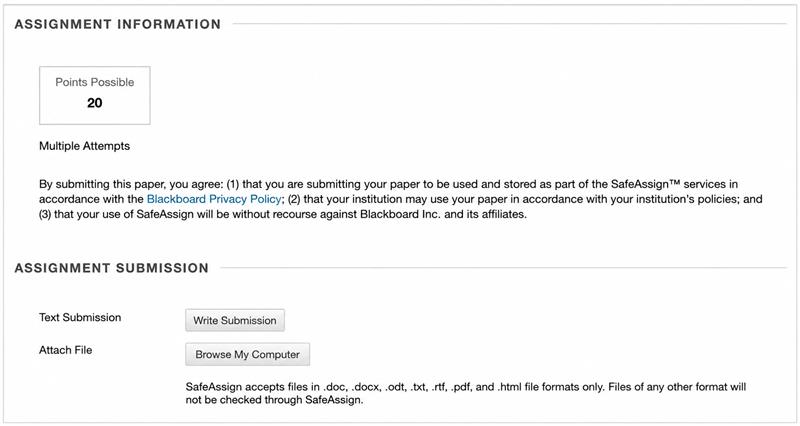
SafeAssign checks submissions against institutional archives, a global reference database of student submissions from other Blackboard institutions, the ProQuest ABI/Inform journal database, and indexed public internet content. None of these databases contains a category for “AI-generated text.” They contain existing written material, and SafeAssign looks for overlap with it.
How does text matching work?
The system breaks submitted text into smaller segments rather than comparing whole documents at once, catching partial or reworded overlap. Each segment is scored against the source databases and compiled into a percentage reflecting the proportion of the submission with detectable overlap. Processing can take a few minutes or over a day during periods of high demand.
What’s inside the SafeAssign originality report?
- Overall similarity score: The percentage of the submission that overlaps with indexed sources.
- Highlighted passages: The specific blocks of text flagged as matches, marked directly in the submitted document.
- Source links: References back to the matching material, where available, so instructors can compare the original and submitted text side by side.
- Match details: A breakdown of individual matches, including which source each passage overlaps with and how closely.
Note: Similarity does not equal misconduct. La Trobe University notes that similarity reports identify matching texts rather than plagiarism itself, and that only an informed reviewer can determine if a match represents academic misconduct. Thus, a flagged match is a starting point for review and educators should never treat it as a verdict. Students as well as instructors should investigate each match individually, since quotations, citations, and standard terminology can all trigger a flag without wrongdoing.
SafeAssign versus an AI detector: Two tools answering different questions
The important question isn’t about SafeAssign AI detection; it’s what SafeAssign is designed to do. SafeAssign and a dedicated AI detector solve different problems, and neither can settle a question of academic misconduct alone. Using both, alongside instructor judgment, builds a stronger process than relying on either tool by itself.
| Question | SafeAssign | Dedicated AI Detector |
|---|---|---|
| What does it analyse? | Overlap with existing indexed sources | Linguistic patterns associated with AI-generated writing |
| What does it produce? | A similarity percentage and a list of matched sources | A sentence-level AI-likelihood analysis |
| Can it prove misconduct on its own? | No | No |
| What is it best used for? | Reviewing attribution and identifying reused source material | Flagging passages that warrant a closer authorship review |
| What should an instructor do with the result? | Inspect each match and its citation | Review flagged passages alongside other contextual evidence |
Originality and human authorship are not the same measurement, which is why a clean SafeAssign report cannot stand in for an AI check. A 2025 study comparing plagiarism checks and AI detectors evaluated 1,000 texts, including 250 human-written papers and 750 ChatGPT-generated papers, and found that many AI-generated texts achieved high originality in plagiarism checks while AI-detection tools were evaluating a completely different characteristic: if the writing showed patterns associated with AI authorship. This highlights that a document can appear highly original without necessarily being human-written.
This is why dedicated AI detectors have become an important part of the academic integrity flow. Rather than measuring text overlap, they evaluate authorship signals that similarity tools are not designed to detect. Their findings still require an instructor’s judgement, but they provide a separate layer of evidence. Proofademic’s academic AI text detector is built around that approach with sentence-level analysis, so instructors see exactly which passages triggered the flag instead of guessing at which part of a long paper deserves a second look.
How accurate is SafeAssign, and what does its percentage mean?
SafeAssign’s accuracy depends on the task. For identifying overlap with material inside its own comparison sources, it performs the job it was designed for. It is not an appropriate measure of AI-detection accuracy, since that was never part of its documented function. There is also no universally acceptable similarity percentage: direct quotations, bibliographies, instructor-provided templates, common phrasing, and discipline-specific terminology can all raise a score without indicating misconduct.
For that reason, the Originality Report should be viewed as a starting point for review. Instructors should evaluate each match in context by considering its source, length, placement, attribution, and relevance before drawing any academic integrity conclusions.
Why should educators not use a universal cutoff?
- A flat rule, such as treating anything above 20% as a violation, ignores what kind of matches make up the score.
- A five-page paper built around three required quotations will score differently than one with a single long unattributed passage, even at a similar overall percentage.
- Institutional policy is better served by defining a review procedure for flagged submissions than by setting a single automatic threshold.
What a 0% SafeAssign Score Does, and Does Not Mean?
- It means SafeAssign found no reportable overlap between the submission and its comparison sources during that scan.
- It does not confirm that the writing is human-authored, factually accurate, well-reasoned, or compliant with the institution’s AI-use policy.
Can SafeAssign detect paraphrased or humanised text?
SafeAssign’s documentation refers to exact and inexact matching, so it can catch close paraphrase that still resembles an indexed source closely enough to register overlap. What it does not have is a category for “humanized” text. Research using the PAN plagiarism benchmark has consistently shown that manually paraphrased plagiarism is one of the hardest forms of plagiarism to identify because substantial rewriting reduces the textual overlap that matching systems rely on. As a result, substantially reworked source material falls below the threshold that triggers a match, and fully novel AI-generated text with no indexed counterpart registers no overlap at all on the SafeAssign originality report.
However, a low or absent similarity score does not necessarily mean the writing is free of attribution concerns. A paraphrase that avoids a high-similarity score can still represent unattributed use of someone else’s ideas without matching their exact wording. This is why, when paraphrasing or AI-assisted rewriting substantially changes the wording, a dedicated authorship analysis can provide additional context beyond source overlap. Proofademic’s paraphrase shield is built for this specific question, checking if reworded or AI-assisted text still carries the linguistic patterns associated with AI-generated text that a similarity scanner would miss.
A quick test of Proofademic’s paraphrase shield
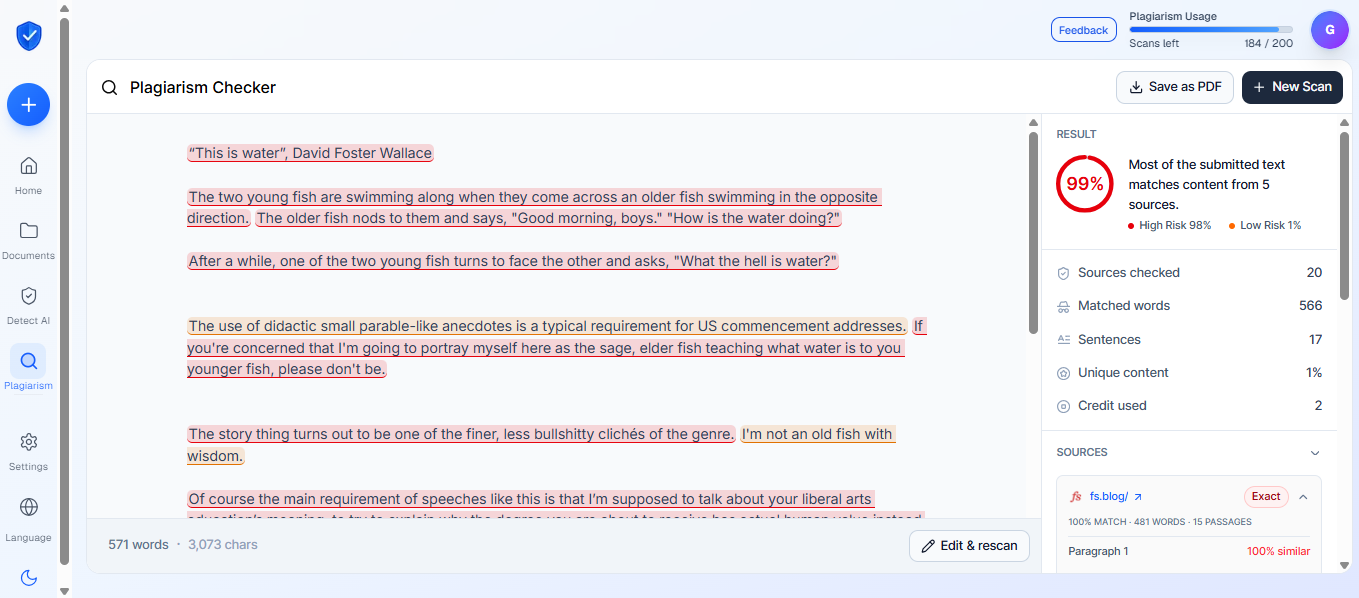
As a definite proof of Proofademic’s paraphrase shield’s accuracy, we took an already published essay and then paraphrased it using a paraphrasing tool.
The directly copied content showed a 100% plagiarism score as expected:
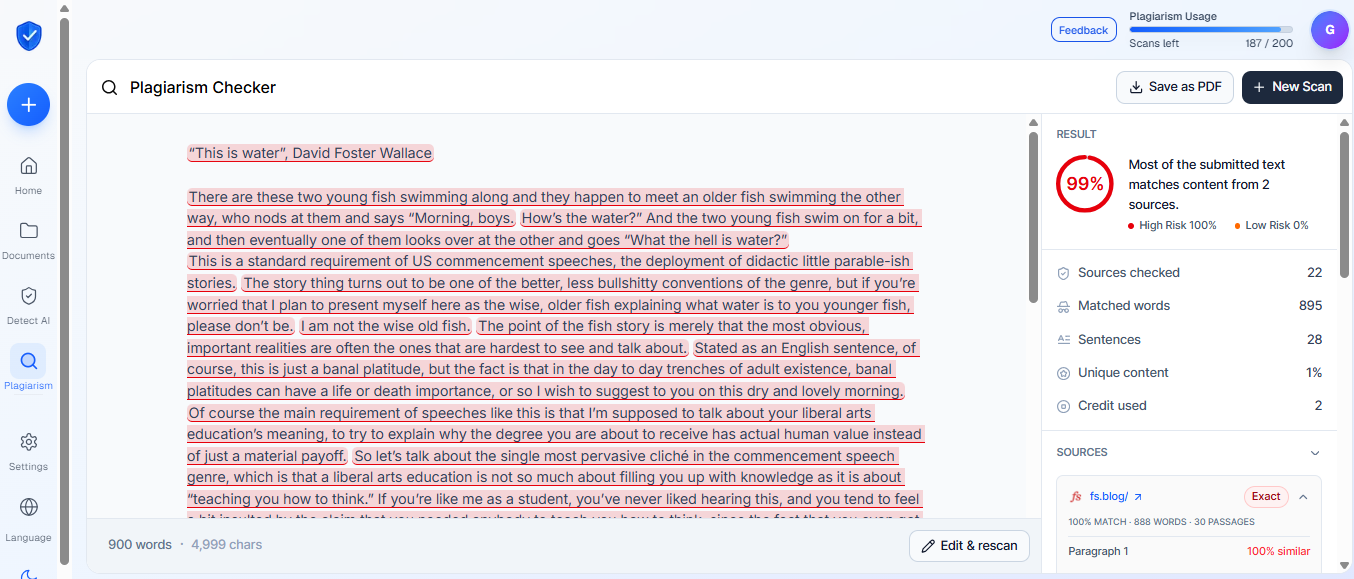
Now for the paraphrased content, SafeAssign similarity report or general plagiarism checker tools will clear it as unique because the wording has changed completely. However, Proofademic’s paraphrase shield still captures the underlying mechanical patterns in the text very well, which makes it a reliable tool for teachers against paraphrasing tools.
So, instead of solely relying on SafeAssign’s similarity report, pair it with Proofademic’s AI detection and plagiarism checker to complete your submission checking workflow.
A practical workflow for reviewing AI writing alongside SafeAssign
Effective academic integrity reviews rely on multiple forms of evidence rather than a single automated score. Treating any tool’s score as final risks false positives against students who did nothing wrong. Universities increasingly recommend treating similarity reports and AI detection results as starting points of investigation, supported by contextual review and institutional policy. The workflow below shows how SafeAssign and a dedicated AI detector can work together as part of a structured academic integrity review.
Step 1: Use SafeAssign for source overlap
Review each matched passage individually, separating direct quotations and cited references from text that looks like unattributed reuse.
Step 2: Use Proofademic for Authorship Signals
Look at sentence-level flags rather than a single document-wide percentage. Use the flagged passages to identify which parts of the submission call for closer reading. Proofademic for teachers outlines how this fits into a classroom workflow.
Step 3: Corroborate the Result
Check where institutional policy allows, compare flagged passages against a student’s prior work. Review drafts, notes, citations, and version history, and account for which forms of AI assistance the assignment permits. This step is especially important because AI policies differ across institutions. For example, the University of Sydney generally permits AI use in many open assessments when it is properly disclosed, while UNSW Sydney defines different levels of permitted AI assistance for each assessment type. Therefore, before drawing conclusions, confirm what the assignment and institution allow.
Step 4: Follow Institutional Policy and Allow Review
Treat an automated score from either tool as one input rather than standalone proof. Document the evidence and give the student a chance to explain their process before escalating through the institution’s established procedure. For how a different platform handles this layer, see how Turnitin detects AI writing, which uses a separate AI-detection system from SafeAssign’s text-matching approach.
Complete your academic integrity workflow with Proofademic
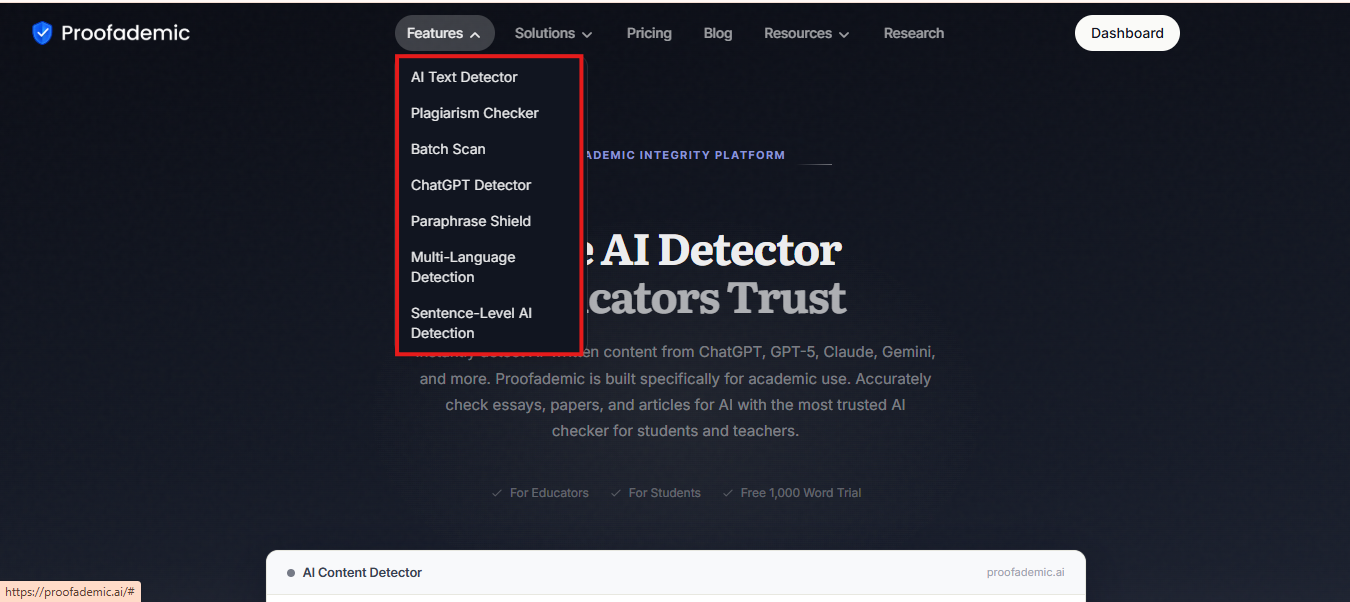
SafeAssign covers one half of a modern academic-integrity check: overlap between a submission and existing material. Proofademic covers the half SafeAssign’s documentation does not address, with sentence-level AI detection accuracy that shows which passages warrant review rather than a single score for the whole paper. Proofademic also includes its own plagiarism checker, batch scanning, and multilingual detection, so one platform can handle similarity and AI-likelihood review in a single workflow. To help educators evaluate the platform before committing, Proofademic offers a 3-day free trial with no credit card required.
TL;DR
SafeAssign does not detect AI writing; it identifies overlap between a submission and existing indexed sources, which is a different question from who wrote the text. A similarity match is not proof of AI use, and a 0% score is not proof of its absence. Instructors get a more defensible result by pairing SafeAssign’s overlap review with a sentence-level AI detector and their own judgment, then following institutional procedure before drawing any conclusion. Proofademic is built to serve as that second layer, alongside SafeAssign helping educators evaluate AI authorship alongside text similarity as part of a comprehensive academic integrity workflow.
FAQs
Does SafeAssign detect AI writing like ChatGPT?
No documented ChatGPT detection capability exists in SafeAssign. It may flag matching source text inside an AI-assisted submission, but that match does not establish that ChatGPT or another AI system wrote the paper.
Is SafeAssign on Blackboard accurate?
SafeAssign on Blackboard performs well at identifying overlap with material in its comparison sources. However, its report still requires manual interpretation and should not be judged as though it were an AI detector.
What percentage of plagiarism is acceptable on SafeAssign?
There is no universal acceptable percentage. An educator as well as a student must review the nature and location of each match instead of applying a fixed cutoff.
What is the difference between SafeAssign and an AI detector?
SafeAssign compares submitted text against existing sources for overlap. An AI detector analyses writing patterns associated with machine-generated text. Neither result alone proves academic misconduct.
Can SafeAssign detect paraphrased or humanised text?
SafeAssign can flag exact or inexact overlap that survives paraphrasing. It has no way to determine if text was humanised, and it cannot reliably identify novel AI-generated prose based on authorship alone.
What should educators use to detect AI writing?
Educators should pair a dedicated academic AI detector with SafeAssign, then confirm the result using assignment context, drafts, citations, and a conversation with the student where institutional policy allows.