Key Takeaways
- A plagiarism checker measures source overlap; an AI detector measures the likelihood of AI-generated writing patterns.
- A similarity score is evidence-based, drawn from matched sources; an AI confidence score is probabilistic.
- AI-generated text can return a low similarity score because it may not exist in any web resources or student submission databases to match against.
- Generic AI detectors can falsely flag human-written academic submissions, which is why results require contextual review and the use of an academic-first AI checker.
- A sound integrity workflow generally runs a plagiarism check first, resolves citation issues, and then reviews AI detection signals in context.
- Proofademic keeps academic-calibrated plagiarism checking and AI detection within one platform, with clear individual reports and deep sentence-level analysis.
A plagiarism checker detects if a text shows similarity to already published content or existing student submissions. An AI detector assesses the likelihood that the text was written by AI writing tools. A paper can pass a plagiarism checker with a near-perfect score and still be flagged by an AI detector. In other cases, a fully human-written paper may receive an elevated AI score on generic detectors, while a copied paragraph goes unnoticed by the same review. Due to these unreliabilities in the results, understanding the difference between a plagiarism checker vs AI detector is very important for students, teachers, institution admins, and publishers.
At Proofademic, we built both tools as part of one academic integrity platform precisely because you need clarity on this distinction rather than a single blended score that hides it. In this article, we will explain what plagiarism checkers and AI detectors check, what their scores mean, when to run each one, and why a reliable academic integrity workflow generally needs both.
Short Answer: Plagiarism detection tools tell you if a text overlaps with existing published or submitted material. An AI detector tells you if the writing shows patterns associated with AI generation. The first relies on source matching; the second relies on probabilistic analysis of writing style. Neither score proves misconduct by itself, and neither should be substituted for the other.
Plagiarism checker vs AI detector: A side-by-side comparison
A plagiarism checker’s score and an AI detector’s score both matter equally. Neither one, taken alone, accounts for how a piece of academic work was actually produced. Therefore, understanding the distinction between the two is essential.
| Factors | Plagiarism Checker | AI Detector |
|---|---|---|
| What it checks | Overlap with existing sources | AI-generated writing patterns |
| Main output | Similarity score and matched sources | AI confidence score or likelihood |
| Best for | Citation and originality check | Authorship and AI-use review |
| Evidence type | External source matches | Probabilistic model signal |
| Main limitation | May miss newly generated AI text | Should not be treated as proof alone |
Want to see both plagiarism and AI detection run on the same document? Try Proofademic and ensure each submission meets your institution’s policy.
What does a plagiarism checker check?
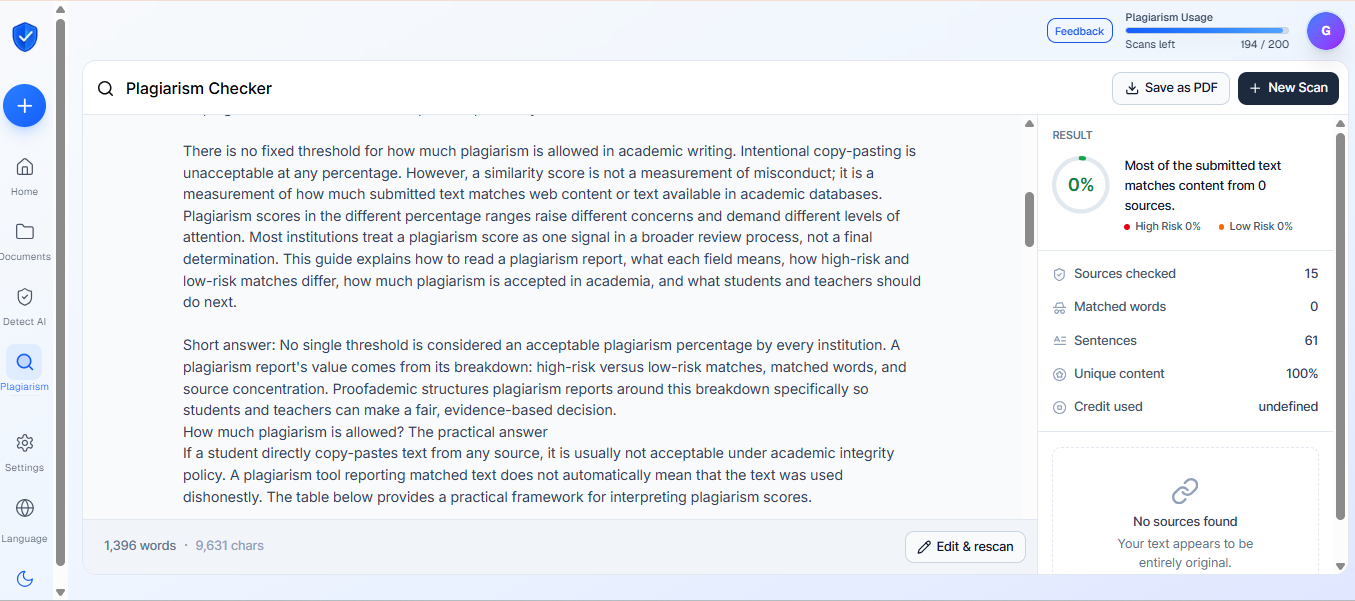
A plagiarism checker compares submitted text against a large index of existing material, which may include published articles, web content, academic databases, repositories, and, in some cases, previously submitted student work. It’s fundamentally a matching exercise, which detects if this sentence, or something very close to it, already exists somewhere else.
The plagiarism checker’s output typically flags several types of matches:
- Direct copying of text
- Close paraphrasing that retains the original structure or phrasing
- Missing or incomplete citations
- Reused language across multiple sources
- Quoted material that isn’t formatted correctly
In short As you can see in the screenshot above, Proofademic’s plagiarism checker compares a text against multiple sources and gives a clear report on the words and sentences that match already published content. This report is the straightforward example of what a plagiarism checker is.
What does a similarity score mean?
A similarity score is a percentage. A 0% score doesn’t prove a paper is fully original; it only means no matches were found in the indexed sources, which can happen even with carelessly AI-generated or fabricated content. Likewise, a 30% score doesn’t automatically mean misconduct occurred. Reference lists, assignment prompts repeated across submissions, common technical phrases, and properly quoted material can all inflate similarity without indicating any wrongdoing.
The score is a starting point for review. That’s exactly why Proofademic’s academic plagiarism checker surfaces matched sources alongside the score, so reviewers can judge context rather than relying on a single number.
When to use a plagiarism checker?
Use a plagiarism checker whenever the concern is attribution: source copying, citation accuracy, or reused text from existing material.
- Students: You should typically run it before submission to catch missing citations or paraphrasing detection that’s accidentally too close to the original wording.
- Educators: Use it when reviewing submitted work for copied passages or unattributed source overlap.
- Institutions: Rely on it to enforce citation standards and originality policy consistently across large volumes of submissions.
The common thread is that when the question concerns text originating elsewhere, a plagiarism checker should be used.
What does an AI detector check?
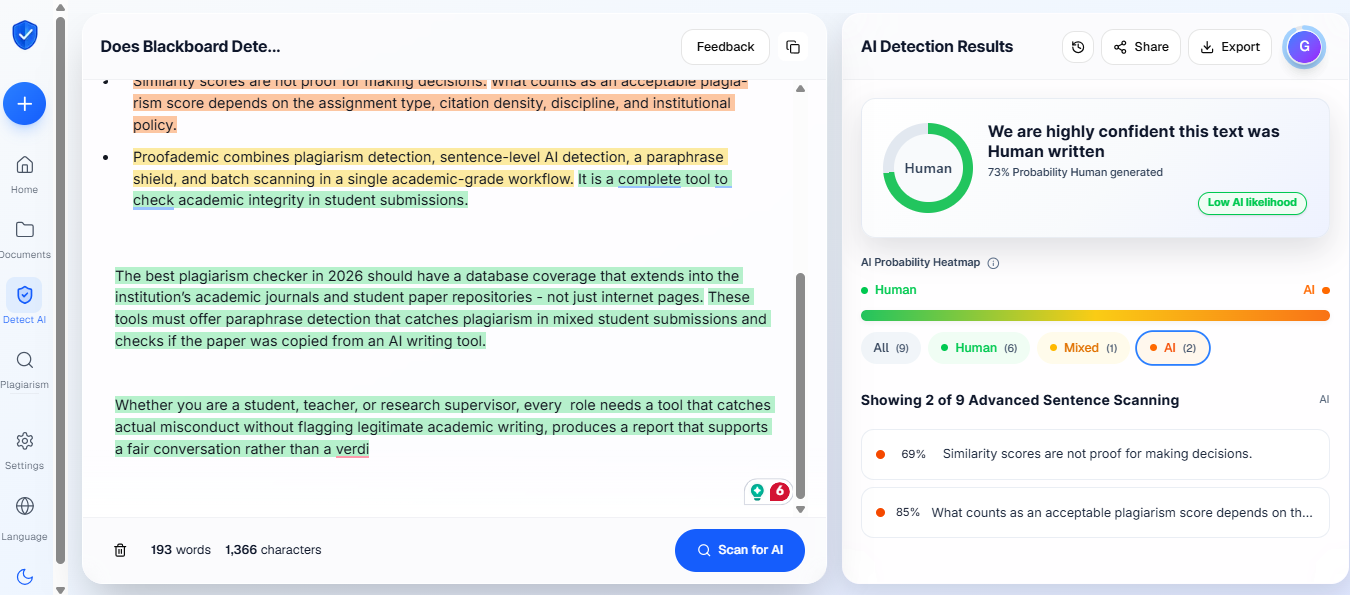
An AI detector works differently. Instead of comparing text to external sources, it analyzes the text itself for patterns associated with machine-generated writing. Features such as unusually predictable word choices, uniform sentence structure, and statistical regularities that deviate from typical human variation are commonly detected. No technical background is needed to understand the core idea: AI models tend to write in measurably different patterns than people do, and a detector is trained to recognize those patterns.
In shortThe Proofademic AI detection report shows an overall percentage of AI possibility of the content. You can also see that the report includes sentence-by-sentence highlights of Human, AI, and Mixed content. These highlights do not indicate copied content from other sources, like a plagiarism checker, but rather identify writing patterns that resemble those commonly produced by large language models (LLMs).
What does an AI confidence score mean?
An AI confidence score is a likelihood indicator. It reflects how closely the writing patterns in a document resemble those typically produced by AI models, based on the detector’s training. However, it should never be treated as definitive proof on its own.
This is where responsible interpretation matters most. AI detector results need context, assignment history, writing samples, drafts, or a conversation with the student before any conclusion is drawn. Proofademic’s sentence-level AI detection supports this kind of careful review by showing which specific sentences are driving the score, rather than providing a single document-wide number to interpret.
When to use AI detectors in academia?
Use an AI detector when the concern shifts to authorship: possible undisclosed AI assistance, or a submission that may not genuinely reflect a student’s own writing process.
Used responsibly, an AI detector score should start a review. It works best when combined with other contexts, such as earlier drafts, writing history, assignment requirements, or a direct conversation with the student about how the work was produced. Given how often this question comes up specifically around ChatGPT-generated submissions, Proofademic also offers a dedicated ChatGPT detector built for that exact scenario.
Plagiarism Detector vs AI Detector: Which should you run first?
The ultimate goal of this order is to establish a factual baseline. AI detection then helps address content authenticity questions that source matching simply can’t answer. So, for a practical academic review, follow this order:
- Run Proofademic’s plagiarism checker first: This surfaces source overlap and citation issues, which tend to be clearer and easier to resolve.
- Review and resolve the obvious matches: Correct citations, properly quoted material, and reused phrases that don’t indicate misconduct.
- Verify your submission with Proofademic’s AI detector next: Once source-level questions are out of the way, evaluate authorship signals on the remaining text.
- Use Proofademic’s sentence-level findings: With sentence-level findings, understand the full context. Drafts, history, and conversation; obtain full context before making any academic integrity decision.
Can AI detectors catch plagiarised content? An actual test.
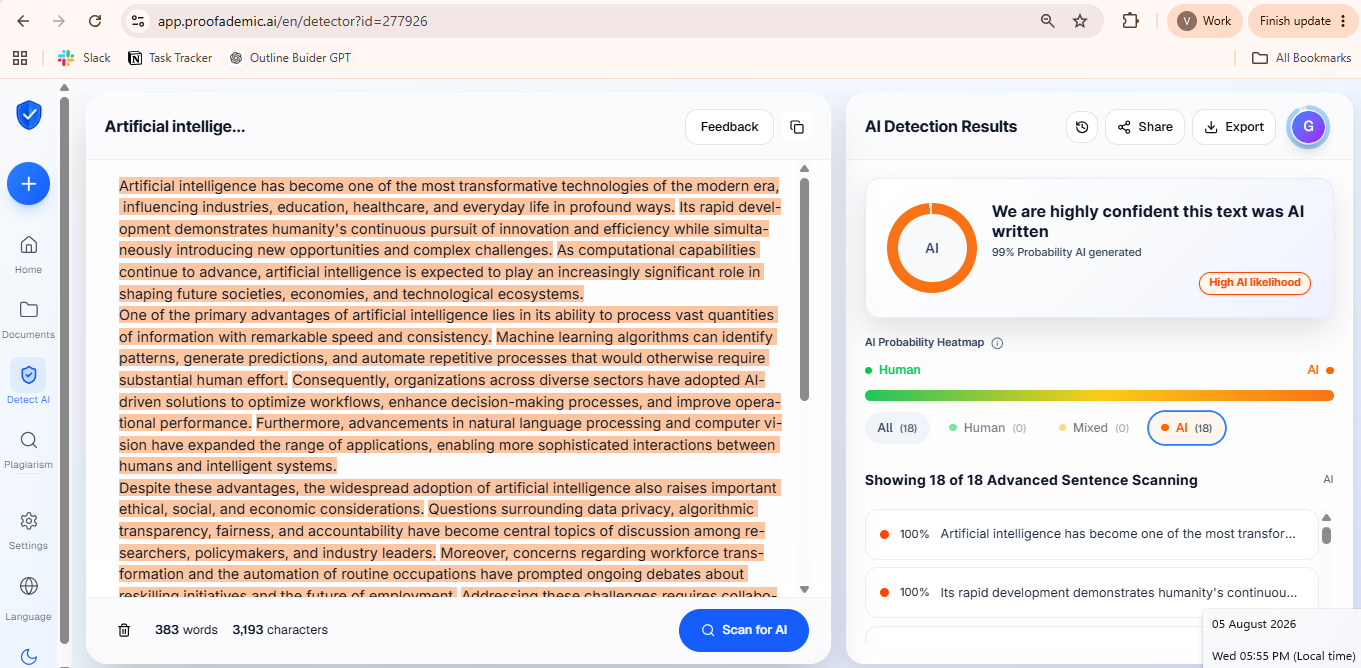
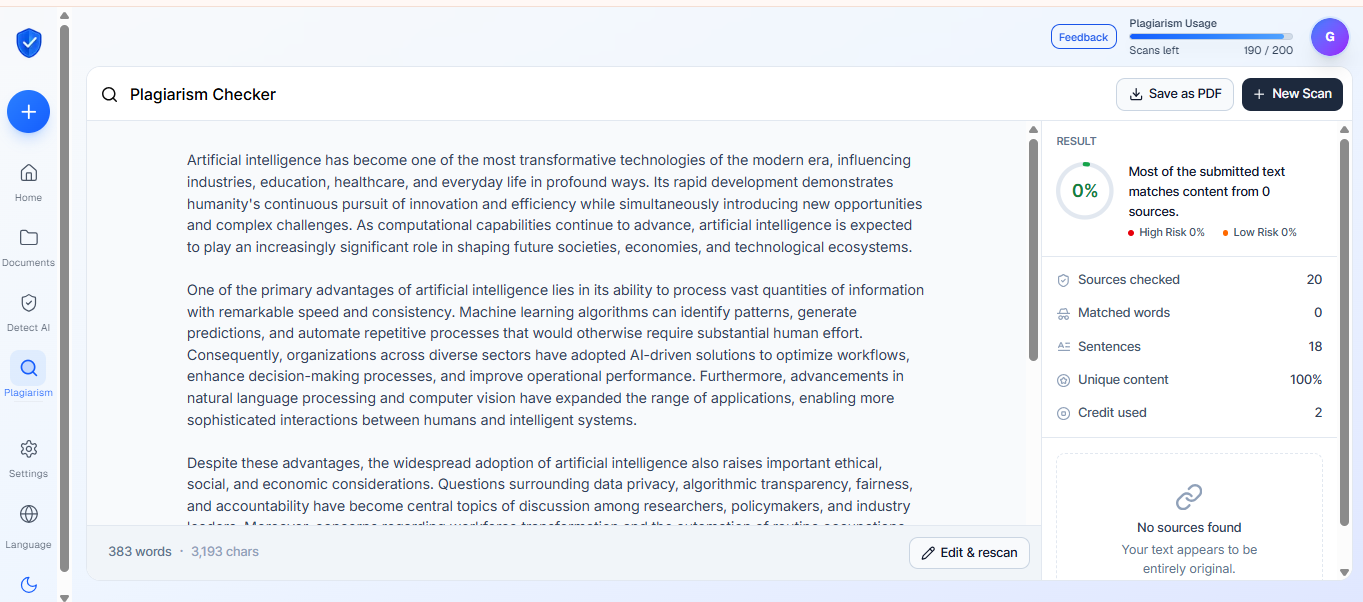
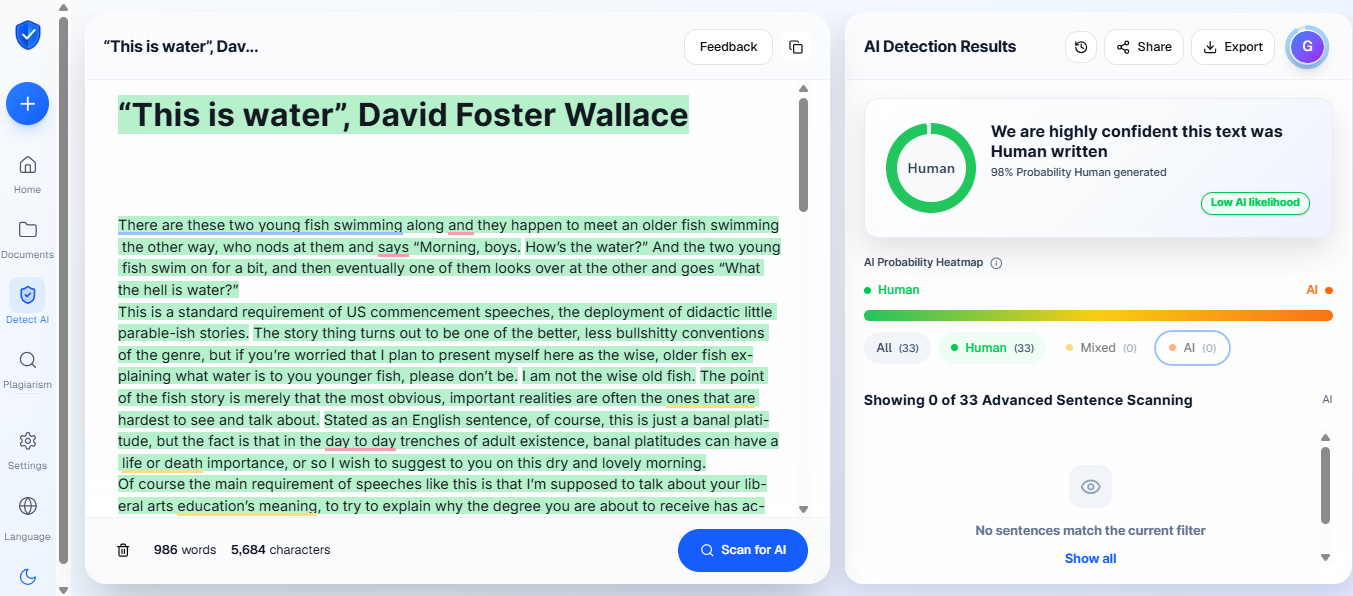
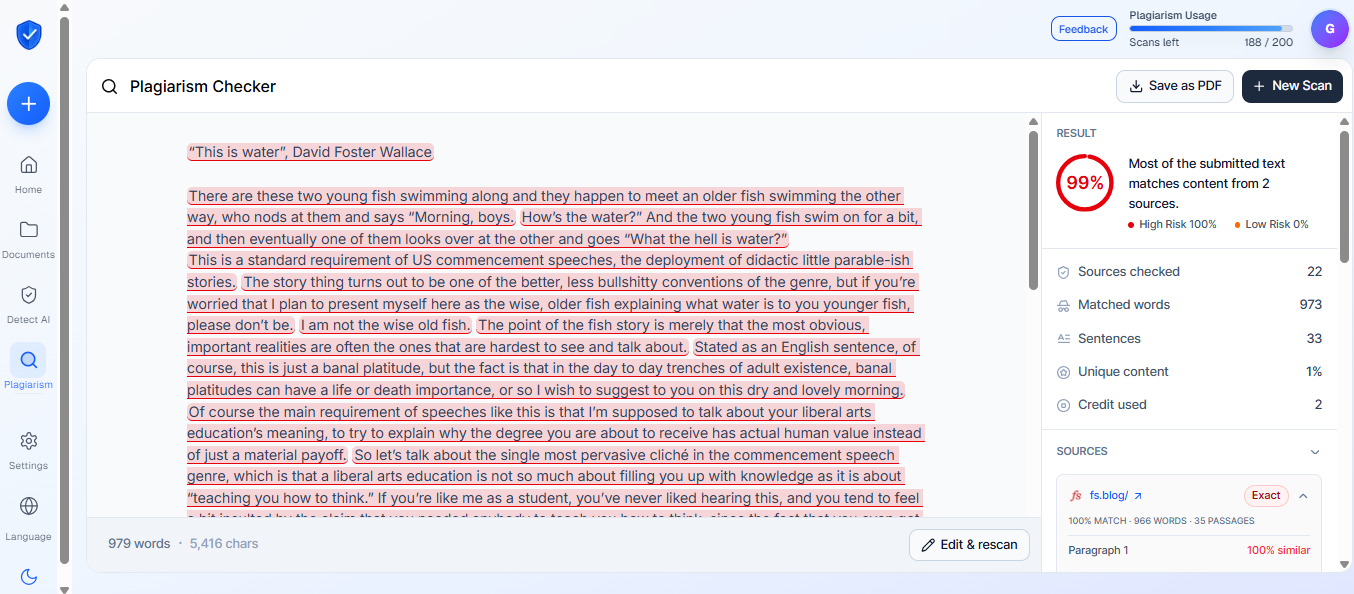
No, you cannot accurately depict a plagiarism score and an AI detection score from a single combined score. They measure two entirely different things using separate methods. To help you better understand the concept, we created two approximately 1,000-word essays. One was generated using GPT-4.1 and had never been published. The second was an already published human-authored essay. Both were scanned using the same Proofademic AI detector and plagiarism checker. Here are the results we found:
AI-Written Essay (Not Published Anywhere)
On the Proofademic AI detector, this sample showed a 99% AI score:
But when we checked it on the plagiarism checker, the score was 0% flagged because the content is not published anywhere:
Human Written Essay (Published)
On the AI detector, this content scored a 98% human score:
However, on the Proofademic plagiarism checker, the content gave a 100% flag:
What does this mean?
This test showed that a fully AI-written content piece with a 100% AI score, if not published anywhere, can easily secure a perfect score on a plagiarism detector. Similarly, a human-written content piece that is published online can be 100% plagiarised but show 0% AI patterns.
So the answer to Can AI detectors catch plagiarised content is a firm NO. Students and educators need a comprehensive tool like Proofademic that includes both AI detection and plagiarism checking capabilities to maintain complete academic integrity.
The core difference: Source overlap vs authorship signals
Plagiarism detection asks if text overlaps with existing work. AI content detection asks if the writing process likely involved an AI system. These are related concerns rather than the same one; conflating them leads to bad decisions.
These three examples will make this concrete:
- A student copies a paragraph from a journal without a citation. The plagiarism checker catches this through source matching. Whereas the AI detector likely won’t flag it, since the writing pattern is human and the issue is attribution rather than authorship.
- A student submits a fully AI-generated essay on a novel topic. The plagiarism checker may return a low similarity score, since there’s nothing to match against. The AI detector is far more likely to flag the writing patterns.
- A student uses AI to paraphrase copied material. Both tools may apply here; the AI detector may pick up generated-style phrasing, while the plagiarism checker may still catch residual similarity to the source.
In each case, the similarity score and the AI confidence score measure different forms of content authenticity. Treating them as interchangeable is how real integrity issues get missed.
Why does academic integrity need both tools?
Plagiarism and undisclosed AI use are related issues, but they aren’t identical, and they don’t carry equal evidentiary weight. A complete review treats them as separate layers:
- Plagiarism checker: Evidence of source overlap
- AI detector: Signal of possible AI authorship
- Human review: Fair, contextual interpretation of both
- Institutional policy: The actual standard for what’s allowed
Fairness depends on keeping these layers distinct. Neither score is proof of misconduct on its own. They should never be merged into one vague “bad score” that obscures what’s being evaluated. When reports stay separate, reviewers know precisely which question they’re answering. Proofademic’s sentence-level detection for academic review supports this by giving reviewers evidence rather than a single number.
How Proofademic handles both while keeping the difference intact
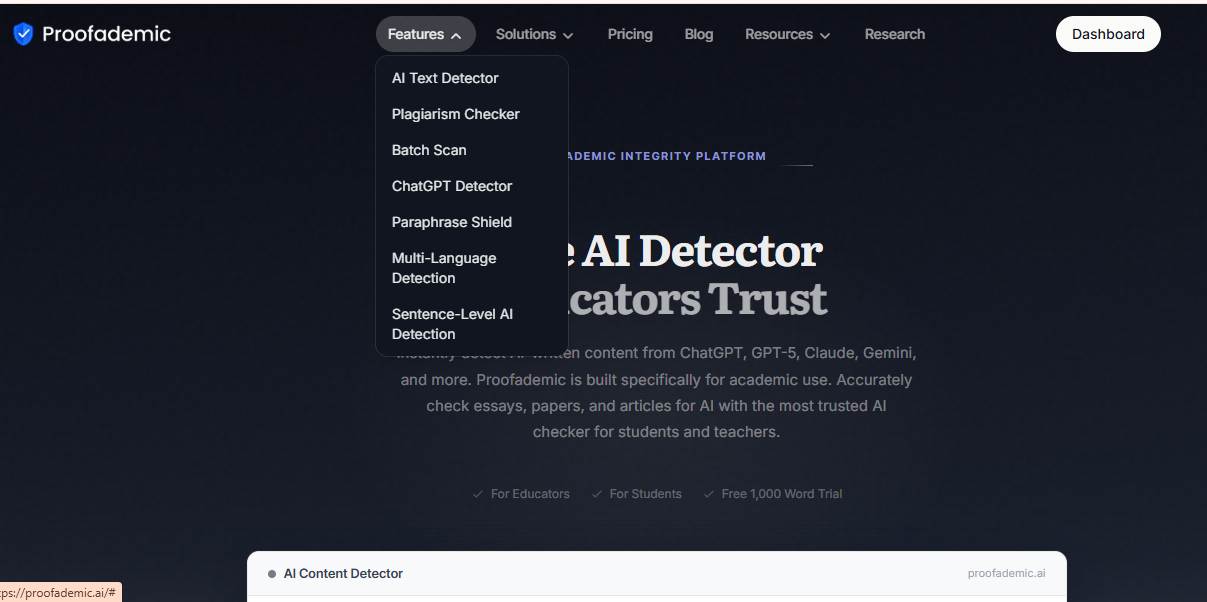
Proofademic is built around this distinction. The platform includes a separate plagiarism checker and a separate AI text detector, accessible from one academia-calibrated platform. The tool offers both together for workflow efficiency, so students, educators, and institutions don’t need separate logins or vendors to run both checks. The results, however, stay deliberately separate, because they answer different questions. A similarity score never gets folded into an AI confidence score, and vice versa. This helps reviewers avoid misreading one score as the other, which can lead to unfair conclusions during student appeals or misconduct reviews.
TL; DR
The difference between plagiarism and AI detection is that a plagiarism checker checks for copied or closely matched source material. An AI detector checks for signals that writing may be AI-generated. They are not competing tools, and they aren’t interchangeable. Plagiarism and AI-detection are two distinct lenses on academic integrity, each producing different evidence for different decisions.
The strongest review workflow uses both, interprets each result on its own terms, and never confuses one score for the other. Proofademic is built for exactly this workflow, keeping plagiarism checking and AI detection distinct in how they’re measured and reported, while keeping both accessible in one platform.
FAQs
What’s the difference between a plagiarism checker and an AI detector?
A plagiarism checker measures source overlap; an AI detector measures the likelihood that text shows AI-generated writing patterns. One is evidence-based, the other is probabilistic.
Can one tool do both jobs?
A single platform can include both a plagiarism checker and an AI detector, but the checks themselves should remain separate, since they measure fundamentally different things.
Do I need both for academic integrity?
Yes. A plagiarism checker and an AI detector address different academic integrity concerns. Running both provides a more complete review, especially for work submitted in the era of generative AI. You should use an academic-calibrated tool like Proofademic that includes both plagiarism and AI detection with sentence-level highlights and clear reports.
Does Proofademic include both tools?
Yes. Proofademic offers plagiarism checking and AI detection as separate tools within one academic integrity platform.
Which should I run first on a student paper?
Generally, run the plagiarism checker first, then the AI detector, and review both results together with context before drawing conclusions.
Can AI-generated text pass a plagiarism checker?
Yes. Since AI-generated text can be newly produced, it may not match any existing source and can return a low similarity score.
Can human writing be flagged by an AI detector?
Yes. AI detector scores are probabilistic, which means human writing can occasionally be flagged. Therefore, results should always be reviewed carefully and never treated as final proof.
Is a similarity score the same as an AI score?
No. A similarity score reflects overlap with existing sources. An AI score reflects the likelihood of AI-generated writing patterns. They measure different things and shouldn’t be compared directly.
Is AI-generated writing always plagiarism?
Not necessarily. It depends on institutional policy, disclosure requirements, and on the AI-generated text itself copying or closely paraphrasing existing sources.