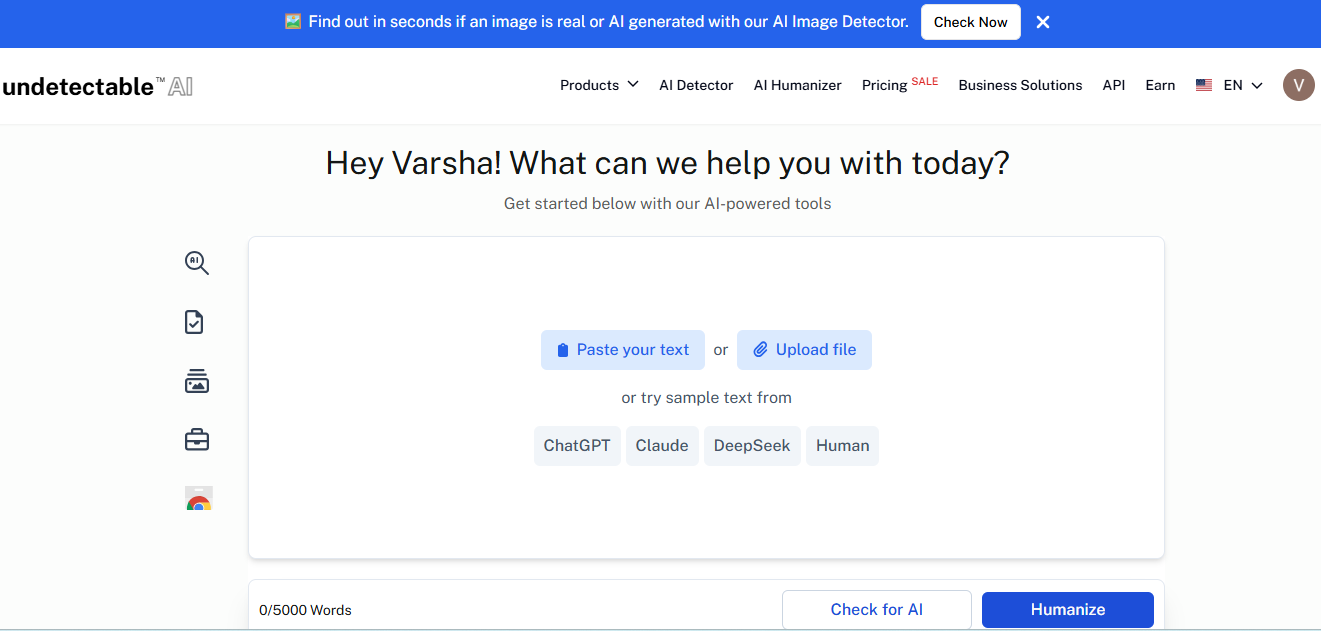
- Undetectable is a broad writing assistance tool with an AI humanizer, AI detector, content writing tool, and image detector.
- This tool is made for a generic audience, including SEO writers and publishers, and has limited capabilities dedicated to academia.
- Undetectable AI detector returns a documented level of AI-flagged results with paragraph highlights. The free plan doesn’t offer proper sentence-level analysis, which is essential for academic work.
- The detector’s accuracy works well on simple niches but fails on content with complex academic prose and citation-heavy text.
- Its AI detection is reliable for purely AI or human-written content. However, it gives false results on lightly paraphrased text.
- Undetectable AI’s humanizer tool is inconsistent against major AI detectors like Proofademic and requires payment details before you can test it.
- For academic integrity work that needs interpretable, sentence-level evidence, Proofademic is built specifically for that purpose.
Undetectable AI pairs a detector with a humanizer. You can use its AI detector to check the content for AI patterns and then paraphrase the text using the AI humanizer. However, the tool is built for a wider general audience instead of being designed specifically for academic purposes. Also, its AI humanizer tool raises a big question: if a student can use Undetectable AI’s humanizer to pass its own AI detection, how can it be treated as an academic integrity layer?
In this Undetectable AI review, we tested its AI detector on real academic writings and against its own humanizer output to help you understand if you can use it for academic work safely.
Is Undetectable AI legit? A quick review
Undetectable AI is a real software with an AI detector, Humanizer, and other writing assistance tools. Its detector functions as a document-level check with sentence-level highlighting without proper context, and its own confidence shifts noticeably once text is rewritten, which limits how much weight the score can carry on its own.
Academic reliability is about more than a detector returning a number. It is about that number being explainable, checkable, and actionable in an educational setting. A 2023 Weber-Wulff et al study on 14 AI detectors found that the 14 detectors tested were not sufficiently accurate or reliable across the evaluated conditions, particularly after text obfuscation or paraphrasing. Here are the benchmarks we used to assess Undetectable Humanizer and AI detector accuracy:
| Category | Assesment | Why |
|---|---|---|
| Detector Accuracy | Sample-dependent | One document-level score; performance shifts by text type and by any rewriting applied to the text |
| Detector Transparency | Sentence-level evidence without proper context | Sentence-level highlights are only color-coded and don’t provide proper context behind the flag |
| Detector Stability | Not consistent under light rewriting or its own paraphrase tool | Detection confidence drops substantially once text is paraphrased. Even its own paraphrase can easily trick its AI detector |
| Free Trial Access | Limited | 250-word humanizer trial; payment details required before the trial starts |
| Humanizer Performance | Inconsistent quality across topics | It clears some detectors and fails others on the same sample |
| Ideal For | Rewriting general non-academic content | Marketing copy and drafts where a detector flag isn’t a policy issue |
| Not Suitable For | Academic submissions or integrity decisions | Detector avoidance doesn’t establish authorship, originality, or policy compliance |
What is Undetectable AI, and what does it do?
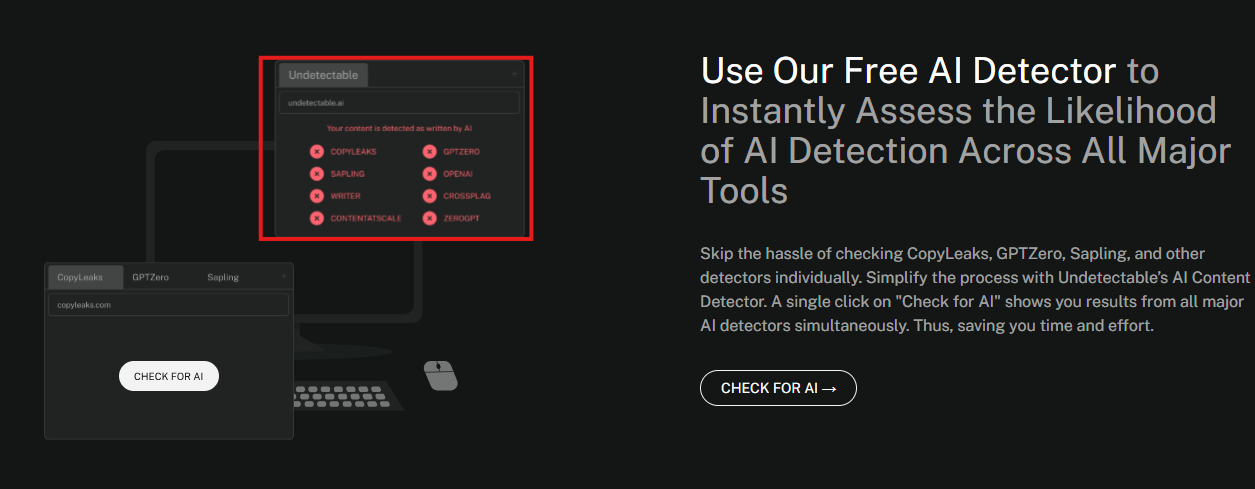
Undetectable AI is a web-based platform combining an AI detector with an AI humanizer, operated by Undetectable Inc. Its own site describes the detector as checking text against signals associated with several major detection engines, and the humanizer as rewriting AI-generated or AI-assisted text so it reads differently to those same detectors. However, it is important to note that, although the tool claims to check the text against different detector platforms, its reports in the free plan don’t show anything related to those detector checks.
Undetectable AI offers:
- AI Detector: Free to use but limited in features. Returns a document-level score estimating the likelihood the text was AI-generated. Sentence-level support with only color coding, no proper context behind the actual reason for the flag.
- AI Humanizer: This is the paid core product and requires payment information to try the tool. Rewrites text with adjustable “purpose” (marketing, email, general, essay) and readability level settings.
- AI Plagiarism Checker: A separate originality check, distinct from the AI detector.
- Human Auto Typer: Simulates human typing patterns while producing a document.
- API and Chrome extension: For plugging detection and humanization into other writing workflows.
- SEO AI writer: An AI writer tool for creating SEO content pieces.
One major thing to notice about undetectable AI is that its headline claims are “passes AI detectors” and “undetectable” rather than accuracy or transparency. That’s a different orientation from where academic guidance currently sits. The University of Edinburgh’s student guidelines encourage students to use generative AI in ways that support their learning rather than replace their own engagement with the work. In another case, Yale’s Poorvu Center AI guidelines state that AI tools should support genuine learning, deep engagement, critical thinking, and skill development, instead of using humanizers to bypass detectors or submission rules. For anyone operating under an institution’s AI policy, “rewriting to sound better” and “rewriting to avoid being caught” are different acts – even though a detector score alone can’t tell them apart.
Our methodology to evaluate Undetectable AI’s academic reliability
Undetectable AI is built around a broader audience, with academia as only one slice of it. To check its academic reliability, we evaluated the tool from the perspective of a student or educator deciding if either its detector or its humanizer could reasonably be trusted for academic work. We checked the detector’s official claims against how it actually behaves on real academic content, rather than accepting the vendor’s combined “check, then bypass” framing at face value.
Our assessment considered:
- Undetectable AI’s official accuracy claims vs how it performs on real submissions
- Its detection confidence on pure AI and pure human vs. paraphrased content
- Can we access its detector and humanizer for free
- Publicly posted user reviews on billing, cancellation, and support
- Its detector’s accuracy around its own humanizer output
- Academic integrity standards around what detector evidence can and can’t support
Need an academic-specific AI detector to check submissions for AI patterns? Proofademic is trained on real student work and under academic checking scenarios. Click below to claim your free word credits and a free trial – No payment information required!
How accurate is the Undetectable AI detector? Putting the tool to the test
For a fairer Undetectable AI review and to find a more accurate answer to “is Undetectable AI legit,” we tested the tool using real academic work. We took a fully AI-generated essay, a fully human-written essay, a lightly edited submission, and humanized the AI-generated essay using Undetectable AI’s own humanizer. Here are the test results we got:
Test 1 – AI-generated submission
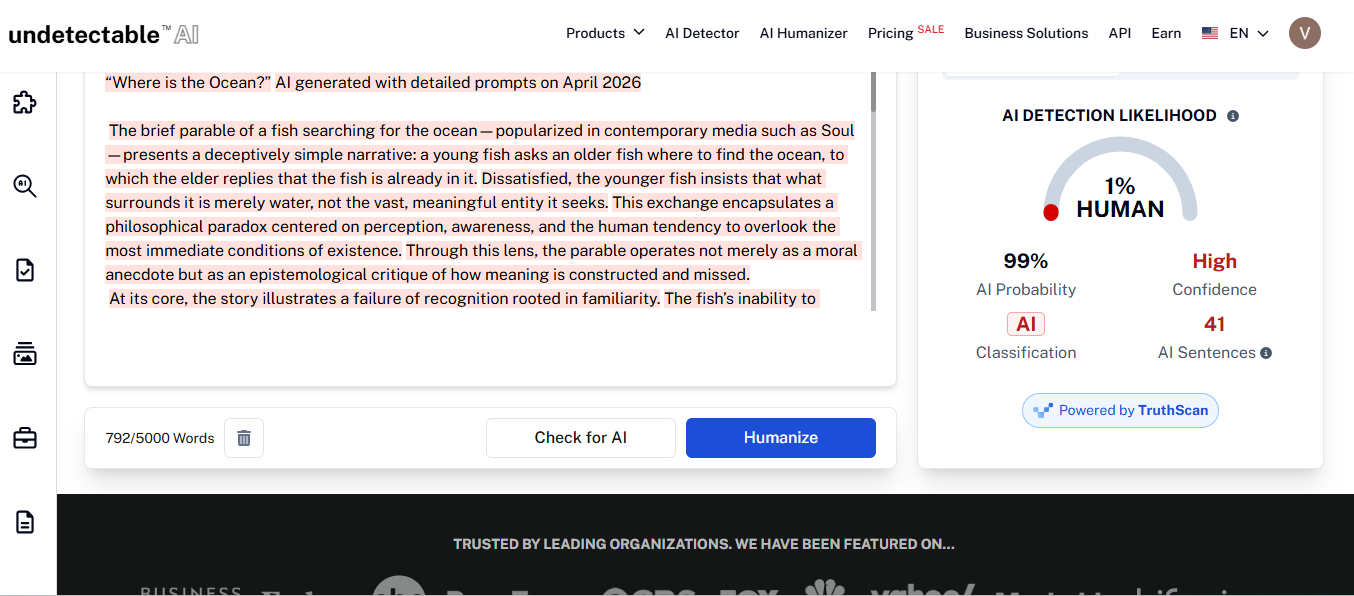
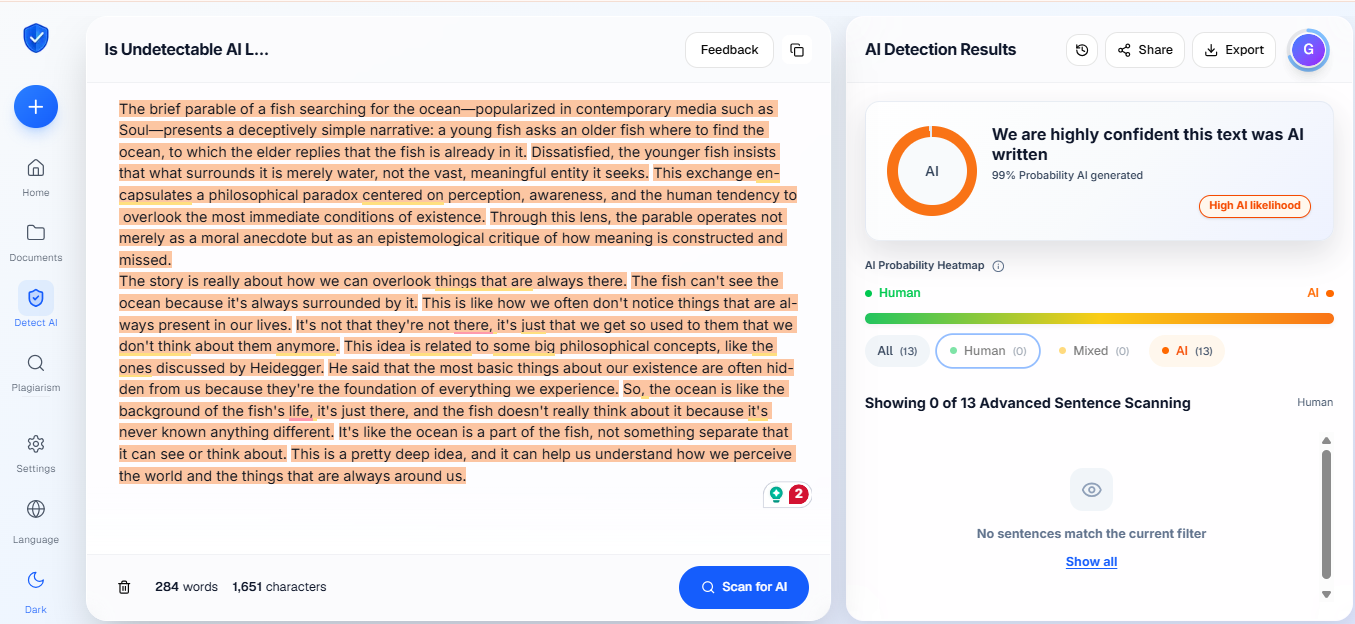
On the AI-generated essay, the tool accurately flagged it as 99% AI. The tool stated that 41 sentences were AI-generated, but sentence-level highlights had no percentage to guide our decision further. Also, the “Humanise” button right next to the AI report may encourage students to take a shortcut instead of writing by themselves, which is a policy infringement for most institutions.
Test 2 – Human-Generated Text
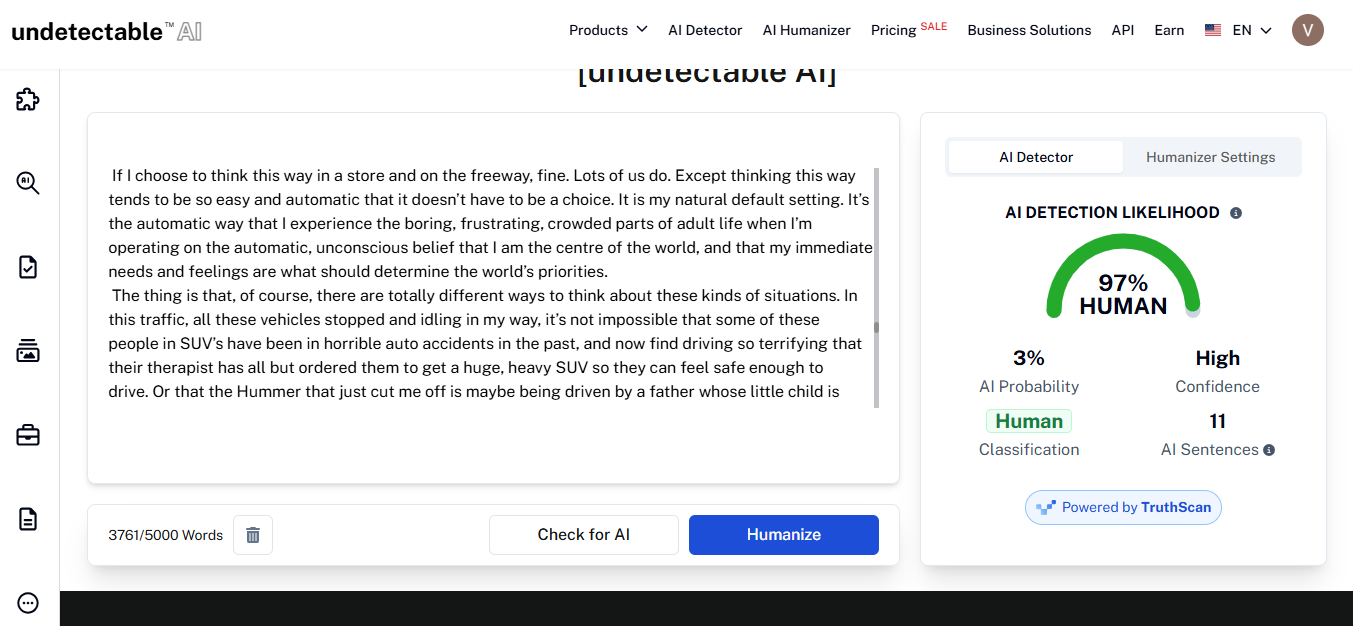
For the human-generated text, it gave a 97% human probability score, which is again accurate.
Test 3 – Version with Human Editing
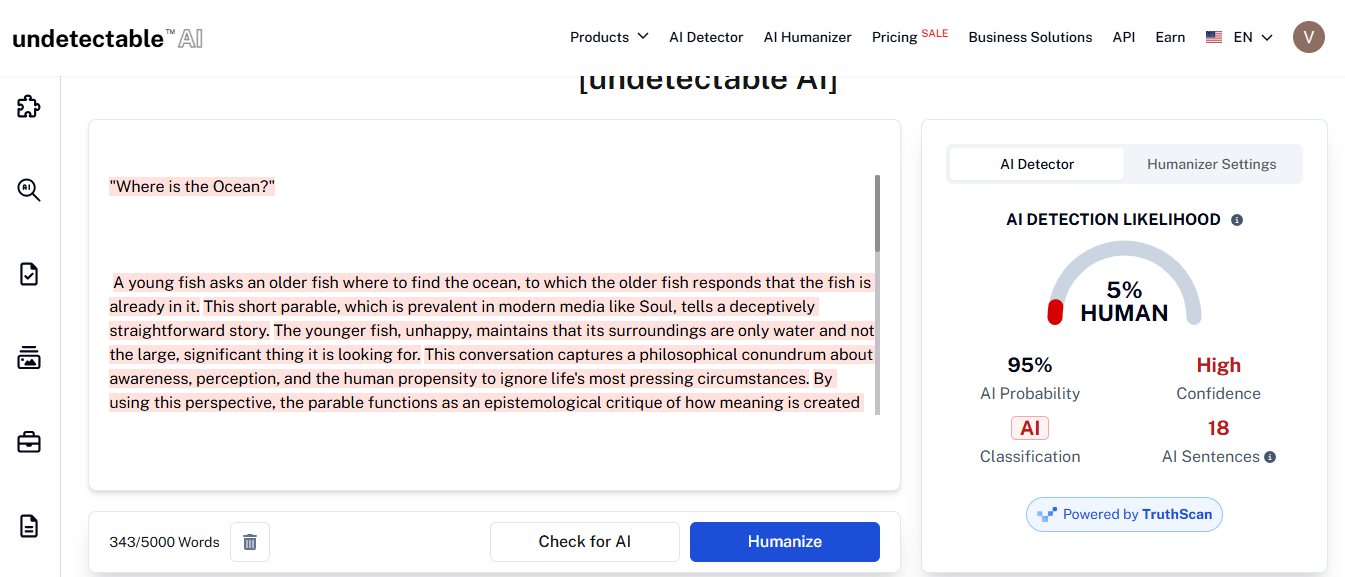
The above 2 tests were based on pure AI and purely human-written text. But real academic submissions are usually a mix of both – written in a formal style, which may carry AI signals with students’ own editing. For our third test, we created a sample with the majority of it written by a real writer. The tool failed to differentiate which part was human-written and which part carried AI patterns, and gave a 95% AI probability score.
Test 4 – Testing its own humanizer output
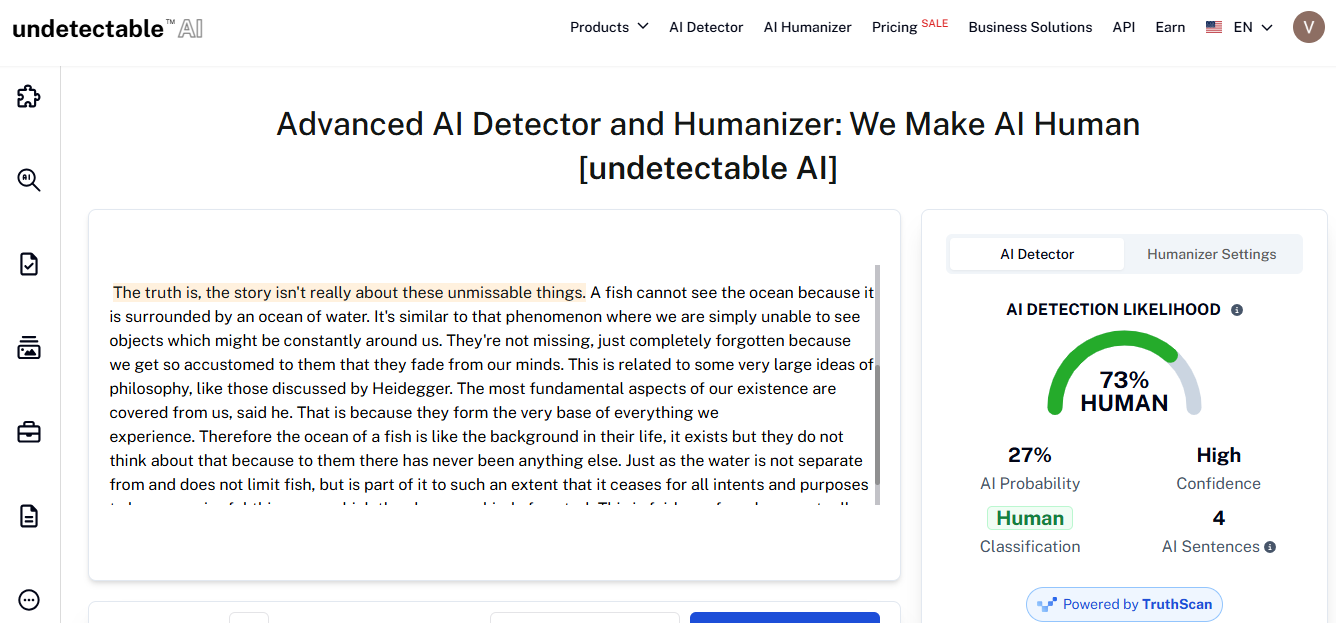
We know that using humanizers as a shortcut is not a correct approach, ethically or policy-wise. If a tool can easily fail with basic humanization, it’s not reliable enough for academic work. We took the original AI-written essay and ran it by Undetectable AI’s humanizer, and the AI probability score on its own detector sharply decreased from 99% AI to only 27%.
Same Tests Run Using Proofademic’s Academic First AI Detector
We took the same 4 samples used to test Undetectable AI and ran them through Proofademic’s AI detector to help you understand what difference an academic-first AI detector can make.
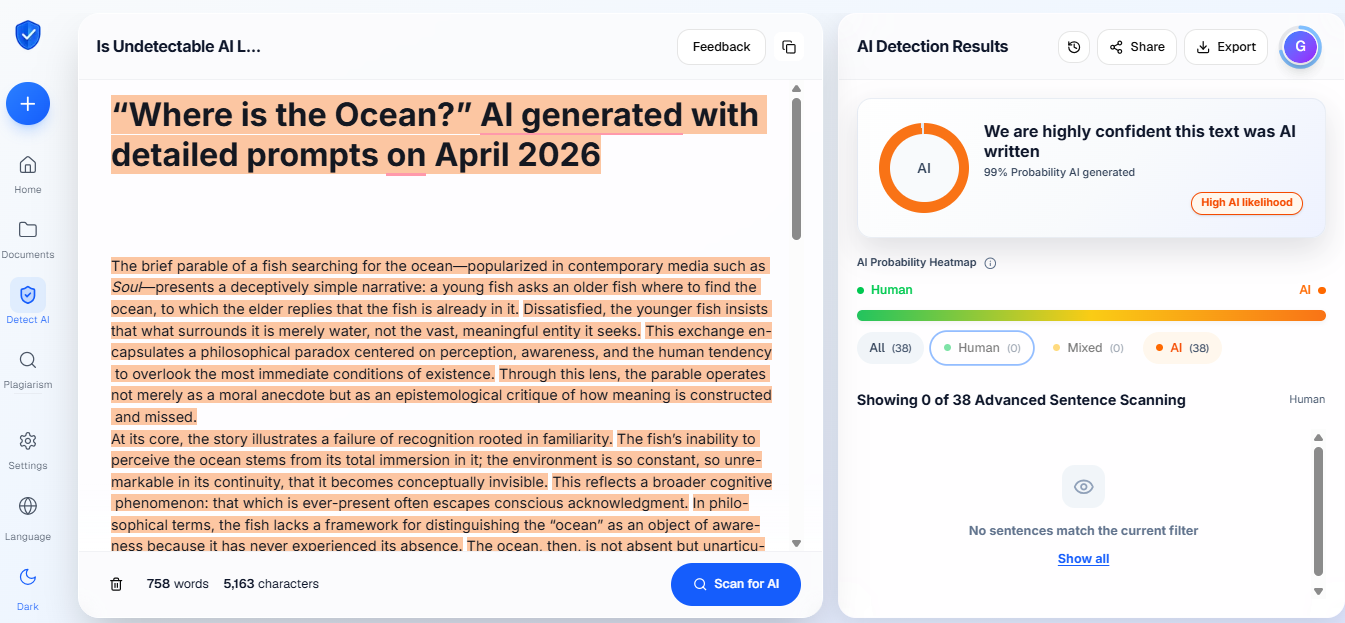
Test A – Fully AI-generated
For the fully AI-generated sample, Proofademic’s AI detector gave a 99% AI score, which is accurate.
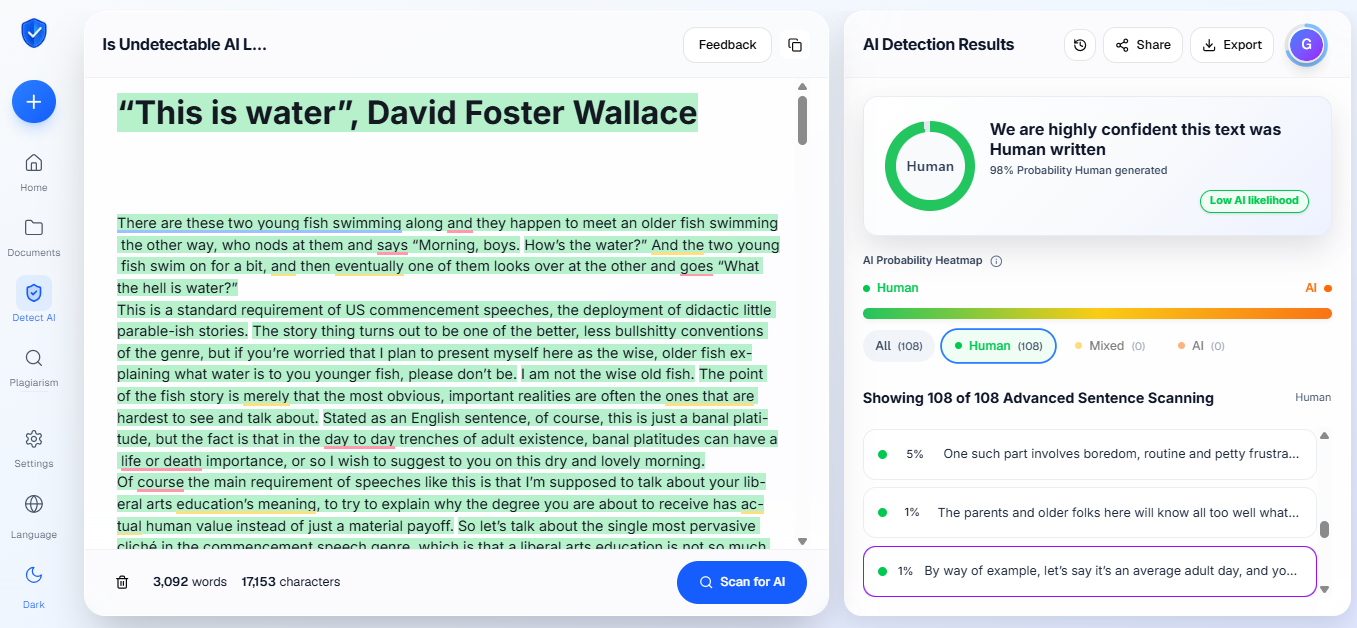
Test B – Fully human-written
For the fully human-written essay, we got a 98% human-written score, which again is accurate.
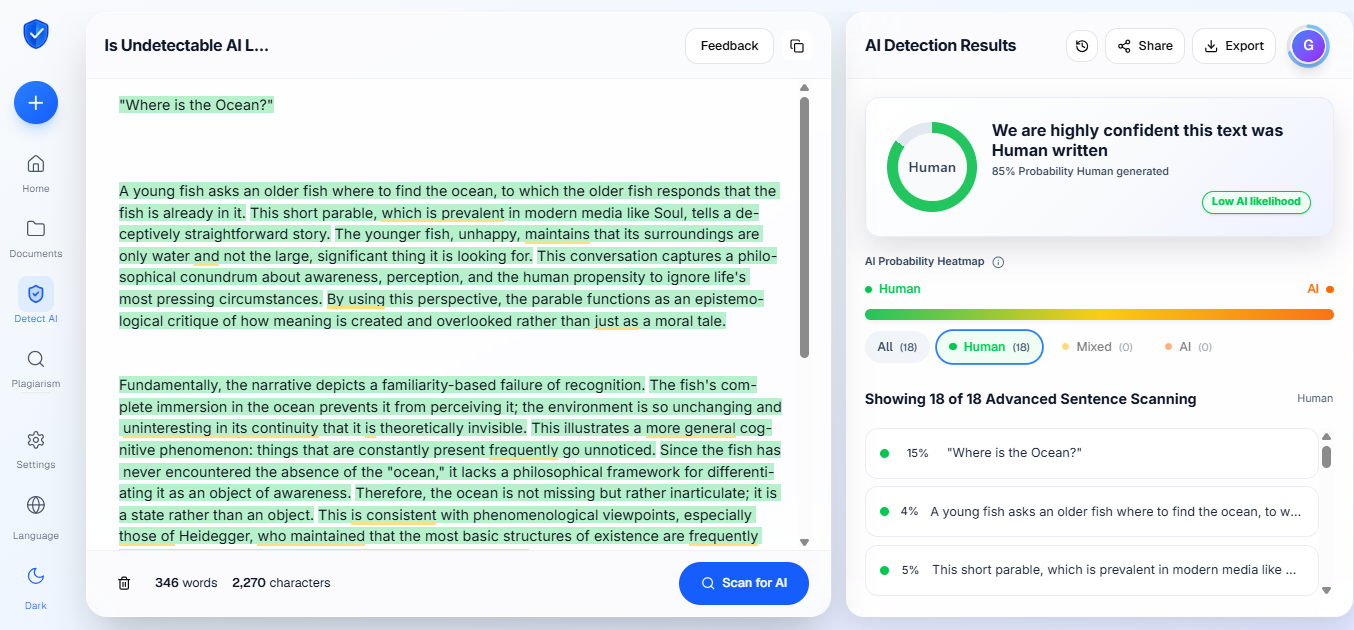
Test C – Human-edited essay
This is where Undetectable AI detector accuracy started to fail. However, even on mixed content, Proofademic’s academia-first AI detector accurately differentiated genuine writing from AI-written patterns and gave an 85% human score.
Test D – Undetectable AI humanizer text
Most generic AI detectors, including Undetectable AI, can be easily tricked with paraphrasing. But with a strong paraphrase shield, Proofademic gave a 99% AI score, which makes it a reliable choice for educators and institution admins.
Undetectable AI vs Proofademic: Which one is better suited for academia
First, here is a side-by-side comparison of Undetectable AI detector vs Proofademic AI detector:
| Test Type | Undetectable AI Detector | Proofademic AI Detector | Verdict |
|---|---|---|---|
| Fully AI-generated | 99% AI ✅ | 99% AI ✅ | Both accurate |
| Fully human-written | 97% Human✅ | 98% Human ✅ | Both accurate |
| Human-edited | 95% AI ❌ | 85% Human✅ | Proofademic wins |
| Paraphrased using Undetectable AI humanizer | 27% AI ❌ | 99% AI ✅(due to paraphrase shield) | Proofademic wins |
What Makes Proofademic a Better Fit For Academic Integrity?
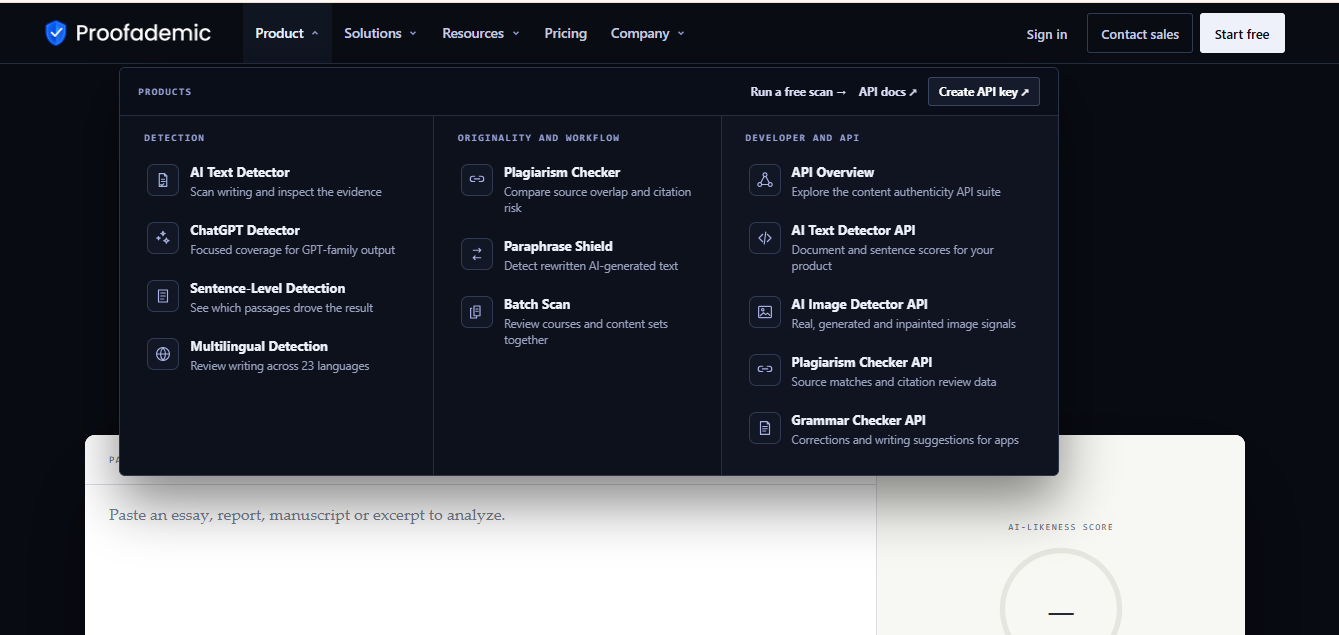
By looking at the stress test results, it is clear that Proofademic’s academic-specific AI detector easily wins under real academic conditions. Undetectable AI’s humanizer tool may seem like an easy way to bypass AI detection, but under strict academic policies, this may become an integrity issue quickly.
On the other hand, Proofademic is trained specifically on academic submissions and complex citation-heavy content. In our four-sample comparison, Proofademic classified the majority-human sample as 85% human and the humanized AI sample as 99% AI. These results suggest that Proofademic was better able to distinguish between different writing scenarios in our tests. Its paraphrase detection capabilities, combined with sentence-level analysis with percentage-based context, provide educators with additional context when reviewing student submissions. Proofademic also offers a 3-day free trial with free word credits, allowing users to evaluate the platform before committing to a paid plan.
Can you access Undetectable AI for free?
The Undetectable AI detector itself is free to use with basic features. Also, in the free plan, you cannot change the content type, and the free report doesn’t have any indication of multi-detector checking that they claim on their website. The humanizer’s free trial is capped at 250 words, which isn’t enough to evaluate on a real paragraph, let alone an essay, and the pricing page requires payment details before the trial starts. In practice, the free tier functions as a preview ahead of the first charge rather than a genuine evaluation period.
Publicly posted user reviews show the point where the trial ends is also the most common source of billing complaints. One reviewer reported being charged for a full year even after canceling the free trial before the window closed. We also found reviews that Undetectable AI’s support team has resolved a number of these disputes with refunds and cancellations once contacted, but the pattern of complaints at the trial-to-paid transition is consistent enough to plan around.
Who should and should not use Undetectable AI?
| Undetectable AI may suit | Undetectable AI is a weaker fit for |
|---|---|
| Rewriting general, non-academic content where a detector flag isn’t a policy issue | Students seeking a guaranteed way past Turnitin or a course detector |
| A free, quick check on a document’s AI likelihood, treated as a rough starting point | Anyone treating a detector score, in either direction, as proof of AI-authored or human-authored work |
| Users who understand output still needs editing and fact-checking | Educators or integrity officers needing sentence-level, defensible evidence |
| Low-stakes drafts where a short trial is enough to judge fit | Longer academic or technical writing where meaning drift is costly |
TL;DR
Undetectable AI’s primary paid product is its humanizer. The AI detector is secondary. Its detector offers free access with limited features, document-level checks with limited-context sentence-level evidence, and its own confidence shifts substantially once text has been rewritten. These are some real limitations for any tool meant to support an academic decision. In our tests, we noted that it fails on human-edited or paraphrased text, which are usually real use cases in academic submissions. For students, educators, and institutions whose actual concern is evaluating writing for academic integrity, Proofademic is built around academic detection specifically, with proper sentence-level evidence and a strong paraphrase shield to avoid academic dishonesty.
FAQs
Is Undetectable AI legit or a scam?
Undetectable AI is a registered, operating company with published pricing and terms. It’s not a scam outright. However, for academic use, its detector and humanizer are not reliable enough for a graded decision or as evidence.
Is Undetectable AI safe to use?
The tool functions as a payment-processing product without major red flags on that front. The realistic risks are billing friction at the trial-to-paid transition, which users report repeatedly, and uploading sensitive academic work without checking the current privacy policy first.
How accurate is the Undetectable AI detector?
Undetectable AI returns a single document-level score with no sentence-level breakdown, and that score’s confidence drops substantially once text has been paraphrased or rewritten. That combination makes it unreliable as standalone evidence in any academic integrity decision.
What is the most trustworthy AI detector?
Proofademic is one of the most trustworthy AI detectors in 2026. It has sentence-level analysis, a very low false positive rate, and Paraphrase Shield, which makes it a reliable choice for both students and educators.
Will Turnitin detect Undetectable AI?
It depends on the type of sample paraphrased using Undetectable AI’s humanizer. However, we advise you not to use any humanizer tool to trick AI detection systems, as it is usually a policy infringement and may result in strict action by your institution.
Is 40% AI detection bad?
Not automatically. A 40% score doesn’t automatically mean 40% of the text was written by AI. Especially in academia, submission context, source use, and drafting history matter more than the number alone.
Is GPTZero or Undetectable AI better?
GPTZero is primarily a detector, while Undetectable AI’s core paid product is a humanizer with a detector attached. If the real question is detector reliability, that depends on text type and which tool an institution actually uses rather than a general preference. One important thing to note is that both these tools treat academic detection as a side feature and cannot be solely trusted for final results.
Does passing an AI detector prove my paper is human-written?
No. A detector score reflects linguistic pattern matching against known AI output rather than verified authorship. Passing one detector on one run isn’t equivalent to proof someone wrote the paper themselves.
Does Undetectable AI offer refunds if its humanizer is detected?
The official pricing page states a money-back guarantee covering the cost of humanization if output is flagged as not human. However, real user reviews of this claim are mixed. Some describe a smooth refund process; others describe delays or partial refunds.