Key Takeaways
- Kipper AI is a multipurpose student platform. Its AI essay writer, AI detector, summarizer, and citation finder are built for convenience and should not be used for institutional reliability.
- The Kipper AI detector returns a percentage score without sentence-level explanation, making it unsuitable as standalone evidence in an academic integrity decision.
- Its AI essay writer produces readable drafts, though citation accuracy and factual grounding require independent verification.
- Kipper does not offer a meaningful free trial, which limits a student’s or educator’s ability to evaluate the tool before committing to a paid subscription.
- For academic integrity work that requires interpretable, sentence-level evidence, Proofademic is built specifically for that purpose, unlike general-purpose student tools that treat detection as a secondary feature.
Kipper AI is a convenient study aid rather than a dependable tool for academic decisions. It combines an AI essay generator, a summarizer, a text enhancer, a citation finder, and an AI detector, which explains it as an all-in-one academic assistant. Convenience, however, is not the same standard as accuracy, source verifiability, or defensible detection evidence, all of which matter more while grading a paper.
This Kipper AI review evaluates the essay writer, detector, citation quality, pricing model, and academic-use risks based on verified product documentation, user feedback, and published academic writing standards. Readers evaluating it for high-stakes academic decisions should also consider Proofademic, which is purpose-built for academic integrity detection.
Short answer: Kipper AI functions as a student productivity tool, useful for drafting, summarizing, and study organization. Its AI detector and essay writer carry limitations that make both insufficient for formal academic integrity decisions. For sentence-level AI analysis designed around institutional requirements, Proofademic addresses what general-purpose platforms like Kipper are not built to provide.
Kipper AI review: The quick verdict
Academic reliability cannot be judged by feature count alone. A platform may generate essays, estimate AI content probability, and produce formatted citations, but the more important question is if those outputs can be trusted in an educational setting. We assessed Kipper AI against the criteria that matter most for students and educators: writing quality, citation reliability, source transparency, and ease of independent verification. The table below presents our overall verdict before each area is examined in greater detail.
| Category | Assessment | Why |
|---|---|---|
| Best for | Brainstorming, drafting, summarization | Helpful for producing first drafts and condensing long material |
| Not ideal for | Final assignment submission without review | Output requires fact-checking, editing, and citation verification |
| Writing quality | Generally readable in our evaluation | Coherent text but may require structural and factual refinement |
| Citation reliability | We observed it requires independent verification | Users need to confirm every citation independently |
| AI detection | Mixed reliability | Results vary by sample type; no sentence-level evidence is provided |
| Ease of use | Beginner-friendly | Simple interface with minimal learning curve |
| Overall impression | Useful with human oversight | It functions as an assistant and is not a replacement for academic judgment |
What is Kipper AI, and what does it do?
Kipper AI positions itself as an all-in-one academic assistant, combining AI-powered writing, editing, summarization, citation generation, and AI detection into a single subscription. According to Kipper AI’s official website, the platform is designed to help students move through coursework more efficiently by reducing the time students spend researching, drafting, and refining assignments.
Its core features, as listed on the platform at the time of writing, are:
- AI essay writer: Generates draft essays from a topic or prompt in one pass.
- AI detector: Estimates the likelihood that submitted text was AI-generated.
- Summarizer: Condenses articles, videos, and documents into shorter summaries.
- Text enhancer: Revises grammar, clarity, and sentence structure.
- Citation finder: Finds citations in commonly used academic formats like APA or MLA.
From an academic standpoint, however, the more important question is how reliably those features perform in real academic contexts rather than which features Kipper offers. This is why we evaluated each feature by how reliably it supports graded work rather than by what it claims to do, responsible research, and academic integrity.
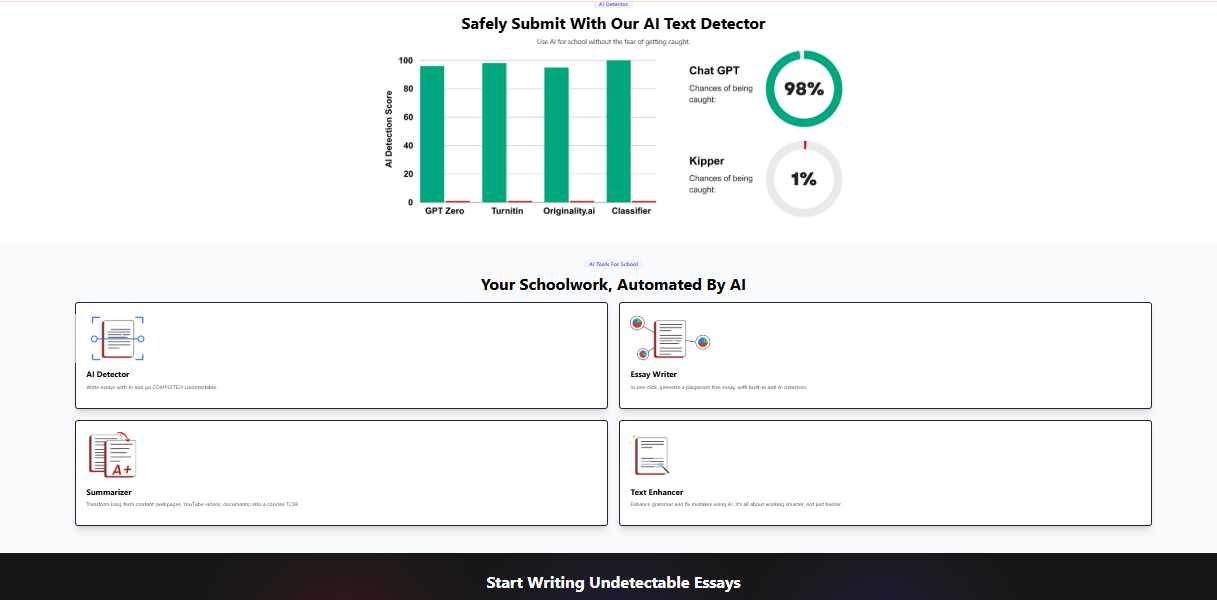
When we visited Kipper AI’s official website, what surprised us was its marketing, which focused on helping students use AI “without the fear of getting caught,” and its claim that its output can bypass AI detectors. While this messaging may appeal to some students, it places more emphasis on avoiding detection than on improving writing quality or supporting responsible AI use. For students working within institutional AI policies, that distinction matters and differs significantly from the direction many higher education institutions are taking. For example, guidance from the University of Edinburgh encourages students to use generative AI as a learning aid instead of a means of masking AI-generated work.
Our methodology for evaluating Kipper AI’s academic reliability
We evaluated Kipper AI from the perspective of a student and educator deciding if it could reasonably be trusted for academic work. We reviewed the platform’s available features based on transparency, ease of verification, and suitability for academic standards, examined its official documentation, looked at how it presents its tools to users, and independently confirmed what could reasonably be verified. We then compared those observations against accepted academic standards and institutional expectations.
Our assessment considered:
- Kipper AI’s official product documentation and pricing pages
- Available platform features at the time of review
- Publicly available Trustpilot feedback
- Published university guidance on AI-assisted writing
- Academic integrity best practices across institutions
How academically reliable is Kipper AI?
Academic reliability cannot be measured by a single score. We evaluated Kipper AI across the areas that most directly affect the quality, credibility, and integrity of academic work. Each section below examines one of those criteria and explains where the platform performs adequately, where caution is warranted, and what that means in practice for students and educators.
Writing quality
Based on our evaluation, Kipper’s essay writer produces coherent paragraphs with a generally logical structure, making it useful for generating a first draft quickly. However, academic tone is inconsistent across topics, and factual claims are not always accurate on specialized subjects. Longer essays tend to repeat phrasing, and depth on complex arguments remains a consistent limitation.
Takeaway: Our evaluation suggests that Kipper is best suited for producing readable first drafts, but accuracy and subject-specific depth still depend on careful human revision.
Source transparency and citation reliability
Kipper AI does not provide the level of source transparency expected from an academic-facing tool. It generates in-text citations and reference lists, but the platform provides limited public information about how citations are sourced, ranked, or verified. This matters because research has shown that large language model-generated references are not consistently reliable and can generate inaccurate and fabricated references, making independent verification an essential part of responsible academic writing.
We also noticed that although Kipper generates references in APA, MLA, and Chicago formats, the references appeared to be incomplete, outdated, and in some cases fabricated without traceable originals.
Takeaway: We highly recommend independently verifying citation outputs as a standard practice and not relying completely on generated output.
Originality, plagiarism risk, and AI detection reliability
Kipper does not include a plagiarism checker as part of its toolset. That distinction matters because paraphrased or AI-generated text can still read as unoriginal or over-reliant on a small set of sources, a risk a dedicated plagiarism check is built to catch. Also, on evaluation, we found that Kipper’s AI detector tends to provide a document-level percentage score and offers limited transparency into how the result is reached or which passages influenced the final score. Kipper’s terms of service explicitly state that it does not guarantee generated content will be original or properly cited. Students should therefore verify both before submitting academic work.
Takeaway: Based on our evaluation, Kipper’s detector and originality tools are best used as a preliminary screening tool rather than a standalone basis for evaluating AI authorship or academic integrity.
Humanized content and detection reliability
When reviewing Kipper AI’s official workflow, we noticed the platform suggests generating text, running it through its own detector, and then humanizing it to make it “undetectable.” This sequence, when looked at technically, is coherent, but it’s oriented entirely around evading review. For students navigating institutional AI policies, that distinction matters. For educators, this points to the gap that document-level AI scores are not reliable for evaluating rewritten or humanized content.
Tools built for academic integrity, such as Proofademic with Paraphrase Shield, are designed to help reviewers assess rewritten content, while not aiming for content to bypass detection.
Takeaway: Based on our review, Kipper’s humanizing workflow is better suited to rewriting content than supporting transparent academic review, so prioritize tools that evaluate writing.
Academic integrity
When it comes to academic integrity, the appropriateness of using Kipper depends entirely on the policy in place. However, based on our review of Kipper AI and published university guidance, using the tool to brainstorm, outline, or improve existing writing generally aligns more closely with how many universities describe acceptable AI-assisted learning, which distinguishes learning support from undisclosed AI-generated work. Submitting an AI-generated essay as original work violates institutional rules and is inconsistent with many academic integrity policies.
Takeaway: Universities differ substantially in how they define and enforce AI-use policies, so we recommend abiding by the institutional policy and checking the specific course or institutional rules, as it determines what is acceptable use.
Ease of verification
One thing we specifically evaluated was how easily Kipper’s outputs could be verified. Based on our review, we found that Kipper does not consistently link back to the material it draws on. To verify the facts, statistics, and references it generates, it required leaving the platform to check primary sources manually. This adds a step that some students may not take, particularly under time pressure, which is where the greatest academic risk lies.
Takeaway: Based on our assessment, its outputs cannot be trusted at face value, and the verification task sits entirely with the user.
Overall academic reliability: Kipper AI functions adequately for early-stage tasks such as drafting and summarizing, but its writing and detection output require independent verification before any of it reaches a graded submission.CTA – Check your submissions for academic reliability
Is Kipper’s AI essay writer reliable?
When evaluating Kipper’s AI essay writer, we looked beyond its ability to write essays; our focus was instead on the qualities that matter in an academic setting, and if students and educators can trust the tool’s output in graded academic work. Based on our evaluation, publicly available user feedback, and comparison against similar tools, the answer is mixed. On Trustpilot, Kipper holds a rating of around 3.7 out of 5, reflecting a fairly even split between users satisfied with drafting speed and those reporting issues with billing and account management.
While reviewing, we observed that Kipper’s essay writer occasionally lost focus in longer responses. Also, we found that some sections required editing for coherence, grammatical precision, formatting, and reasoning quality. Based on these observations, before relying on any generated draft, it is worth checking prompt adherence, thesis clarity, logical progression, factual accuracy, citation validity, and how much revision the output still requires. The highest risk scenarios are submitting unverified facts or non-existent references, treating fluent prose as confirmation of accuracy, and assuming that passing a detection check is the same as meeting a course’s submission standards.
Can you access Kipper AI for free?
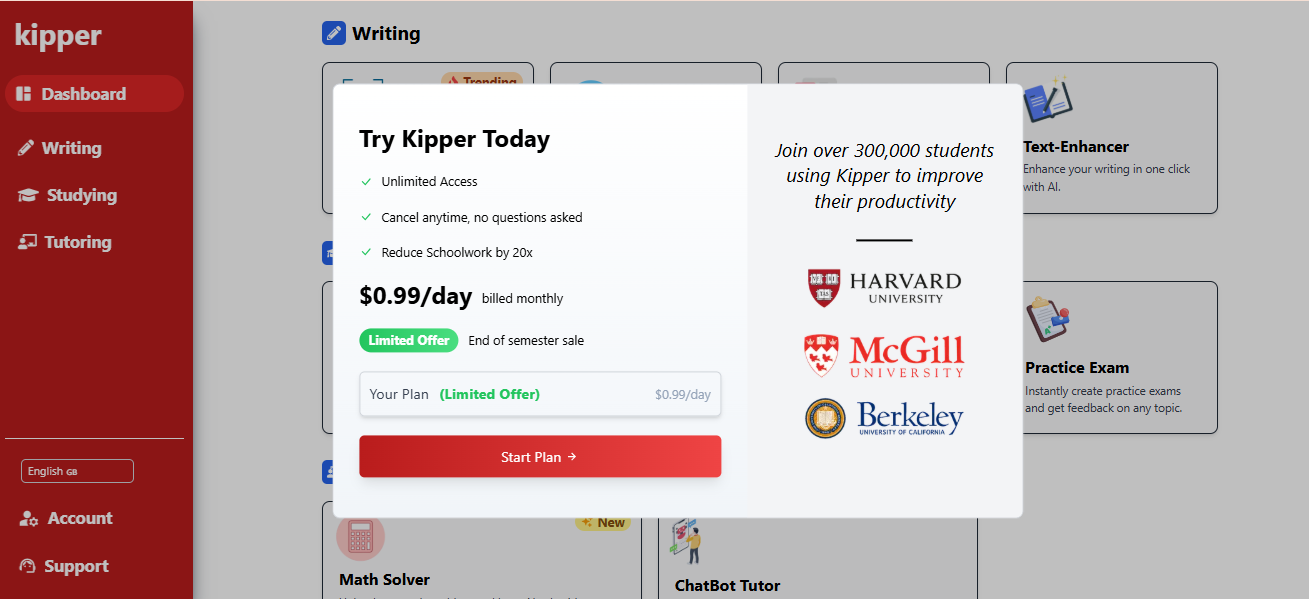
No! Kipper AI doesn’t have any free trial plan that teachers or students can use to test the tool. As part of this review, we evaluated Kipper’s AI detector accuracy ourselves. After creating an account and navigating to the detector, we found the feature could not be accessed without purchasing a subscription. Kipper redirected directly to its pricing page before any text could be analyzed. No free trials were offered.
This matters for prospective users, as students and educators cannot test the detector against their own work before subscribing, which means purchase decisions are more likely to rely on marketing claims and reviews in place of first-hand evaluation. For educators and students evaluating a tool for academic integrity work, the inability to test the detector before subscribing is an important practical limitation.
How accurate is the Kipper AI detector?
For this part of our evaluation, we assessed Kipper’s AI detector using the same academic criteria discussed throughout this review. Our focus was on how students and educators would use it in an academic setting. The detector process clearly detects AI-generated, unedited text quickly and integrates smoothly with Kipper’s other tools, which is useful if a student wants a fast first pass on a draft.
However, it was notable that Kipper’s AI detector returns a document-level percentage and not sentence-level evidence, which means it cannot explain which sentence triggered a flag or why. This is a practical limitation when a result needs to be understood, disputed, or acted on meaningfully. Also, its reliability fluctuates slightly with paraphrased or highly structured content. Based on our evaluation of the detector, a Kipper detection score is best treated as a starting signal. A flagged paper should be read by a human reviewer and, where the stakes are high, checked against a second tool before any conclusion is drawn.
Who should and should not use Kipper AI?
When it comes to who this tool is for, our assessment considers it based on the specific task involved and the level of scrutiny that applies to it. Fit depends heavily on context, which is why a blanket recommendation in either direction would be misleading.
| Kipper may suit | Kipper is a weaker fit for |
|---|---|
| Students using it for low-stakes brainstorming | Instructors making misconduct determinations |
| Summarization followed by independent source checking | Institutions needing consistent and documented review procedures |
| Practice questions or study organization | Users who need transparent, sentence-level detection evidence |
| Early drafting where AI assistance is explicitly permitted and disclosed | Anyone treating a single detector score as proof of AI presence or absence |
Final assessment: Overall, our evaluation suggests that Kipper AI is a student productivity platform with genuine utility for drafting and summarization, but its citation accuracy, detection transparency, and absence of a free trial make it an unreliable choice for high-stakes academic decisions without significant independent oversight. Its appropriateness depends on the task, the institution’s policy, and how much verification a user is prepared to do.
Proofademic: The more appropriate Kipper AI alternative for academia
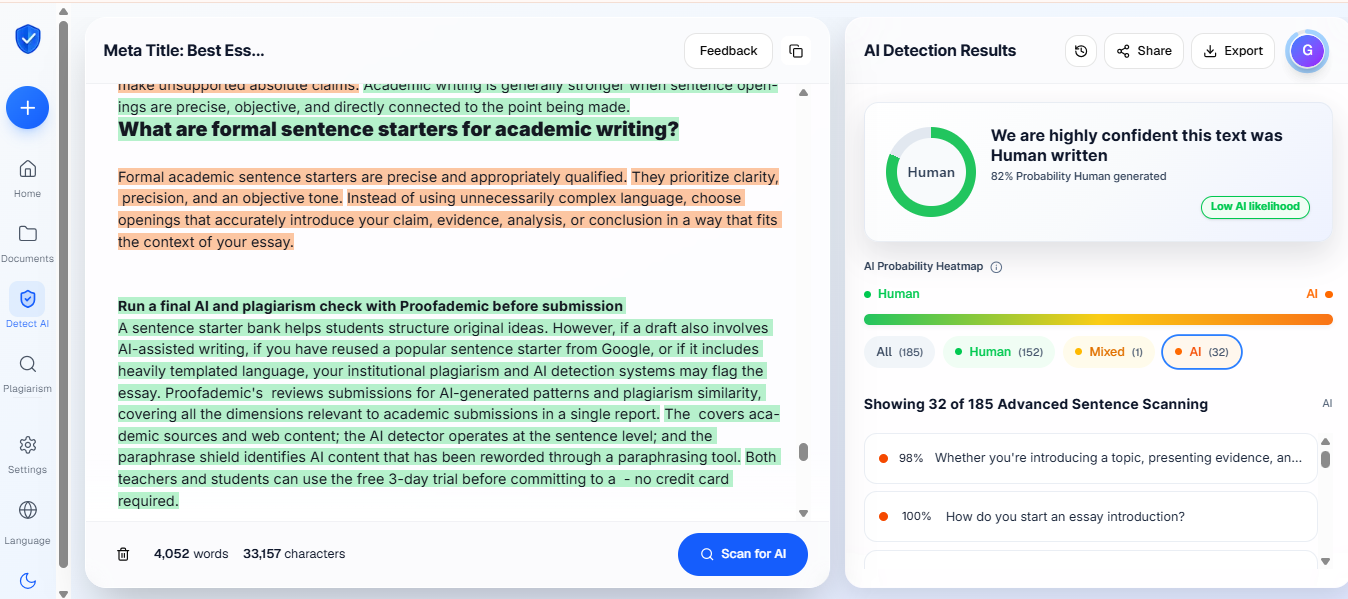
Throughout this review, we found that Kipper performed adequately as a general study assistant but fell short in areas that matter most for academic integrity, including source transparency, sentence-level detection evidence, detecting paraphrased content, and the ability to evaluate rather than only generating the content. Generating academic content and evaluating academic integrity are fundamentally different tasks, and a platform built primarily for the former will not always be the right tool for the latter.
For students and educators whose primary concern is evaluating writing for academic integrity, Proofademic is designed specifically for that workflow. It provides sentence-level AI detection, a dedicated plagiarism checker, batch scanning, paraphrase shield, and multilingual detection, all aimed at academic review rather than general content assistance. One limitation we encountered during this review was that Kipper’s detector could not be evaluated without purchasing a subscription. For users who want to compare detection results before committing to a paid plan, Proofademic offers a three-day free trial with no credit card required.
TL; DR
Kipper AI is a legitimate, functioning platform with real use for brainstorming, summarizing, and early drafting. It falls short as a dependable source for grading work, since citation accuracy, factual grounding, and detection scores all need independent verification before submission. Kipper AI pricing offers no free way to test the reliability first, which adds risk. For readers whose actual concern is evaluating writing for academic integrity, Proofademic is built around that problem, with sentence-level detection and a free trial to check it against real work first.
FAQs
Is Kipper AI legit?
Yes, Kipper AI is a real, operating company with a functioning product. Legitimacy as a business is separate from the reliability of its writing and detection output for academic decisions.
How can you use Kipper AI for free?
Kipper AI does not offer a free plan or trial; students and educators who want to try it before making any decision need to buy a plan first. Any claim of free access should be checked against the current official pricing page before signing up.
Is Kipper AI safe for students?
Safety covers several separate issues: billing practices, how uploaded papers are stored, personal data handling, and compliance with the school’s AI-use policy. Each should be checked individually.
Does Kipper AI check for plagiarism?
Kipper AI does not include a dedicated AI plagiarism checker. Plagiarism checking looks for textual overlap with existing sources, which is a different function from AI detection.
Does Kipper AI generate real citations?
Kipper AI generates citations in common formats, but not all of them are complete or verifiable. Every author, title, date, and claim should be opened and checked independently before use.