Key Takeaways
- Accidental plagiarism occurs when borrowed material appears in academic work without adequate attribution.
- The most common causes of accidental plagiarism are failures introduced earlier rather than mistakes at submission – at the research stage, during note-taking, through close paraphrasing, or by postponing citations until the end.
- Changing wording without preserving sentence structure does not eliminate a citation obligation. Paraphrased arguments, statistics, theories, and distinctive ideas generally still require attribution.
- Institutional responses to accidental plagiarism vary. Lack of intent should not be assumed to eliminate academic consequences, and students should consult the relevant policy beforehand.
- Proofademic provides sentence-level plagiarism detection designed for academic contexts, helping students identify missed attributions and close paraphrases before a submission reaches institutional review.
Accidental plagiarism or unintentional plagiarism occurs when someone uses another person’s words or ideas in academic work without proper attribution, without deliberately intending to misrepresent authorship. The problem appears in submitted work when borrowed material is presented without adequate attribution, regardless of intent. It can happen at any academic level and across any discipline, often because of poor note-taking, misunderstood citation requirements, or drafting too closely from a source. Understanding how it happens in the writing process is what allows students to prevent it reliably. For a final review before submission, Proofademic provides sentence-level plagiarism detection calibrated for academic use.
Short answer: Accidental plagiarism is an attribution failure. Students who understand where the mistake enters their workflow can prevent it through better research habits, note-taking discipline, and pre-submission checking. Proofademic’s plagiarism checker helps identify what manual checking may miss before the document reaches an instructor.
What is accidental plagiarism?
Accidental plagiarism, often described as unintentional plagiarism, occurs when a student or researcher uses another person’s material in their work without adequate attribution. The omission may result from unfamiliarity with citation rules, poor research habits, or the drafting process. Although the lack of intent may distinguish the situation from deliberate plagiarism, it does not necessarily eliminate an academic-integrity concern or its consequences.
It happens for reasons that are often quite common, such as notes taken without source details, paraphrases that follow the original text too closely, citations left until the end of a project and then missed, or misunderstanding what actually requires attribution. None of these necessarily involve an intention to deceive, and most are correctable, but they can still create a real attribution problem that may be identified during academic review.
Accidental vs. intentional plagiarism
Accidental and intentional plagiarism both describe attribution failures, but the distinction matters in two ways: it affects how an institution may interpret the violation and what remediation may look like. Students should not, however, assume that an accidental mistake carries no academic consequences. Policies vary significantly by institution, course, and assignment, and the only reliable approach is to consult the applicable policy of academic integrity in the age of AI.
| Accidental Plagiarism | Intentional Plagiarism |
|---|---|
| Attribution is missing or inadequate due to misunderstanding, poor habits, or drafting too closely from a source. | Knowingly presenting another person’s material as original work. |
| It may involve missing citations, close paraphrasing, forgotten quotation marks, and incomplete references | Often involves copying verbatim, purchasing essays, fabricating sources |
| It is connected to research habits, note-taking discipline, and citation knowledge | It is usually a student’s conscious choice |
| Example: A student paraphrases a source passage correctly but forgets to add the in-text citation | A student copies a paragraph from a published article and presents it as their own analysis |
Why accidental plagiarism happens
Accidental plagiarism usually begins long before a paper is submitted. It often happens when either source material is copied into notes without attribution, ideas are paraphrased closely, or citations are left until the final stage of writing. These small oversights can make it quite difficult to distinguish your own ideas from borrowed information. Understanding where these mistakes occur in the writing process makes them much easier to prevent.
- Research stage: You copy a useful passage into your notes but don’t mark it as a direct quotation. As a result, weeks later in your draft, the copied language looks like your own summary.
- Drafting stage: You write with the source open in front of you and unconsciously reproduce its sentence structure, even while changing the words. Research on university students’ source-based writing has identified patchwriting and other source-dependent writing strategies as recurring approaches among students working from sources.
- Citation stage: You plan to add citations later and keep writing. By the time you return to the draft, it may become difficult to identify which claims came from which sources.
- Deadline stage: Under time pressure, students may skip source verification. A final review that would have caught missed attributions doesn’t happen because there isn’t time for it.
- Knowledge stage: You don’t realize that paraphrased arguments, statistics, and distinctive ideas also require attribution.
5 accidental plagiarism examples and what went wrong
Accidental plagiarism examples tend to cluster around the same recurring failure points in the research and drafting process. Each scenario below follows a consistent format: what happened, why it constitutes an attribution problem, and how to correct or prevent it. These are not edge cases but are situations most commonly identified in academic-integrity guidance.
1. You paraphrase a source but forget the citation
Example: “Two roads diverged in a yellow wood”
The Road Not Taken by Robert Frost
Student’s version: “The speaker encounters two paths separating in a forest”
What happened: A student reads the poem, writes a paraphrased version in their own words, and submits it without an in-text citation because the wording is their own.
Why it’s a problem: The student changed the wording, but the underlying idea came from a source. Paraphrasing changes the expression; it does not change the origin of the intellectual content.
How to fix it: Information, arguments, or ideas taken from a source generally need an in-text citation, unless they qualify as common knowledge in the relevant context, even when the wording is entirely your own. So write the citation the moment you draft the paraphrase.
2. Your paraphrase follows the original too closely
Example: “I wandered lonely as a cloud”
Daffodils by William Wordsworth
Student’s version: “I roamed alone like a cloud.”
What happened: The student has changed several words but has essentially reproduced the original sentence pattern and comparison. Academic writing guidance often discusses this kind of close paraphrasing as patchwriting, in which the writer substitutes individual words or phrases while retaining too much of the source’s original wording or sentence structure.
Why it’s a problem: Replacing words with synonyms does not constitute genuine paraphrasing. Research examining students’ and instructors’ paraphrasing practices found variation in how acceptable paraphrasing and patchwriting were understood, highlighting why close source-dependent writing can be difficult for students to recognize.
How to fix it: Read the passage, close the source, and explain the idea in your own sentence construction without looking at the original. If your sentence still mirrors the structure of the source, rewrite it again.
3. A direct quote loses its quotation marks
Example: “To be, or not to be: that is the question”
Hamlet by William Shakespeare
What happened: A student, while analyzing Shakespeare’s Hamlet, copies the line into their research notes. Later, while drafting, they paste the line into their essay but remove the quotation marks, leaving it as it is. They plan to add the citation before submitting but overlook it during the final edit.
Why it’s a problem: The wording is exactly the author’s, but it now appears without quotation marks in the submitted work. Even with a citation, presenting verbatim text without quotation marks misrepresents the nature of the borrowing.
How to fix it: Any passage copied word-to-word into research notes must be marked as a direct quotation immediately. Keep the quotation marks in your research notes and record the source information alongside them.
4. You cite the source incorrectly or incompletely
Example: “Reading maketh a full man; conference a ready man; and writing an exact man”
Of Studies by Francis Bacon
What happened: A student quotes Francis Bacon’s “Of Studies” in an essay, but they cite it only as (Bacon) without providing the essay’s full details in their reference list or enough information to identify the version of the text they used.
Why it’s a problem: The student has attempted to acknowledge Bacon, but the incomplete citation makes the quotation difficult to trace back to its original source. A citation should provide enough information for readers to locate the source according to the requirements of the relevant citation style.
How to fix it: Include the complete reference required by the chosen citation style and provide any location information that style requires. Then check that the in-text citation and reference-list entry correspond exactly.
Note: An incomplete citation can be a formatting or documentation error, while deliberately disguising a source is a different issue.
5. You reuse previous work without disclosure
Example: Reusing substantial portions of your own previously submitted work without disclosure.
What happened: A student submits a strong paragraph from a first-year essay into a third-year paper on a related topic. They wrote both; no wording was borrowed from another author. The paragraph appears in the new submission without acknowledgment. This is also referred to as self-plagiarism.
Why it’s a problem: Rules on reusing previously submitted work vary by institution, instructor, assignment, and discipline. Some policies prohibit substantial reuse, while others may permit it with disclosure or prior permission. For instance, Harvard states that students are expected to submit work done specifically for each course and requires written permission for substantially similar work across courses.
How to fix it: Check the relevant institutional or course policy before reusing any prior submitted work. If reuse is permitted with disclosure, include it; if it requires permission, seek it explicitly.
We tested how easily accidental plagiarism can happen
To help students better understand what accidental plagiarism looks like in practice, we ran a controlled test. The test demonstrates how small, common writing habits can affect a plagiarism check, specifically the kind of check students receive from an academic plagiarism tool.
Methodology
We started with a manually reviewed academic essay written with correct citation practice as our baseline document. We then produced a modified version of the same essay by introducing five specific changes, while keeping the rest of the document unchanged.
- Copying one passage verbatim without quotation marks.
- Replacing words with synonyms in a second passage while retaining the sentence structure.
- Paraphrasing a third passage correctly but omitting the citation,
- Adding an incomplete citation to a fourth passage.
- Reusing a paragraph from a prior piece of work without acknowledgment.
Both versions were tested using Proofademic’s plagiarism checker, which provides sentence-level detection and source attribution. The resulting flags were manually compared with the changes introduced. Results reflect this specific test sample and should not be interpreted as a universal detection accuracy claim.
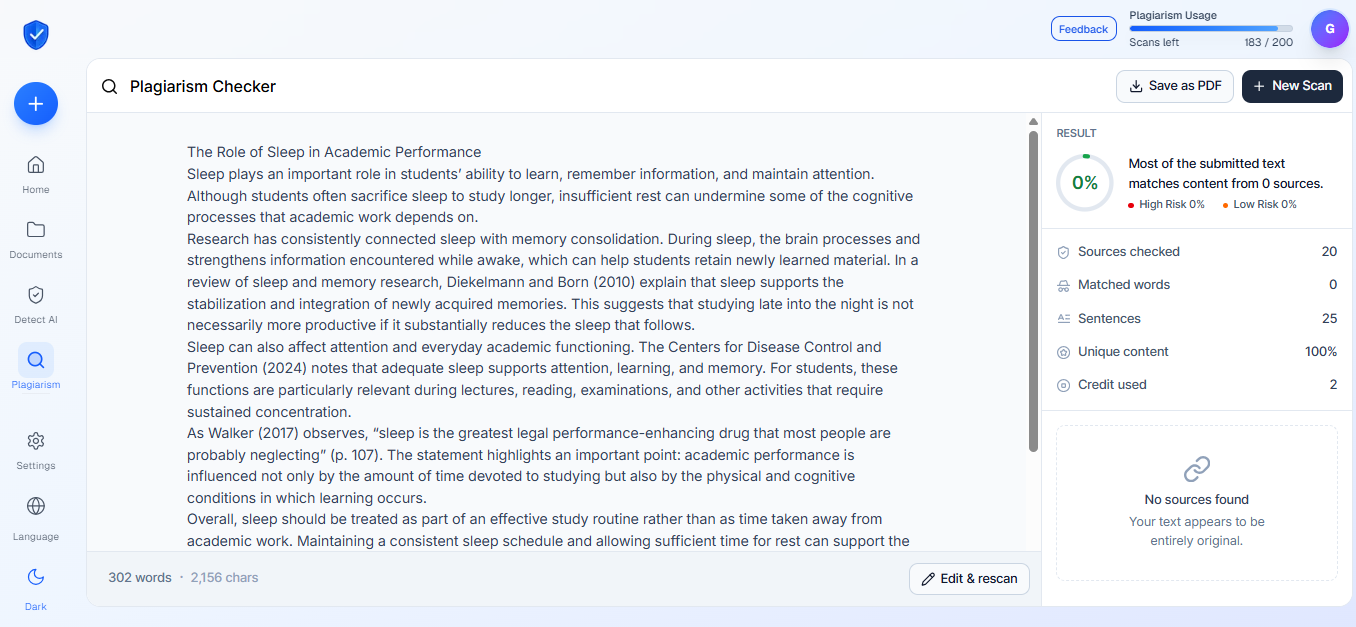
Test 1: Correctly written essay
Results: No sentences were flagged for similarity in the baseline document. Every borrowed idea carried an attribution, every direct quotation was marked, and no structural paraphrasing was detected.
Test 2: Modified essay
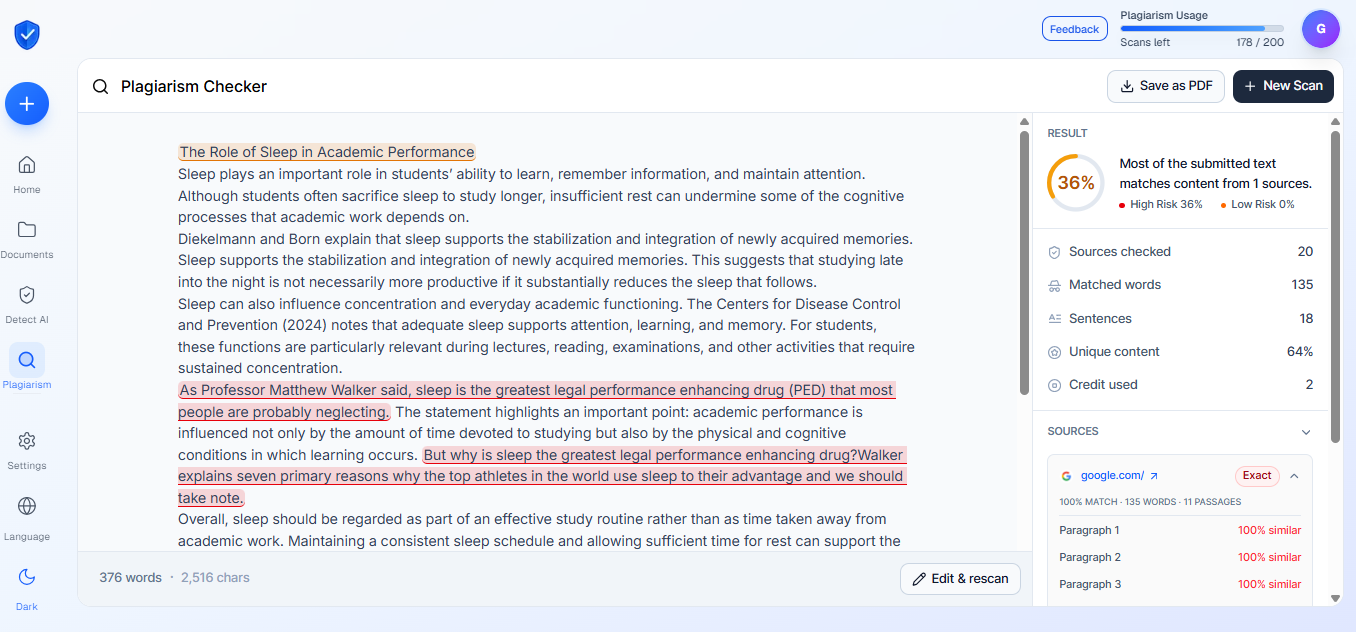
Results:
| Introduced error | Tool observation | Human review/interpretation |
|---|---|---|
| Verbatim copying | Exact or near-exact source match identified | Check for missing quotation marks or attribution |
| Synonym substitution | Similarity or close-paraphrase match identified | Review for patchwriting and source dependence |
| Paraphrase without citation | Source-related passage identified | Check if attribution is missing |
| Incomplete citation | Source match identified | Verify the citation against the required reference style |
| Reused prior work | Match identified with the earlier version | Check the applicable policy on reuse and disclosure |
What the results mean for students: Our test illustrated that accidental plagiarism can arise from ordinary research and drafting habits, even without an intention to mislead. The key lesson for students is simple: mark quotations, paraphrase independently, and add citations while drafting rather than trying to reconstruct sources at the end.
What happens if accidental plagiarism is found?
If a student discovers accidental plagiarism in their work, what academic consequences it will carry depends on the institution’s policy, the assignment, and the nature of the attribution error. Some institutions distinguish between intentional and unintentional violations, while others focus primarily on if academic-integrity rules were breached. For example, Stanford University’s Honor Code guidance states that “benign intentions” do not necessarily excuse a violation and emphasizes students’ responsibility to cite concepts, premises, and ideas. This is why students should not assume that accidental plagiarism will automatically be treated as a minor issue.
The same principle applies when interpreting a plagiarism or similarity score. There is no universal percentage that determines if plagiarism has occurred. A high similarity score may reflect legitimate quotations or commonly used academic language, while a low score does not guarantee that every borrowed idea has been properly attributed. What matters is the nature of the matched content and if it has been appropriately acknowledged.
What should you do if you find accidental plagiarism before submitting?
The most reliable way to prevent accidental plagiarism is not a single action at the end of the writing process; it is a sequence of habits distributed across the entire research-to-submission workflow. Each point below addresses a specific stage in that process. If a student has found accidental plagiarism before submission, the corrective workflow is straightforward.
- Identify the original source for the flagged passage.
- Decide if the material should be directly quoted with quotation marks, genuinely paraphrased in your own sentence construction, or removed if it no longer serves the argument.
- Add or correct the attribution, in-text citation, and, where missing, a reference list entry.
- Review the sentences surrounding the flagged passage for related source-dependent material that may share the same attribution gap.
- Verify the citation or reference against the required style guide to confirm it is complete and correctly formatted.
- If significant changes were made, re-run the plagiarism check before finalizing the document.
Detect accidental plagiarism before submission with Proofademic
The practical challenge with accidental plagiarism is not that students don’t care about attribution; it’s that the mistakes are often invisible from inside the draft. A quotation without marks looks like original prose to the person who wrote it. A close paraphrase that follows the source’s sentence structure looks like legitimate rewording. A missed citation looks like nothing at all until it appears in a similarity report after submission. Proofademic addresses exactly this gap.
Proofademic’s sentence-level plagiarism detection identifies specific passages rather than returning only a document-wide percentage, which means the output tells you where to look. The paraphrase shield identifies close paraphrasing patterns that conventional similarity checks may not surface, helping students review passages that remain too dependent on their sources. A free three-day trial is available with no credit card required, allowing students and educators to test the tool against real work before committing.
TL; DR
Accidental plagiarism is not a single mistake made at submission; it is usually the result of a chain of small mistakes introduced during research, note-taking, paraphrasing, and citation. The attribution problem that appears in the submitted document exists regardless of intent. Prevent it by recording sources as you research, clearly distinguishing source material from your own ideas, citing borrowed information as you draft, and checking your work before submission. Use an academia-first plagiarism checker like Proofademic as the final review of that workflow. Starting earlier, citing continuously, and checking carefully before submitting are the habits that reduce most plagiarism prevention problems before they become academic-integrity cases.
FAQs
Can plagiarism be accidental?
Yes. Accidental plagiarism occurs when attribution is missing or inadequate because of poor note-taking, misunderstood citation requirements, close paraphrasing, or forgotten sources, with no deliberate intent to deceive.
What is an example of accidental plagiarism?
A student paraphrases a source passage correctly and understands the idea well, but forgets to include an in-text citation. The wording is original; the attribution is missing. A situation in which there is an attribution failure without deliberate intent is an example of accidental plagiarism.
How to avoid accidental plagiarism?
Record source details, separate source notes from your own ideas, paraphrase by understanding and then writing independently, add citations while drafting, and review your document before submission. A final plagiarism self-check should be the last step in that workflow.
Can a plagiarism checker catch accidental plagiarism?
Plagiarism checkers can help identify missed attributions, close paraphrases, and verbatim passages without quotation marks. Thus, review flagged matches individually rather than treating the similarity score as the final answer.
Is patchwriting a form of accidental plagiarism?
Yes. Patchwriting occurs when a student substitutes synonyms or rearranges phrases while retaining the original sentence structure. It is typically accidental in the sense that the student believes they have paraphrased adequately, but it is clearly traceable to the source.
Do I still need a citation if I paraphrase completely?
Yes. Paraphrasing changes the expression; it does not change the origin of the intellectual content. Borrowed arguments, findings, statistics, theories, and distinctive ideas generally require attribution in academic writing regardless of how thoroughly the wording has been revised.
Does a high similarity score automatically mean plagiarism?
No. A high similarity score indicates that portions of the document match text found in other sources. Correctly cited quotations, properly attributed paraphrases, and standard academic phrases can all contribute to a similarity score without constituting plagiarism. The content of the matches determines if an attribution problem exists, rather than the percentage figure alone.