Key takeaways
- The most reliable way to detect AI writing is to use a dedicated AI text detector that analyzes sentence structure, word choice, and stylistic patterns across tools like ChatGPT, Claude, and Gemini.
- To check if text is AI generated, combine an AI detection tool with manual checks for repetitive transitions, hedging phrases, and unnaturally balanced paragraph structure.
- Detecting ChatGPT writing specifically requires tools trained on ChatGPT’s fingerprints – GPT-4o and GPT-4.5 produce more natural output than older models, making general-purpose detectors less reliable.
- If you need to check if something was written by ChatGPT, look for sentence-level scoring that flags exactly which sentences are AI-generated rather than giving a single pass/fail result.
- Proofademic’s AI text detector offers free sentence-by-sentence analysis (1,000 words, no credit card) and supports detection across 23 languages.
Artificial intelligence is transforming the writing process. In a very short amount of time, tools such as ChatGPT, Claude, and GPT-5 have moved from experimental toys to almost everyone’s writing tool of choice. They easily draft emails, generate blogs, write essays, and can even write an entire research paper.
However, with this level of ease, comes a burning question: How do you know that what you are reading was written by a human vs. generated by AI?
As a teacher grading assignments, a content manager reviewing the article, or a reader interested in knowing if the text you are reading was AI-generated, knowing how to detect AI writing is of the utmost importance. With guidance from this step-by-step library of the most reliable ways to check for AI writing, you will learn from detecting tools to noticing small patterns of style on paper.
Why AI detection is important in 2026
By the year 2026, AI writing is now able to imitate human voices surprisingly well. Early AI text sounded robotic and stilted. Now these products are so smooth, persuasive, and even generating creative content.
So, what’s the big deal if we are able to tell if text is AI?
1. Academic integrity
Educators are facing a unique challenge: ensuring that students are actually learning and producing their own work. When AI essays can score high marks, it’s harder than ever to guarantee fairness. That’s why universities are increasingly turning to AI essay detectors built for academia – like Proofademic – to protect learning outcomes.
2. Content marketing and SEO
For companies, original content is the lifeblood of digital visibility. Search engines, such as Google, prioritize original, high-quality content, and they have already started to flag AI-spammy content. If you were to publish AI writing without any checks, you could face penalties or the loss of your reader’s trust.
For this reason, it’s important for businesses to utilize an AI content detector online before posting blogs, whitepapers or website content.
3. Reader trust
Readers deserve to know if the words they’re consuming come from a human or an algorithm. This matters most in journalism, politics, and healthcare, fields where credibility can literally shape decisions or lives.
4. Compliance and ethics
New regulations are emerging that require organizations to disclose when AI has been used to produce content. To meet these standards, businesses and institutions must have ways to verify and prove authorship.
5. Combating Misinformation
Finally, AI tools can be misused to flood the internet with fake reviews, fabricated news stories, or biased propaganda. Having methods to detect ChatGPT text is essential for fighting misinformation.
Step 1 – Use an AI detector
The fastest and most accurate way to start is by using a specialized AI detector. Unlike plagiarism checkers, which only identify copied text, these tools are designed specifically to analyze writing patterns and predict whether a passage was human or AI-generated.
One of the best solutions is Proofademic’s free AI text detector. It’s built to catch signals left behind by popular large language models, including ChatGPT and GPT-4.
How AI detectors work
Most detectors rely on two key concepts:
- Perplexity: Humans naturally write in less predictable ways. AI tends to create “smoother,” more statistically likely text.
- Burstiness: People vary their sentence lengths. AI models often stick to a balanced rhythm.
Detectors also look for:
- Overuse of certain connectors (“In conclusion,” “Moreover,”).
- Uniform tone without emotional variation.
- Lack of unique personal details or original thought.
How to use Proofademic
- Copy and paste your text into the Proofademic tool.
- Click “Analyze” to generate a detection report.
- Review the percentage likelihood of AI authorship and see which passages were flagged.
Step 2 – Look for writing style shifts
Even without a tool, you can often spot AI writing by watching for sudden changes in style.
Humans have quirks. They make typos, break rules, use humor, or bring in personal anecdotes. AI tends to be consistent—sometimes too consistent.
Signs of style shifts include:
- Abrupt changes in vocabulary difficulty: A writer who usually writes plainly suddenly uses advanced academic phrasing.
- Tone mismatches: Text that flips between overly casual and overly formal.
- Missing voice: AI often avoids strong personal opinions or emotions, making writing feel detached.
Example: If a student usually writes “I think this book is good because…” but suddenly submits “This literary piece exemplifies profound thematic resonance…,” chances are they’ve had some AI help.
Step 3 – Spot repetition and generic patterns
AI, even in 2026, still has a weakness: it sometimes falls back on predictable patterns and repetitive filler.
Here’s what to look for:
- Repetitive phrasing: Several sentences starting with the same word (“Another reason,” “Another reason,” “Another reason…”).
- Overuse of clichés: Phrases like “in today’s fast-paced world” or “it is important to note.”
- Surface-level arguments: AI often expands on points without truly deepening the analysis.
- Keyword stuffing: AI-generated SEO text may cram keywords unnaturally.
If a paragraph feels like it could appear in hundreds of other essays, you may be looking at detected ChatGPT text.
How to tell if a text was written by ChatGPT
ChatGPT is the most widely used AI writing tool today, and it leaves distinct patterns that make it possible to detect ChatGPT writing if you know what to look for.
Unlike older AI models, GPT-4o and GPT-4.5 produce text that reads more naturally, which makes general-purpose detectors less reliable. But ChatGPT still has stylistic fingerprints that dedicated tools can catch:
- Hedging phrases like “It’s important to note,” “It’s worth mentioning,” and “There are several factors to consider” appear far more often in ChatGPT output than in human writing.
- Over-structured paragraphs that follow a predictable pattern: topic sentence, supporting detail, concluding transition. Real writers don’t write this symmetrically.
- Flattened voice: ChatGPT avoids strong opinions, personal anecdotes, and informal phrasing. The result reads competent but impersonal.
- Transition stacking. Words like “Furthermore,” “Additionally,” and “Moreover” appear in nearly every paragraph, often back to back.
The challenge is that these patterns are subtle enough to miss on a manual read, especially in longer documents. That’s where sentence-level AI detection helps. Instead of giving you a single score for the entire text, sentence-level detection flags the exact sentences that match ChatGPT’s patterns, so you can see precisely where the AI writing starts and stops.
Proofademic’s ChatGPT Detector is built specifically for this. It analyzes text against ChatGPT’s known fingerprints across GPT-3.5, GPT-4, GPT-4o, and GPT-5, and breaks results down sentence by sentence.
AI detectors vs human judgment
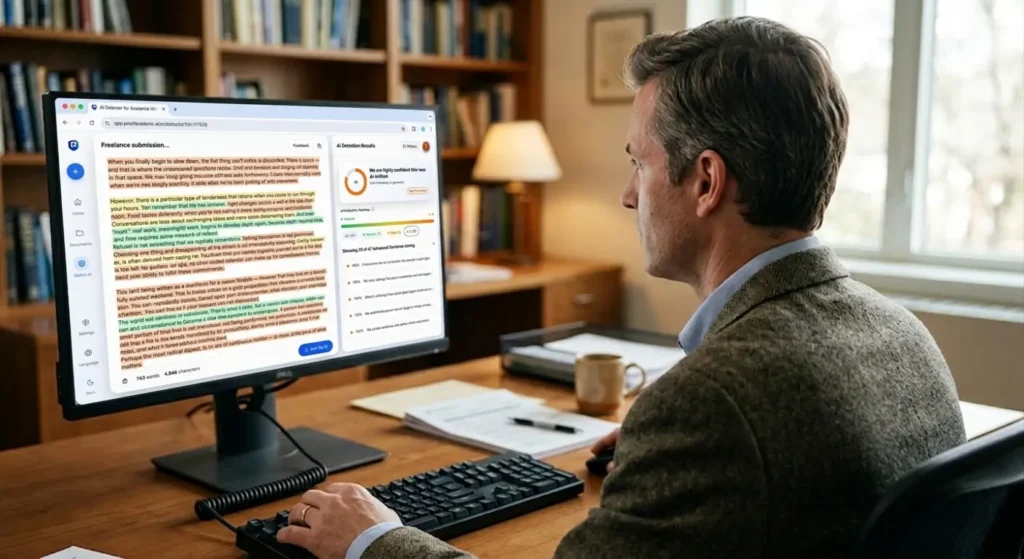
So which is more effective, tools or people? The truth: they work best together.
Why AI Detectors are powerful
- Speed: Instantly scan thousands of words.
- Objectivity: Statistical markers can’t be faked easily.
- Scalability: Perfect for teachers, editors, and businesses handling large volumes.
Why human judgment still matters
- Context awareness: People can spot personal details (or lack thereof).
- Comparisons: Teachers know their students’ past writing styles.
- Creativity checks: Humans better identify authentic humor, storytelling, or emotional nuance.
The most reliable approach is hybrid: run an AI scan, then apply human reasoning to interpret results.
Best way to check if text is AI written
By now, you know that AI detection isn’t just about spotting obvious clues. It’s about combining tools and insight. The best way to check if text is AI written in 2026 is to start with a trusted tool like Proofademic, then use your own analysis to verify.
- Educators: Proofademic doubles as an AI essay detector for students, helping maintain fairness.
- Businesses: Its scanning ensures your content won’t get flagged by search engines.
- Individuals: It’s a quick way to satisfy your curiosity about an article, review, or online post.
Final thoughts: how to detect AI writing?
The ability to check if text is AI generated has gone from a niche curiosity to an essential skill. As AI becomes more integrated into classrooms, businesses, and online platforms, the line between human and machine writing can blur.
But by following this step-by-step guide, you’ll be prepared to spot AI-generated content:
- Use a reliable AI content detector online like Proofademic.
- Watch for style inconsistencies and unnatural shifts.
- Look for repetition, clichés, and generic arguments.
- Combine detector results with human judgment for maximum confidence.
Ultimately, AI will keep evolving, but so will our ability to detect it. By staying aware and using the right tools, you can ensure authenticity, trust, and originality in the content you read, share, or publish.
FAQs
Can AI writing be 100% undetectable?
Not exactly. Advanced models can “humanize” text, but detectors keep evolving too. Even if AI slips past one tool, combining multiple checks usually reveals inconsistencies.
What if the detector says the text is “partly AI-generated”?
That’s common. Many people use AI to assist rather than fully write their content. In these cases, the flagged sections are likely where the AI was most active.
Is AI detection the same as plagiarism detection?
No. Plagiarism checkers compare text against existing sources. AI detectors analyze writing style and statistical patterns. For full coverage, many institutions use both.
Do detectors work on very short text?
Short texts (like tweets or brief messages) are harder to detect accurately. The longer the passage, the more reliable the detection.
Can AI detectors tell if something was written by ChatGPT specifically?
Some detectors, like Proofademic’s ChatGPT Detector, are trained to recognize ChatGPT’s specific writing patterns. General-purpose detectors flag AI writing broadly, but dedicated tools can identify ChatGPT’s stylistic fingerprints with higher confidence.
Is 40% AI detection bad?
A 40% AI detection score means roughly four out of ten sentences in your text were flagged as likely AI-generated. In academic settings, that’s usually enough to raise concerns. The issue is that a single overall percentage doesn’t tell you which parts triggered the flag. Tools with sentence-level detection let you see exactly which sentences scored high, so you can decide if those sections need rewriting.
Can professors tell if AI wrote an essay?
Experienced professors can sometimes spot AI writing through generic tone, lack of personal voice, and suspiciously polished structure. But with newer AI models producing more natural text, manual detection alone isn’t reliable. That’s why many educators now use AI checkers for teachers like Proofademic.
Can AI be detected in essays?
Yes. AI-written essays tend to have predictable patterns: balanced paragraph structures, hedging language, limited personal voice, and overuse of transitions like “Furthermore” and “Moreover.” AI detectors trained on academic content can flag these patterns reliably. For students who want to check their own work before submitting, Proofademic provide detailed breakdowns of which sections read as AI-generated.